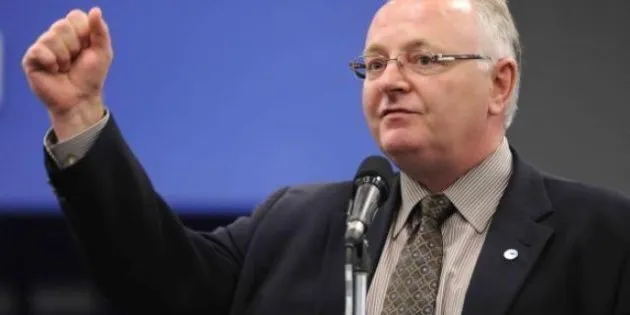
The post-recession world has not been kind to organized labour. With corporations and governments under pressure to cut costs and reduce deficits, unions have been lobbying hard to garner wage increases and protect pensions. But with dwindling numbers of Canadians sharing in the gold-plated benefits unions are fighting to protect, the battle for hearts and minds may prove to be the tougher one. In advance of Labour Day, Paul Moist, president of the Canadian Union of Public Employees (CUPE), Canada’s largest labour group, discusses the challenges facing the labour movement in the age of austerity, why CUPE is working to connect with Canadians, and what Jack Layton’s passing means for Canada.
Unionization, particularly in the private sector, has been declining for the last 15 years. How has this affected their collective bargaining power? And are there other consequences to the overall drop in union membership?
Paul Moist: There’s a huge correlation historically in Canada between a worker having a defined-benefit pension plan, which about 36 per cent of the workforce does, and [being in a union]. Over 80 per cent of the Canadians today that have a defined-benefit pension plan are connected to a union.
A lot of private sector jobs have been lost, and a lot of private sector employers have been backing away from sponsorship of a defined-benefit pension plan. So if there’s less unionization in the private sector, and if the general trend in the private sector is less sponsorship of defined-benefit pension plans, that has a consequence for the public sector just on sheer politics. There are forces in the country that say, “Well, if private sector workers don’t have a pension plan, why the heck should government employees,” which I think is purely a ferocious political response.
Since the recession it seems like that “ferocious political response” you described has become a lot more commonplace. Unions used to be seen as the everyman, doing battle for the regular guy, but now, when the public gets a glimpse of the benefits unions are fighting to protect, they realize how far removed it is from their reality. What happens to a public sector union like CUPE when the general public is no longer on side? How can you prevent that from happening?
PM: If we allow ourselves to be pigeonholed as greedy public employees, or allow [other] people to define us, we’re going to be in choppier waters than we are now. I think if we’re able to connect with people about “What kind of a community do you want?”, and we’re prepared to be responsive to what we hear from Canadians -- not trying to shape their views but reflect what they tell us -- we’re much better positioned.
We won’t put all of our strategic tools in the bag of collective bargaining, as important as that is. In Ontario right now, we’re running a campaign about the state of our hospitals. We’ll have resources that go to [promote] public medicare, the Council of Canadians, the society of seniors who want more long-term care, child care. CUPE is not front-and-centre on all these issues, but we’re making a contribution to all these policy areas.
Why did CUPE spend lots of money on the Canadian Pension Plan debate [when m]ost of our members have a private workplace pension? Because we believe all Canadians should have a viable pension option. Get down on that level, and CUPE’s not a four letter word when you’re talking about bread and butter issues that matter to people.
If we can’t connect with the community, then the frame may be set by those forces in society that chip away at us over wages and pensions. But the average worker in Canada who doesn’t have a pension or a union doesn’t want a unionized worker to do badly.
What about the conflict from within? The Canada Post strike was in part a response to a proposal to create two tiers of workers -- a situation that has reportedly caused a lot of unrest among autoworkers in the United States. What threat does this trend pose to the well-being of unions as a whole? How concerned are you about the turmoil this can cause?
PM: We will not easily go down the road of a wage increase for all of us working today and a new tier of wages for future CUPE members. We don’t agree to that as a rule.
Flight attendants -- most Canadian carriers with the exception of WestJet are CUPE members -- they came to us in the mid-80s because they had lost a couple of strikes. When we inherited Air Canada, there was a two-tier wage system in place. All the flight attendants who were pre-1980 had a certain wage level and all the ones that were hired after had a lower one. Well, we fixed that in two rounds of bargaining.
So we’re not going down that road easily at all with any employers. It’s a prescription to have future union members who have no respect for the union. We’re not going to go there.
You’ve mentioned pensions a couple of times. In the labour disputes that we’ve seen during the last couple of years, pensions always seem to be front-and-centre. To what extent do you think pensions are the major issue, and will remain so for some time to come?
PM: I think that the pension question will remain front-and-centre from a public policy point of view. I don’t expect the private sector employers, especially the small employers, to quickly change tack and start sponsoring pension plans, so I think there will have to be government leadership on this issue. Politicians of all stripes I talk to say they know there’s a looming problem in Canada. It’s in no one’s interest for someone to work their whole life and not be unable to sustain themselves in retirement and there will be ... huge pressure on governments from a service point of view.
The retirement insecurity debate is one where the positive solution is to try and fix things for 65 per cent of the workforce who don’t have a regular pension plan at work, not the political knee-jerk response from some who say if they don’t have it, public employees shouldn’t have it. It’s an issue that goes way beyond the boundaries of union membership. Most workers in Canada kind of know they’re not saving enough for retirement, and kind of know they have to, and they find it very difficult without a system to plug into.
We’ve been able to connect with Canadians on the retirement insecurity debate, which I think is positive.
With the move toward government austerity and deficit reduction, the privatization of public services -- everything from Manitoba Hydro to Toronto garbage removal -- has been a hot topic. How is CUPE positioning itself to function and forward the concerns of unions in such an environment?
PM: We historically faced pressure at CUPE to contract out and privatize since we were formed in 1963. The stakes are maybe a little bit higher right now with these so-called public private partnerships for major pieces of public infrastructure -- kind of a leasing of debt to the private sector -- for everything from bridges to buildings the government occupies.
We spend a lot of time equipping this organization to at least debate the merits from a fiscal point of view and a policy point of view of privatization. You mentioned Manitoba Hydro. Our union represents some of the workers there. We surveyed Manitobans, and 90 per cent of them in no way, shape or form want privatization of Hydro.
It’s more of a traditional struggle going on in Toronto. They’ve made their choices, they won’t be confused by the facts. We’re just going to have to tough that one out, and demand that there be a transparent discussion. Future rounds of bargaining in Toronto will determine the security or not of the members’ jobs so Toronto is in a bit of a unique situation.
Privatization may be one of the more expensive long-term consequential decisions that a municipal politician makes. All we say is make it with your eyes wide open. We’ve won some and we’ve lost some, but we’ll continue to speak up.
The loss of Jack Layton was felt by all Canadians, but it was particularly significant for the labour movement. What’s his legacy, and what kind of hole does he leave?
PM: He leaves a big emotional, and frankly physical leadership hole for the NDP. But eight years ago when he became the leader, outside of municipal circles and the Greater Toronto Area, he wasn’t well-known. What did he do in the last eight years? He built and modernized the NDP. It’s [now] a modern, well-functioning, well-oiled machine, and he himself grew in the minds of Canadians.
I knew Jack Layton on a personal level and I will miss him incredibly. But professionally speaking, I know what Jack Layton would say if he was eavesdropping on this conversation -- keep building. We’re going to keep building this thing. I think that’s the greatest legacy Layton’s given us.
5 LABOUR CONFLICTS UNDERWAY IN CANADA TODAY
Since 2008, when the financial crash laid waste to huge swaths of corporate assets and sent public expenses soaring, employers and governments have increasingly set their sights on the costly benefits that many unions enjoy. But unions will not easily make concessions on wages and gold-plated pensions they have long fought to protect, which explains why, in the age of austerity, collective bargaining has often turned ugly, resulting in lockouts, strikes and the embitterment of both sides.
Here’s a look at five nasty labour disputes that have unfolded over the past few months.