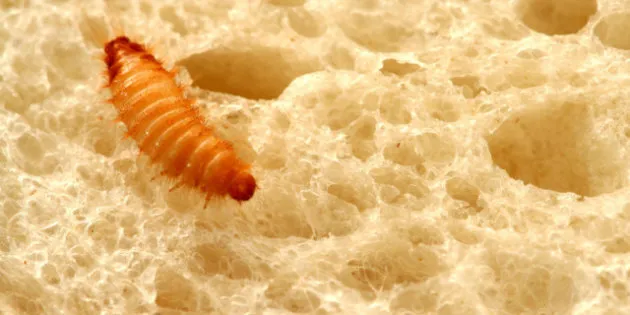
Bugs In Food: What You're Eating Without Realizing It

The Huffington Post Canada  |  By Posted: 05/ 2/2012 10:56 am

If you thought finding a fly in your soup was enough to turn you off your meal, try finding a maggot in your canned mushrooms or caterpillar remains in your spinach salad. Just about everyone has heard a horror story when it comes to food and insects, and part of that might be thanks to relaxed policies when it comes creepy crawlers and governmental food agencies.

In the United States, the Food and Drug Administration (FDA) is the body overseeing the protection of public health by assuring the safety and security of food consumed in America. However, due to what's described as by Organic Gardening as "a lax food-safety loophole," the FDA permits a certain degree of insects, such as worms or aphids, so long as their presence doesn't compromise the aesthetic quality of the food.

The Canadian Food Inspection Agency has some rules about labels when it comes to bugs and food with which produce can be sold. For example, for cabbage, 10 aphids on a head can still equal a no.1 grading during inspection, but any presence of worms on an edible portion of the head bumps a crop down to a no.2 grading.

Here's a compilation of the eight bugs you might be unintentionally eating according to the FDA's "The Food Defect Action Levels: Levels of natural or unavoidable defects in foods that present no health hazards for humans" guide. Story continues below:

Loading Slideshow...
  • Aphids

    If you thought aphids were only a threat to your tulips and roses, think again. The number of whole aphids that the FDA deems permissible varies from vegetable to vegetable. On the low end, you can expect about 30 whole aphids/100 grams in Brussels sprouts and about 60 of the little buggers in frozen broccoli.

  • Thrips

    Also known as thunderblights or corn lice, thrips are winged pests and are about a millimetre in length. They feed by sucking out the nutrients in the vegetables you'd find in a frozen vegetable mixture. You can expect to find no more than 50 of them in every 100 grams of canned or frozen spinach or in a package of sauerkraut. (Photo courtesy of <a href="http://www.flickr.com/photos/jean_hort/" target="_hplink">Flickr/ jeans_Photos</a>)

  • Mites

    There's a good chance that you'll be able to spot if your food is laced with velvet mites since they're bright red (see photo), but you might have trouble with their cousin, the white mite. The white mite can often be found in grains, but has also been known to make its way into frozen vegetables too. Expect to find no more than 75 of them in your canned mushrooms. (Photo courtesy of <a href="http://www.flickr.com/photos/enygmatic/" target="_hplink">Flickr/ Enygmatic-Halycon</a>)

  • Maggots

    Unless you're a <a href="http://en.wikipedia.org/wiki/Maggot_cheese" target="_hplink">Casu marzu</a> connoisseur, the thought of maggots in your food is enough to make you throw up. If so, you'd best pass up canned mushrooms, which allow 20 maggots for every 100 grams of drained mushrooms, according to FDA standards.

  • Fruit Flies

    There's a good chance you've seen a fruit fly before, buzzing around a fruit basket or a wine glass left out too long. There's also a good chance that you've been ingesting these flies with your fruit juice, since there's about five flies in every 1 cup of juice.

  • Cowpea Curculio

    If you've ever wanted a reason to buy dried black-eyed peas instead of the canned variety, thank the Cowpea curculio. It's a type of larva that eventually grows into a small brown weevil, and there's about five of them in every can of peas.

  • Caterpillars

    You'd think it would be hard to miss out on something like a caterpillar in your food, but just because you don't see it doesn't mean it isn't there. Such is the case with spinach, which can be dotted with caterpillar larvae and larval fragments.

  • Corn Ear Worm

    The next time you're shucking corn, keep an eye out for the corn ear worm, which fortunately doesn't go for the kernel, but rather, the silk in the husk. You'll also want to double-check canned corn since these worms tend to leave traces of their skin and larvae where ever they go.<br> Photo: (cc) By Jack Dykinga USDA Agricultural Research Service, via Wikimedia Commons

TEXT VERSION OF SLIDESHOW HERE

In some countries, the consumption of insects is a common practice, since they're an excellent source of affordable protein. However, many people aren't quite ready for dinning on mealworms sautéed in a marinara sauce or flies instead of french fries. Back in 2008, Vancouver's Vij's, recently rated Canada's best restaurant by Vacay.ca, made headlines for offering cricket paratha . The crickets were ground and used as flour for the paratha, an Indian flatbread. Most recently, Starbucks announced that they would stop using a dye made out of ground-up beetles for their drinks.

To best avoid an unappetizing surprise when it comes to your food, take the time to inspect any produce while shopping and give all fruits and vegetables a thorough rinse just before cooking.

SLIDESHOW TEXT VERSION:

  • If you thought aphids were only a threat to your tulips and roses, think again. The number of whole aphids that the FDA deems permissible varies from vegetable to vegetable. On the low end, you can expect about 30 whole aphids/100 grams in Brussels sprouts and about 60 of the little buggers in frozen broccoli.
  • Also known as thunderblights or corn lice, thrips are winged pests and are about a millimetre in length. They feed by sucking out the nutrients in the vegetables you'd find in a frozen vegetable mixture. You can expect to find no more than 50 of them in every 100 grams of canned or frozen spinach or in a package of sauerkraut.
  • There's a good chance that you'll be able to spot if your food is laced with velvet mites since they're bright red (see photo), but you might have trouble with their cousin, the white mite. The white mite can often be found in grains, but has also been known to make its way into frozen vegetables too. Expect to find no more than 75 of them in your canned mushrooms.
  • Unless you're a Casu marzu connoisseur, the thought of maggots in your food is enough to make you throw up. If so, you'd best pass up canned mushrooms, which allow 20 maggots for every 100 grams of drained mushrooms, according to FDA standards.
  • There's a good chance you've seen a fruit fly before, buzzing around a fruit basket or a wine glass left out too long. There's also a good chance that you've been ingesting these flies with your fruit juice, since there's about five flies in every 1 cup of juice.
  • If you've ever wanted a reason to buy dried black-eyed peas instead of the canned variety, thank the Cowpea curculio. It's a type of larva that eventually grows into a small brown weevil, and there's about five of them in every can of peas.
  • You'd think it would be hard to miss out on something like a caterpillar in your food, but just because you don't see it doesn't mean it isn't there. Such is the case with spinach, which can be dotted with caterpillar larvae and larval fragments.
  • The next time you're shucking corn, keep an eye out for the corn ear worm, which fortunately doesn't go for the kernel, but rather, the silk in the husk. You'll also want to double-check canned corn since these worms tend to leave traces of their skin and larvae where ever they go.

FOLLOW FOOD


  • Comments
  • 11
  • Pending Comments
  • 0
  • View FAQ
Post Comment Preview Comment
To reply to a Comment: Click "Reply" at the bottom of the comment; after being approved your comment will appear directly underneath the comment you replied to.
View All
Favorites
Recency  | 
Popularity
05:56 PM on 01/12/2013
The bugs are what gives our food a je ne sais quoi taste which makes us gobble it down and ask for more.
HUFFPOST COMMUNITY MODERATOR
xstevejx
07:25 AM on 05/07/2012
Looks like someone's still obsessed with the stupid Starbucks strawberries & cream nonsense!
11:15 PM on 05/06/2012
A little overstated...probably for shock value. A couple of things:

1. It is IMPOSSIBLE to be 100% sure about anything and these things grow out of the ground, so if you did a full scale recall every time a can of peas has a cricket's leg in it, we'd have no food and no industry to produce it.

2. This does NOT mean that you eat these bugs whenever you eat these products. Chances are you never will. In the case of many veggies, they are washed, so bugs that were on there are not allowed to remain after they are spotted.
This user has chosen to opt out of the Badges program
photo
07:37 AM on 05/06/2012
Oh and I surprised ground coffee didn't make the list. I read something a few years back, ground coffee has permissible levels of ground up coach roaches, and rat and mice feces.
This user has chosen to opt out of the Badges program
photo
07:35 AM on 05/06/2012
I go to some local farmer's markets in Europe and the bugs are just like cats and dogs ... all part of the process and no big deal ... you just have to wash what you buy.
photo
Opus Fideo
Atheist. Social Democrat. Canadian.
12:41 PM on 05/04/2012
extra protein. its all good
photo
HUFFPOST SUPER USER
darkevolutonary
author/artist/jack-of-all-trades, master of none..
10:16 PM on 05/03/2012
There is and likely always will be tiny insects or fractions thereof in our vegetable matter. The real problem is the germaphobic attitude society has adopted whereby they are terrified of the very organisims we have been living with since mans exhistance. You see a great example of this with hand sanitiser. There are a lot of people obsessed with the stuff, like they are saving their lives with it when for the most part it isn't even necessary, (particularly if you are using it 20+ times a day). Or the sani-wipes at the shopping cart stand in the supermarket so you can wipe the germs from the handle. Is this really necessary?
This user has chosen to opt out of the Badges program
smeeeee
Now take your nice red pill
08:00 AM on 05/04/2012
It's really irrational when you consider that we are continuously breathing in molecules of ancient dead people.
photo
HUFFPOST COMMUNITY MODERATOR
BuckyJamesDio
This monkey's going to Heaven
09:41 PM on 05/03/2012
I'd rather eat insects than insecticide.
This user has chosen to opt out of the Badges program
photo
07:34 PM on 05/03/2012
The onlt way to avoid bugs in food is to grow crops in sealed clean rooms and pollinate by hand.
Funniest sentence: However, due to what's described as by Organic Gardening as "a lax food-safety loophole," the FDA permits a certain degree of insects
a) Bugs are NOT a safety issue (too many bugs "might" indicate a safety issue, which is why there are limits) It's aesthetics.
b) There would be no logic argument that organic farming prevents bugs, in fact the logical extension would be more bugs
05:22 PM on 05/03/2012
Nothing is wrong with a little extra protein.