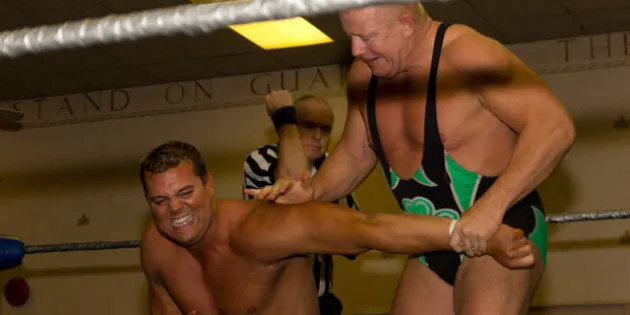
Could Stampede Wrestling be poised for a Calgary comeback?

CBC Calgary is reporting that Bruce Hart, a former wrestler and second oldest child of Stampede Wrestling's founding family, is training wrestlers and hopes to have them ring-ready for a televised event in November.

The goal is to return to the roots of the original Stampede Wrestling venture and there are no plans to bring Vince McMahon's World Wrestling Entertainment into the fold.

"Stampede (Wrestling) was sort of like two guys going at it and a lot more action than talk, and WWE is about 60 per cent talk and about 40 per cent action — not all that spectacular either," Hart told CBC Calgary.

This is the second time in recent years a Hart family member has pitched to bring the live ring back to Canada.

In October 2011, Smith Hart - the oldest of the Hart children - appeared on Dragon's Den, pitching the return of Stampede Wrestling to Canada's most famous investors.

He was turned down for the $350,000-for-33-per-cent-of-the-company -investment, but hosted an revival showing of Stampede Wrestling for one night in Barrie, Ont., anyway.

"The Hart name is sort of what I'm pushing, Stu Hart's brand of wrestling," Smith Hart told Canoe.com at the time.

"It wasn't just that we were all stiff and solid out there, and maybe my dad liked submission wrestlers, guys that could hold their own in a lot of circles. It was more good, sensible issues that people could identify with."

Stampede Wrestling was operated by the Hart family in Calgary from 1948-1984, when the World Wrestling Federation took over the franchise. Until that point, founder Stu Hart drew huge crowds to the Calgary Stampede grounds weekly for the televised matches. According to the Calgary Herald, special guests to the ring included Andre the Giant, wrestling bears and Bengal Tiger.

Almost one year ago Calgarians said goodbye to the East Village's B.J.'s Gym - once a training facility and home for many wrestlers, including those of the Hart family. The gym was torn down to make way for new development in the area, but not before a big blowout party was thrown.

Loading Slideshow...


Also on HuffPost:

Loading Slideshow...
  • Two women fight during a combat of "Lucha Libre"

    Two women fight during a combat of 'Lucha Libre' in Puebla, Mexico, on February 1, 2010. 'Lucha Libre' is authentic Mexican free wrestling and features strong women or men in mysterious and elaborate masks. Is mainly based on acrobatics and complex, fast-paced manoeuvres as these masked men throw each other around the ring. AFP PHOTO/ Jose Castanares (Photo credit should read Jose Casta

  • In this photo taken on Sunday, May 27, 2012, Mexican Lucha Libre wrestler "Super Tarin" performs with artificial blood in downtown Mexico City. Independent backyard shows form an underground wrestling circuit for Mexico City's poor who lack the money to buy a 300 pesos ($22) ticket to see a professional wrestling event at one of Mexico City's big arenas. (AP Photo/Alexandre Meneghini)

  • "Cholitas" - Benita La Intocable hits Simpatica Angela

    Benita La Intocable (L), hits Simpatica Angela with a piece of wood during a 'cholitas' (Aymara women in skirts) all-in wrestling fight on December 4, 2010 in La Paz. The fighting 'cholitas' are one of the main attractions of the 'catchascan', a kind of circus that perform in popular neighbourhoods of Bolivia. AFP PHOTO/Aizar RALDES (Photo credit should read AIZAR RALDES/AFP/Getty Images)

  • In this photo taken Nov. 12, 2011, Mexican Lucha Libre wrestling masks are attached with clothespins to a wire, on display for sale in a school yard during a wrestling show in Mexico City. Independent backyard shows form an underground wrestling circuit for Mexico City's poor who lack the money to buy a 300 pesos ($22) ticket to see a professional wrestling event at one of Mexico City's big arenas. (AP Photo/Alexandre Meneghini)

  • In this photo taken May 13, 2012, Mexican Lucha Libre wrestlers Dama del Ring, right, Black Fury, second right, Estrella de Fuego, second left and La Chola, wait for their turn to perform in a Caravan Super Tarin traveling wrestling show on the outskirts of Mexico City. The caravan brings Mexico's Lucha Libre wrestling to the capital's poorest neighborhoods, orphanages and prisons, giving free performances to those who don't have the money to buy a 300 pesos ($22) ticket to see a professional wrestling event at one of Mexico City's big arenas. (AP Photo/Alexandre Meneghini)

  • In this photo taken May 13, 2012, Mexican Lucha Libre wrestler Mixteco Jr., hugs an elderly woman during a Caravan Super Tarin traveling wrestling show on the outskirts of Mexico City. The caravan brings Mexico's Lucha Libre wrestling to the capital's poorest neighborhoods, orphanages and prisons, giving free performances to those who don't have the money to buy a 300 pesos ($22) ticket to see a professional wrestling event at one of Mexico City's big arenas. (AP Photo/Alexandre Meneghini)

  • "Cholitas" - Benita La Intocable vs. Simpatica Angela

    Benita La Intocable (R), faces Simpatica Angela during a 'cholitas' (Aymara women in skirts) all-in wrestling fight on December 4, 2010 in La Paz. The fighting 'cholitas' are one of the main attractions of the 'catchascan', a kind of circus that perform in popular neighbourhoods of Bolivia. AFP PHOTO/Aizar RALDES (Photo credit should read AIZAR RALDES/AFP/Getty Images)

  • In this photo taken Nov. 12, 2011, a Mexican Lucha Libre wrestler smokes a cigarette in a chapel room of a school prior to his performance in a schoolyard, in Mexico City. Independent backyard shows form an underground wrestling circuit for Mexico City's poor who lack the money to buy a 300 pesos ($22) ticket to see a professional wrestling event at one of Mexico City's big arenas. (AP Photo/Alexandre Meneghini)

  • Two women fight during a combat of "Lucha Libre"

    Two women fight during a combat of 'Lucha Libre' in Puebla, Mexico, on February 1, 2010. 'Lucha Libre' is authentic Mexican free wrestling and features strong women or men in mysterious and elaborate masks. Is mainly based on acrobatics and complex, fast-paced manoeuvres as these masked men throw each other around the ring. AFP PHOTO/ Jose Castanares (Photo credit should read Jose Casta

  • In this photo taken Nov. 6, 2011, Mexican Lucha Libre wrestler Gato Salvaje, left, gets ready for his performance on a grassy lot in a makeshift wrestling ring in Coacalco, Mexico. Independent backyard shows form an underground wrestling circuit for Mexico City's poor who lack the money to buy a 300 pesos ($22) ticket to see a professional wrestling event at one of Mexico City's big arenas. (AP Photo/Alexandre Meneghini)

  • "Cholitas" - Simpatica Angela grabs Benita La Intocable

    Benita La Intocable (down), is grabbed by Simpatica Angela during a 'cholitas' (Aymara women in skirts) all-in wrestling fight on December 4, 2010 in La Paz. The fighting 'cholitas' are one of the main attractions of the 'catchascan', a kind of circus that perform in popular neighbourhoods of Bolivia. AFP PHOTO/Aizar RALDES (Photo credit should read AIZAR RALDES/AFP/Getty Images)

  • Women fighters and referees wave to crowd

    Women fighters and referees wave to crowd at the end of a combat of 'Lucha Libre' in Puebla, Mexico, on February 1, 2010. 'Lucha Libre' is authentic Mexican free wrestling and features strong women or men in mysterious and elaborate masks. Is mainly based on acrobatics and complex, fast-paced manoeuvres as these masked men throw each other around the ring. AFP PHOTO/ Jose Castanares (Photo credit should read Jose Casta