I wish to strongly condemn the violence this week that marred the Quebec election results. Such violence has no place in our country and in our democratic process, where millions of Canadians exercised their democratic rights by casting their ballots in peace and freedom. My thoughts are with the victims and their families.
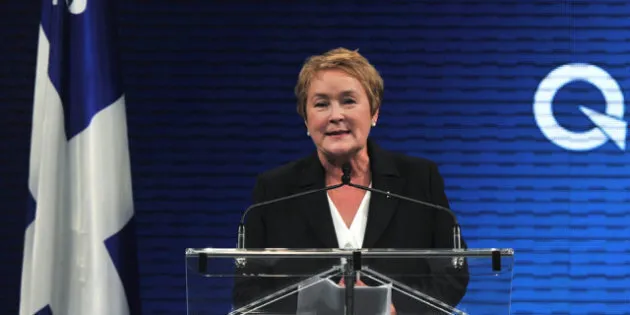
I would like to congratulate Pauline Marois on becoming the first female premier of Quebec. This is an achievement that is celebrated by everyone committed to gender equality and the advancement of women in politics. I also thank Jean Charest for his service to his province and his country for so many years.
The results of the Quebec election are positive for Canada and the strength of our federation. Over 70 per cent of Quebecers participated in the vote. While Quebecers achieved a change in provincial government led by the pro-sovereignty Parti Québécois, it's a restrained minority government. A strong majority of Quebecers voted for candidates committed to strengthening Quebec's place within a united Canada.
Quebec has and will continue to forcefully promote the strength of the French language and culture in Quebec. Canadians everywhere should support this effort. And the federal government must demonstrate to Quebecers that a strong Canada is pivotal in buttressing the French language in Quebec and indeed, across the country.
The advent of a PQ government in Quebec is both a challenge and an opportunity for Canada. This is a time for renewed national leadership that reaches out to Canadians to offers an overarching vision for Canada in the 21st century -- one where a strong federal government works with the provinces, with the municipalities, with aboriginal leaders in the national interest. A strong national vision and the specific policy proposals to make it real -- whether the environment, EI, equalization, language and immigration.
This is not the time for Stephen Harper's continued abdication of national leadership, his deliberate weakening of the federal role, and his consistent refusal to establish a meaningful national agenda that speaks to our collective challenges. Harper's absentee federalism threatens our ability to achieve effective national action far more than the election of a PQ government in Quebec. So does Thomas Mulcair's declarations about the responsibility of the prime minister to promote the nation of Québécois, with no comment on his responsibility to promote the nation of Canada and the national interest.
It has always been understood that in a dynamic federation, provincial governments will demand greater powers from the federal government from time to time. What is unprecedented is the degree to which Harper refuses to stand up for the national government and an acceptable balance of power.
Under cover of a steady stream of portentous pronouncements full of empty rhetoric from both the Conservatives and the NDP, Canada becomes more and more a disconnected collection of provinces -- a nation in name only in which we expect less and less from our fellow Canadians. We're losing the mutual sense of fairness and respect that is essential to building a prosperous future together as citizens of one of the most dynamic and diverse countries in the world.
I look forward to working with Quebecers and all Canadians to build a 21st century Canada -- one Canada, for all Canadians.
Follow Deborah Coyne on Twitter: www.twitter.com/DebCoyne
There is no shared culture, language or aspirations. Each region feels already closer to its neighboring US states than "sister" province across the land. Really Albertans don't give a hoot about Nova Scotians, as an example. Actually the only common shared attitude across the country is a profound hatred of Qc. Not sure if that's a good enough base though fir a strong nationhood?
"A strong majority of Quebecers voted for candidates committed to strengthening Quebec's place within a united Canada."
Please.
The PQ got 31.93% of the vote. They are sovereignist.
Quebec Solidaire got 6.03% of the vote. They are ultra-sovereignist.
The CAQ got 16.35% of the vote. Headed by a former cabinet minister of the PQ, they are, currently, not officially sovereignist but most assuredly "nationalist" and quite explicity say so.
My math says the total is 54.31% of the popular vote. Hardly a rousing endorsement of strengthing Quebec's place within a strong and united Canada. And hardly a "strong majority", Ms. Coyne.
What kind of suckers do you think we are? Do you think we can't google "Quebec election results" and use our computers desktop calculators?
And what's worse is that all of the above -- plus the Liberal Party of Quebec -- support strengthening the human rights-violating legislation known as Bill 101. That works out to, oh, 100% of all parties represented in the National Assembly.
If that's your idea of a strong and united Canada, Ms. Coyne, I want no part of it.
There's also ON who is also ultra-soveirengnist with 1.90%.
Polls mentioning a decreasing interest in sovereignty tend to mention (but not the editorialists referring to them) the same for federalism. Basically both are really not very popular. "Not wanting to hear about it" is what dominates the majority of the Quebec population and is certainly not a sign of unity.
Tho I believe an even stronger point is that this last election showed how Quebec was anything but united. If it can't be united with it's own self, how really united is it with Canada?
"Quebec has and will continue to forcefully promote the strength of the French language and culture in Quebec. Canadians everywhere should support this effort"
No, they do not.
The means through which Quebec "forcefully promotes" the French language and culture in Quebec, Ms. Coyne, is through a law -- Bill 101 -- that segregates its citizens. This is unacceptable in a free and democratic society.
French is the official language of Quebec. All that means is that government services must be offered in the French language. However, once we move outside the ambit of government services, ALL languages are on an equal footing: French is not allowed to be promoted by government more than, say, Swahili or Portugese. Indeed, the Quebec Charter of Human Rights and Freedoms lists "language" as a prohibited base. And although "language" does not appear in the Canadian Charter of Rights and Freedoms, by virtue of a Supreme Court decision in 2005, "language" is now considered as a prohibited base of the Canadian Charter regardless of its explicit absence.
Indeed, by virtue of the fact that French is an official language, its power and influence naturally spills over into the non-governmental arena, thus giving it an incredible advantage over all other languages. As such, it should put French on the bottom of the list when it comes to granting any preferential from government to a language. But, of course, Bill 101, discriminates unfavourably towards French.
Then your talking to the wrong man! Harper has little interest in Canadians needs or wishes.
Look at his record and his actions.