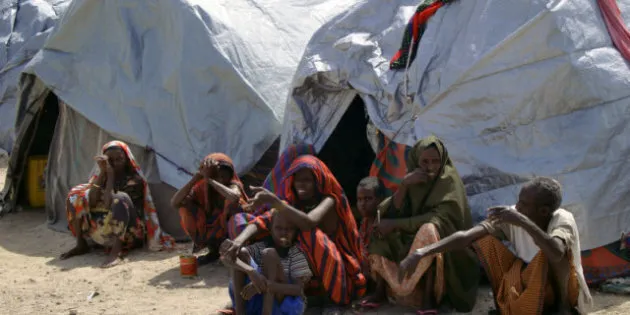
There is some movement now on the famine in and around Somalia.
As NGOs raise private donations that rich-country governments have promised to match, the UN's World Food Programme just airlifted 14 tons of nutritionally fortified food for children into Mogadishu.
This is dangerous work. About 9,000 African Union peacekeepers patrol that city, but there should be 20,000 -- the number that was originally pledged by the UN but that rich countries failed to ensure. Pirates control much of Somalia's coastal region. And large swathes of the interior are run by the militants of al-Shabab, an Islamist group with ties to al-Qaeda that has prevented aid agencies from reaching the hungry.
It's no surprise that when sustained drought is combined with lawlessness, the consequences for civilian populations are deadly and tragic.
But there is positive movement on another front. Celebrities with roots in Somalia are now speaking out on the famine. A few days ago, Somali-Canadian rapper K'naan joined U2 lead singer Bono on stage at a concert in Minneapolis to support the local Somali community's humanitarian efforts. "Yes, I'm the wavin' flag guy," says K'naan on his Twitter account, referring to his hit single that became the commercial anthem of the 2010 World Cup in South Africa. He's also an activist, and a staunch supporter of affordable medicines for Africa and of education for children in Somalia and Haiti.
Bono, of course, is well-known for his own activism. He is co-founder of the charity ONE, which campaigns against poverty in Africa, often focusing his efforts on heads of state. (Though he is often effective, the fact that there is even a need for someone like Bono to hold politicians to their promises is a continuing insult to the poor).
Meanwhile, in a video posted earlier this week, Somali-born model Iman warned of the one million children at risk now each day in Somalia. The head of a $25-million a year cosmetics company, and the partner of rock star David Bowie, New-York-based Iman is also a spokesperson for Keep A Child Alive, a nonprofit organization co-founded by singer Alicia Keys that provides drugs to children with HIV/AIDS in Africa.
It is estimated that nearly 11 million adults and children in East Africa now suffer from severe food insecurity triggered by the drought, including 3.7 million people in Somalia itself, as well as 4.6 million in Ethiopia, and 2.6 million in Kenya.
Ethiopia and Kenya are generally held up as successful African nations that are managing both their economies and governance reasonably well -- though their paths have not been easy or simple. While the famine is testing their ability to cope with crisis, these countries appear to have sufficiently strong institutions and systems that, with some external support, should enable them to prevail.
In fact, alongside the failed and fragile states that scar the face of the continent, Africa also boasts some of the world's fastest growing economies. Botswana and Mauritius have become middle-income countries. South Africa and Nigeria are major regional forces of commerce and trade. The economies and democracies of countries like Ghana and Rwanda are recording impressive gains as they proceed forward.
It is essential that these and other African nations succeed in economic terms. Such success will help to minimize ethnic and religious conflict, disease and food insecurity, and maximize income per capita, quality of life and civic participation. Achieving positive futures in these "other Africas" matters profoundly. The bottom line is that these countries need sustained economic growth.
To this end, the World Bank has approved a new 10-year strategy for the region that aims to boost competitiveness and employment and mitigate vulnerability. The foundation of the strategy involves strengthening governance capacity. However, on the economic side, the strategy will focus "reforms and public investments on areas of highest growth potential, a healthy and skilled workforce, women's empowerment and regional integration programs." Light manufacturing, agribusiness, mining, information technology and tourism, for example, are priority sectors for the strategy.
Such strategies are not without risks, however. Their economic benefits must be spread widely. Businesses must not be permitted to pollute or abuse human rights. Foreign investment must not undermine sovereignty. Nonetheless, economic development is a fundamental precondition for ensuring food security and a better life for African households and communities.
The celebrities' call to action on the famine in Somalia and neighbouring countries is welcome. And their efforts to mobilize solidarity in North America and Europe are valuable. But there is a longer game here in which they should engage. That game is to accompany all the Africas in the decades ahead in constructing a robust, fair and independent economic base -- and one that really could make famine history.