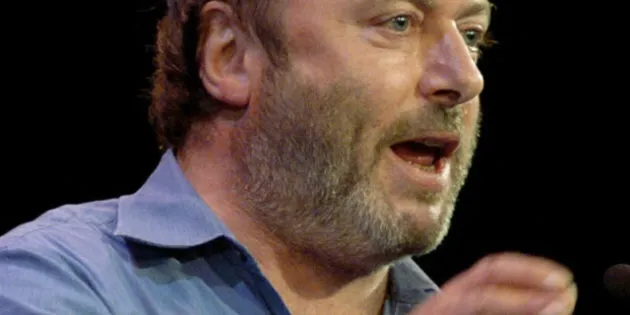
I want my son to question everything and Christopher Hitchens died recently (Dec.15).
First, about Christopher Hitchens: I'm weirdly sad. Maybe because I've just started to love him (I'm a late Hitchens bloomer), or maybe because I thought his last columns in Vanity Fair on his "living dyingly" were so poignant, considering he had some big questions and challenges for the laws of universe and god (not being great). When else but during death does one turn to god and religion? He -- as far as we know now -- hadn't, wouldn't: "I shall continue to write polemics against religious delusions, at least until it's hello darkness my old friend," Hitchens wrote in the last year of his life.
He is dead and I'm grateful that he was such a strong voice (even after he lost his own), making those who don't believe -- or at least question -- feel represented in this religion-crazed world.
I want my son to at least question (see how I did that?). I know that with my partner and I as parents, he won't start frothing at the mouth at the mention of god, a higher power, Jesus or Muhammad for a while, but naturally he will come of age when he'll try to rebel and perhaps he will even come home wearing a white robe, pockets full of rosaries and his head full of conviction that our lack of conviction is a sure work of evil. Or maybe not. Maybe he'll let his mind consider other possibilities that will bring his life meaning and will make him a good human being no matter which side of god he ends up on.
Religion is the mother of touchy subjects and it's one I've never really cared to argue against or about because I find arguing about it somewhat pointless in general. Grown-ups usually have their minds made up about it one way or another, so either you're (pun intended) preaching to the converted, or talking to an unholy wall. I'm curious as to what will happen when it (religion, god) will be brought up by a child, my child specifically, who with his fresh mind will be seeking ways to form his own opinions.
I'm sure it will come up sooner or later (we live in a Portugese neighbourhood and if that doesn't tell you anything, you should say a couple of Hail Marys for good measure). I will probably tell him that I was born into a Catholic faith and that I was baptized and that, yes, there was a point in my life when I obsessed over god being really mad at me because I said a swear word. I will tell him these things because he'll need to know where I'm coming from when I tell him to question religion and even god. I want to influence him, but I want him to have a mind of his own. I want to tell him that it's bad to blindly buy into dogma, but at the same time I don't want him to feel like I'm prohibiting him from developing his beliefs. My only lesson would be to question everything because you should always, always be curious and work your mind in all the bendable ways possible. (Yes, even allow it to consider god, if god happens to appear to it one day after bouts of atheism -- just make sure it's never the god that makes you scared, unforgiving and closed-minded.)
And speaking of fear, I've given my son's baptism some thought. I'm shocked that his Polish grandmother (my Ma) hasn't kidnapped him yet to get him dunked in holy water, though there are moments when I think, darkly, that she had, like my friend's mother who took my friend's daughter to have her secretly baptized. I could see my mother doing the same because she often worries about god being upset over this and that, and her church finding out, too. I'm not blaming her at all for being this way -- that's how she was raised. And so, I too have grown up being told that I would be doomed for eternity had I not gotten dunked in the said holy water and I've had this belief so ingrained in me that there are moments now when I still wonder if I'm damaging my son's heavenly future by not getting him that particular ticket to salvation. I will look at my partner (a hardcore atheist who was baptized to please his grandmother) with wild eyes once in a while and say, "Maybe we should get him baptized?" My partner looks back at me and we both shake our heads and remind ourselves that the child -- when he's all grown-up -- can make that decision for himself, especially if that will make him feel better about life. I'm sure I won't be too impressed if he does show up in a white robe with rosaries in his pocket and if he does, we will probably try to exorcise each other -- him with a Bible, me with Hitchens on the opposite side -- but I want my son to know that his faith or lack thereof should never come from being afraid.
Hitchens didn't let himself be scared by death into buying into something that brought him no comfort even when there was fear of the unknown. But he's been kind, even when talking about people who wanted to pray for him (Sept. 20 was "Everybody Pray for Hitchens Day") to bring him salvation: "I don't mean to be churlish about any kind intentions, but when September 20 comes, please do not trouble deaf heaven with your bootless cries," he wrote. "Unless, of course, it makes you feel better."
Originally published on they don't tell you.