In a drawer somewhere, I have a nickel-sized coin of the Roman emperor Gallienus (ruled 253-268 AD). Gallienus is long-forgotten, but he shouldn't be. He is one of the true fathers of inflation, and there should be a statue to him on the Acropolis in Athens and in the lobby of every government's central bank.
Gallienus was a victim of bad timing. Plagues and invasions had weakened the Roman Empire. Big chunks of it were seceding and rebelling. Gallienus rarely visited Rome. He spent most of his reign on the road, hunting down various barbarian hordes and rebel legions.
And he fretted over his finances.
Because of the wars and the decline of trade, (along with hoarding by nervous Romans), silver disappeared from circulation. Coins were almost impossible to come by.
Gallienus' money guys came up with a solution to this problem. They got the mint to stamp his coinage in copper. Then they put a silver wash on the coins. Gallienus paid his army with it.
The resulting carnage left Gallienus and his entire family dead, his statues smashed and his monuments pulled down. Geneologists re-wrote family histories to erase Gallienus.
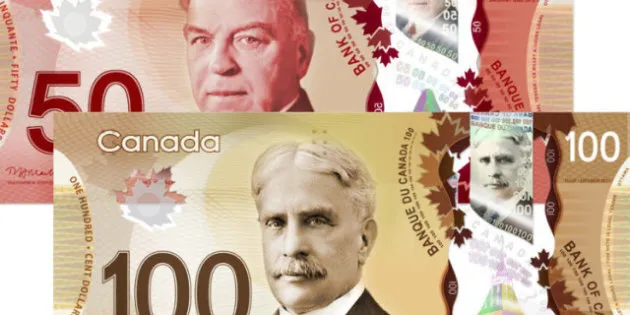
I bring up poor Gallienus just hours after seeing Canada's new polymer $100 bills. I was at a news conference where these bills were handed out to reporters. We had to give them back, but, while we had them, I went at mine with every intention of seeing if it really could not be torn or mutilated, as the Bank of Canada's people said.
Some of the people around me reacted in horror at the disrespect I showed to my little piece of plastic, as though "money" -- even a piece of holographed chemistry that no one would accept as money right now -- was somehow sacred.
Money is what people think it is. A "dollar" used to be the same everywhere: one ounce of silver, give or take a small nip. A dime was 1/10 of an ounce of silver. A "penny" was, for hundreds of years, 1/240 of a Roman silver pound, which was 12 troy ounces. A British pound morphed from those 12 ounces of silver to ¼ ounce of gold, which was also about the size of a U.S. $5 gold piece. A U.S. $20 gold piece was just under one troy ounce of gold.
A century ago, Canadians were very familiar with the big British copper penny, which was about the size of a loonie and had about the same purchasing power.
But now money is all numbers, articles of faith. Canada's paper money used to bear the words "The Bank of Canada will pay to the bearer on demand..." the number of dollars on the bill. The bill was a promise to pay money. By sleight of hand, the bill somehow became money.
Money and governmental jiggery-pokery have always been intertwined. Henry VIII's subjects called him "Old Copper Nose" because he watered his silver coins down with so much copper. I have a $50 trillion Zimbabwe note around the house somewhere, one of the last bills issued by Robert Mugabe's regime before the German printers stopped the presses until their account was settled (in Euros).
Somewhere else, I have a stash of billion-mark bonds issued by Germany's Weimar Republic in 1923. That inflationary trick, which conned some of my gullible relatives and wiped out the bond-holding German middle classes, helped seal the German republic's fate. (The company that printed the German bank notes in the worst weeks of the inflation submitted a bill to the government for 32,776,899,763,734,490,417.05 marks.)
Sound currency issuers: Elizabeth I, Julius Caesar, Constantine the Great, Napoleon, George Washington, Sir John A. Macdonald, Otto von Bismarck.
Unsound currency issuers: Richard Nixon, Jimmy Carter, unlamented Gallienus, the Soviet Union, Communist China, Robert Mugabe (and Abraham Lincoln, just to throw a wrench into my own argument. But war is hell on currency).
We're in for a reckoning about money, not because we've physically debased it, but because we don't understand it. The yuppie who stiffs a waitress on a tip has no problem bidding up a house by $50,000 over its asking price, which already reflects a speculative "value" that has no basis in intrinsic costs.
Politicians in Canada hold a five-week election campaign to argue about economics, then pass $275 billion in spending, some 800 pages of estimates, in far less time than it takes to read them.
Each Canadian family has, on average, some $180,000 in mortgage and personal debt. Take out the renters, the people making minimum wage, people with bad credit, the elderly who have the sense to be debt-free at retirement, people who abhor debt or have religious scruples about usury, and the small number of people who are so rich that they rarely borrow, and you have a skilled working class and a professional middle class in deep, deep financial trouble.
The CMHC, which insures most of the worst of Canadian mortgages, has more risk on its books than the amount of the federal debt. We also hide debt by spreading it among pension plans, provinces and municipalities. Our statisticians play with numbers to try to convince us that inflation is much lower than it actually is.
Our allies and friends are already showing us the future. In Greece, revolution is in the air because the government is worse than broke. In the U.S., public debt levels are above the ability of most people to comprehend. It's like trying to calculate the number of stars in the universe.
Eventually, things will work out. People will need stuff. People will make stuff. People will carry stuff around and sell it. Barter is far less efficient at setting prices than a cash economy, so people will create good money out of necessity. But the road between now and then could be pretty rough.
I doubt the new plastic currency will help, though I did find that if you do pull really hard, you can stretch the new bucks. You just can't stretch them far enough.