Featuring fresh takes and real-time analysis from HuffPost's signature lineup of contributors
Hot on the Blog
Raffi Cavoukian
Sameer Zuberi

GET UPDATES FROM Sameer Zuberi
 

Accessible Education: A Societal Choice

Posted: 04/ 7/2012 12:03 pm

Since the beginning of 2012, I've been sporting a red felt square. Today, it's quite the fashion statement in Quebec. But it was only last week that I noticed how worn my red square had become. After several months, it's now frayed at the edges with bumps starting to appear.

Why are red felt squares in such vogue? The recent provincial budget in Quebec is to be credited for this. In it the provincial Liberals introduced a 75 per cent tuition hike, where the cost of university education will increase from the current average of $2,500 to $4,125. This is after a 30 per cent increase since 2007-2008.

But anyone who has attended a post-secondary institution knows that the cost of education is much more than simply tuition. When you consider books, transportation, and sometimes housing, it's clear costs quickly balloon. In real dollar terms, McGill's admissions department says that students living at home need at least $4,800 a year. Those living alone should budget between $16,500 and 20,000 a year. And this doesn't factor in the planned fee increase.

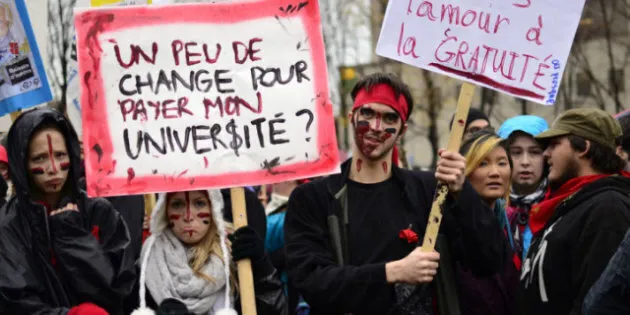
In response to the tuition hike, there are currently an estimated 180,000 Quebec students on strike and counting. This includes 14,500 students between McGill and Concordia who are not attending class, and another 20,000 from Université de Montreal and Université de Québec à Montréal respectively. However, it's not simply students who are advocates of accessible education -- teachers, young parents and citizens of all walks of life are too. A recent Leger Marketing poll uncovered that 45 per cent of Quebecers favour the position of students over that of the government.

At stake is more than a mere tuition increase, but the very concept of accessible education.

When we read about tuition in Quebec, we're often reminded that it is the lowest in Canada. (Newfoundland and Labrador's tuition rate is a close second at $2,650 per year.) But we forget to mention that Quebecers pay the highest taxes after Nova Scotia and PEI, and deserve a break when it comes to social programs. Also, the Canadian Centre for Policy Alternatives recently uncovered that university grads, over the course of their careers, pay back provincial subsidies to education many times over. In B.C., a four-year undergrad degree costs taxpayers $20,000. However, university-educated women contribute $106,000 more to the public purse, when compared to peers with only a high school diploma. British Columbia men pay back $159,000 more because of their university education.

We also don't mention that higher tuition historically leads to lower participation rates. According to Quebec's Ministry of Education, an estimated 6,000 to 13,000 students stopped attending university because of the $100-per-year hikes between 2007 and 2012. University of California researchers have found enrolment rates dropped among low-income students and minorities due to tuition increases.

We often forget the real reason why our tuition is the lowest nationally. It's because Quebecers have made a societal choice to keep education accessible to all, regardless of income. This societal choice is something we as Quebecers should be proud of, and defend.

Outside of a get-rich-quick scheme, post-secondary education remains the most reliable method of achieving social mobility and a better standard of living. For low-income households, it is the surest ticket to breaking inter-generational poverty. Today, households with immigrant roots still understand this. This is the reason why newly landed immigrants place so much value on academic excellence and achievement. Education is seen as the best way of securing a better future.

What happens when, due to lack of resources, we remove the ability of citizens to educate themselves? To answer this, we only need to look at our neighbours to the south.

It's a popular belief that the U.S. has prohibitively high education rates, and that Quebec's tuition is, by comparison, dirt cheap. If we consider the least costly university degrees available in the U.S., the tale of where Quebec is headed is much clearer. According to America's College Board, in 1988 a year's tuition at a public university cost $2,800 on average. By 2008, that same year of schooling increased by 130 per cent to $6,500.

The societal cost of the tuition increase in America was the death of accessible education. The Internet is rife with reporting and analysis on the College Board's numbers. Titles like "Rising college costs price out middle class," which appeared in CNNMoney, are quite telling. They indicate that in America, a seemingly modest yearly tuition of $6,500, not only bars the poor and disenfranchised from education, but middle class kids too.

The example south of the border begs the question: what sort of society do Quebecers want to create? Do Quebecers want to maintain a proud tradition of accessible education, where all have the chance to educate themselves? Or does the province want to limit opportunities so that only some can attend university and secure a promising future?

On these issues, the jury's out. One thing is certain though, the Quebec budget, as it now stands, is an affront to the cherished value of accessible education. If left unchanged, red felt squares will continue to become increasingly popular on Quebec's streets and may soon debut in the fashion world.

 
Since the beginning of 2012, I've been sporting a red felt square. Today, it's quite the fashion statement in Quebec. But it was only last week that I noticed how worn my red square had become. After ...
 
 
  • Comments
  • 13
  • Pending Comments
  • 0
  • View FAQ
Comments are closed for this entry
View All
Favorites
Bloggers
Recency  | 
Popularity
03:25 AM on 05/31/2012
If Mr Zuberi, a professional student by choice, believes post secondary education should be free, then prey tell is the money going to come from? If you raise taxes too high then people will leave regardless of their society standing. If the political leaders of Quebec (regardless of affiliation) had any real courage, they would stand up to both the student protest organizers, aka the Student Unions, and its backers, the trade unions. Alas, it seems that the government, and the Assembly, is actually run by non-elected officials, who do not work.

Quebec students should be grateful that they have the lowest tuition fees in North America and that the formerly proposed increase was extremely low. Higher tuition fees do not necessarily rule out lower income people from obtaining higher education. If they truly want to go, they will find away.
photo
HUFFPOST BLOGGER
Sameer Zuberi
06:43 PM on 04/16/2012
Several people emailed me their feedback, but one, from an author and friend, disserves to be shared:

“I was delighted to see your ...article...”

“Just for the sake of discussion, I felt that you might also have mentioned the massive demonstration that took place two weeks ago, exceeded in size only by that of March 2003 against the invasion of Iraq. That demo enabled Jean Chrétien to avoid backing American aggression. Too bad Jean Charest finds himself unable to draw similar lessons: when there are that many people on the street, opinion polls become secondary. The red tag demonstrators of today are the brightest lights of tomorrow's society. Ignore them at your risk.

“One more thing, on the old cliché that Quebeckers are more heavily taxed than others. Not so. Historically, Quebeckers have understood that in order to have an egalitarian social system, with low-cost, accessible health care and public education worthy of the name, collective commitment is necessary. That commitment can only come through progressive income taxes. The problem in Québec, however, is not taxes, which are scandalously low for the wealthy (not to mention the resource extraction companies), but the profusion of user fees, all of which are highly regressive.”
05:47 PM on 04/09/2012
Live most students, I am appalled at how student voices have been hijacked by so-called leaders of the protests. Nadeau-Dubois and Bureau-Bloin do not speak for me. My CEGEP hasn't held a general assembly since the strike was approved. At that time most students didn't vote and nobody believed that things would get so out of hand. To make it worse, the so-called leaders reject the government's offer to increase financial aid regardless of others issues. This increase is a blessing for poor students like me. The new system will make education much MORE accessible and affordable for poor students. Right now there is little financial aid because everyone -- rich and poor -- pay the same. In my opinion, this is what rich students like Nadeau-Dubois and Bureau-Bloin are fighting to preserve, and this is just not fair. What happened to solidarity?
photo
HUFFPOST BLOGGER
Sameer Zuberi
05:37 PM on 04/16/2012
Danielle, thanks for your comment.

About your CEGEP not having a general assembly since the strike mandate was approved – this is disturbing. If your strike has been going on as long as mine has (since mid-February), I encourage you to help organize a GA, so students can decide if they want to renew their strike mandate.

Although I believe in the strike (as inconvenient as it is), the process by which we get there is equally important.
08:59 PM on 04/08/2012
Mr. Zuberi has dealt with an issue that is of concern to many students, if not all. Sadly, politicians hardly ever talk about this issue. It is probably due to the fact that students do not pose a direct threat to the future of politicians. If they were involved in politics and contributed a lot to voting, politicians would have paid more attention to them. I am really afraid a time to come when only rich students will be able to pursue higher education and everyone else will be left behind to serve the rich and take care of them.
05:28 PM on 04/08/2012
this article is awful.
1. UQAM isn't a real law school, huffpo should know that if they knew anything about Québec
2. he constantly quotes US sources...try some canadian stats
3. if access to education and cost are negatively correlated, then Ontario would have the lowest university enrollment, since it is the most expensive, but in fact, the opposite is true.
12:58 AM on 04/09/2012
Max ish: you should read this article one more time!.....
1. The article is not about defining "Real law School"
2. The writer wisely used US quotes to defend his stands.
3. What is the canadian Quote for this third argument of yours?

Bottom line: your post is not diffrent from staying quiet!

This article is inspiring!
This user has chosen to opt out of the Badges program
photo
01:23 PM on 04/08/2012
Students always neglect to mention that someone has to foot the bill for their education. The money does not fall as manna from heaven.
05:28 PM on 04/08/2012
agreed. i think you'll prefer this article http://www.huffingtonpost.ca/supriya-dwivedi/quebec-student-protest_b_1390776.html
08:35 AM on 04/08/2012
As such, perhaps if tuition hikes do get implemented, citizens will need to keep an eye on the management of this money inflow - i.e. what proportion it is going towards providing accessibility of education?
08:33 AM on 04/08/2012
Basically, it accrues more power & authority to government & universities. On the one hand, it can be good if they exercise this power to achieve the respectable goals of accessibility. If they don't, there may be a more significant issue underlying the way authorities operate in Quebec, and that would be up to the people to hold them accountable for the objectives they set. On the other hand, perhaps my analysis may be highly optimistic, because "ensuring that university remains accessibnle to all student" is only one of four goals stated on the website. The risk is that a bigger proportion of money collection from tuition hikes may go to achieve the other 3 goals rather than this one.
08:33 AM on 04/08/2012
Good summary of why education should remain accessible. I was 100% against the tuition hikes previously; however, I was just checking out the Ministry of Education webite about where the money will go. http://www.mels.gouv.qc.ca/enseignementsuperieur/droitsscolarite/index_en.asp?page=utilite_argent. According to it, it seems that the tuition hike is partly meant to be a redistribution mechanism. Under "where will the money from the tuition increase be used to pay?", the website says, "Ensure that university remains accessible to all students" among 3 other things. It seems to me that one goal in this tuition hike is to make education accessible to those who may not be able to otherwise afford it. In other words, more money entering = more money given back as financial aid. It may serve to redistribute from the richer students to the poorer students by taking more tuition from those who are better off & giving it as financial aid to those who are less well-off. In a sense, this would preserve the Quebec culture of redistribution & accessibility - it is perhaps just a different measure to attain accessibility. However, the danger arises in the fact that it will be up to university & governmental authorities to make the decision on who deserves & really needs financial aid or not.
03:06 PM on 04/07/2012
Great article. Investing in accessible post secondary education is the best investment we can make in our collective future.