Since much debate these days is focused on foreign investments, perhaps it's time to turn an eye to food security, a growing global crisis that is being exacerbated by climate change, rapid growth and foreign "interests."
Currently, Canada has no national policy approach to how we will sustainably and equitably feed our growing population. Additionally, while some provinces have protections in place, there is no overarching federal law to protect against foreign accrual of Canadian farmland. The absence of policies like this is what allowed for the purchase of prime farmland in Melancthon Township by a Boston hedge fund, to build what would be the largest quarry in Ontario and the second largest in North America.
And while the mega quarry has created mega opposition and a movement to defend Ontario's precious food growing areas, and though Ontario boasts the world's largest greenbelt, a considerable amount of farmland is still being gobbled up all over the province.
This past winter, I was invited by local famers and community members to tour areas under development pressure in Brant county. Brant county is a small, predominantly rural municipality in Southern Ontario, approximately 100 kilometres southwest of Toronto. It is bordered by the Region of Waterloo, the City of Hamilton and the provincial greenbelt. It is also the target of one of the most aggressive farmland grabs by offshore investors in the country.
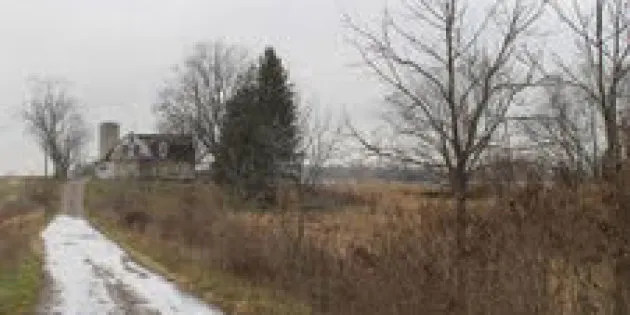
During my visit, I was shown vacant farm lots with barns that had been stripped of their exteriors and left to decay. Some of these have collapsed or been bulldozed since my visit. Community members that I spoke with told me stories about elderly widows approached by land-buying agents, one even at her husband's funeral, and division within families over the future of their land and livelihood.
A few years ago, a National Farmers Union (NFU) report shone the spotlight on the foreign land grab in Canada. The report outlines the investor group eyeing Brant county farmland for conversion into "development-ready property" -- i.e. urban sprawl. That company is Walton International.
According to their website, Walton manages nearly 65,000 acres on behalf of over 75,000 investors worldwide. They specialize in "Research, acquisition, planning and management of land in the anticipated development path of major North American growth corridors."
According to a presentation made by Walton to council, the company holds over 4,302 acres in Brant county. This represents approximately six per cent of the total county land. Proposals for two new highways are driving more land speculation. As the county completes a review of its official plan, councillors and staff have been pressured to expand its urban boundaries for development. Of particular interest are tracts of land between Paris and St. George, east of Cainsville, and in Tutela Heights, home to the historic Alexander Graham Bell Homestead.

The community group, Sustainable Brant, has been lobbying for the preservation of prime farmlands and for the county to "grow up, not out." Their glimmer of hope is the possibility of greenbelt expansion into their community, along with a little-known provincial bill that was established in the 1980s and designed to set aside an area of land for "permanent agricultural and rural related uses." This area lies only a few miles away from the western edge of the Ontario greenbelt. Developers argue that this piece of legislation has expired.
Sustainable Brant is not giving up quite that easily. They continue to push the issue at council and at Ontario Municipal Board (OMB) hearings. In the lead up to the 2015 review of the Ontario greenbelt, they are petitioning the province to grow the greenbelt into Brant county before it's too late.
Global trends show a growing number of countries, agri-business and large corporations scanning the globe for land purchase. They are not ignoring Canada. They are certainly not ignoring Brant county. If we continue to lose farmland for sprawl and foreign investment, we ignore our future food sovereignty. Our future, our children's future. Seems like a worthy investment to me.