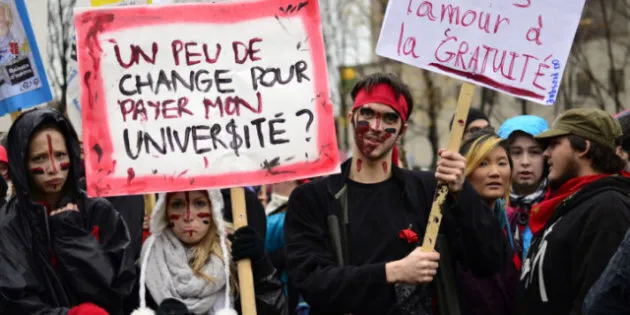
March 29 marked yet another student protest in Montreal over planned tuition hikes by the Quebec provincial government of $1625 over the next five years, which would still make Quebec's tuition among the lowest in Canada.
As the child of immigrants, I often find it hard to air grievances pertaining to matters that would be hashtagged as #firstworldproblems. So, when a bunch of over-privileged, entitled kids overreact to situations that really aren't that bad, I have a hard time relating to them.
Moreover, I have had the great privilege of attending two of Canada's most reputable universities, McGill and Université de Montréal, at a fraction of what it would cost other Canadians. At the end of my six years of post-secondary education, I will have paid less than what it costs the average out of province student to attend either school for half of the time that I did. I for one am very grateful to our province's low tuition fees, and can understand why maintaining a tuition freeze over the last 33 years is simply not sustainable.
Yet even though I do not agree with the students' grievances, I believe in their right to express their opinion. Additionally, one cannot help but sympathize with the protesters' initial argument that the tuition increases will become a new barrier in accessing post-secondary education for lower socioeconomic classes.
However, as time goes on, it is becoming increasingly clear that the students' message is mixed at best and flawed at worst. Dispersed amongst their signs of a "printemps érable" and effigies of "John James Charest," the cries from the protesters range from maintaining the status quo, to demanding free tuition, to the obvious underpinning of all Québécois malaise -- demanding an independent Quebec.
During the most recent protests, the students were grouped into four different groups -- orange, blue, yellow and green -- in order to represent their different messages. My gripe pertains to the yellow group, which found another foe worthy of their vociferous appeals to the masses: student scabs. The protesters claimed that the "scabs" in question had the right to be against the strike, but did not have the right to cross picket lines and go to classes.
This isn't a matter involving a unionized labour dispute with an immoral corporation illegally hiring people to work during a strike. This is a matter of students boycotting classes over an issue that is centered on their demand for further entitlements that serve their own self-interest; and because other students choose to go to class and learn, they are being shamed.
Never mind the fact that many student associations voted against the strike, the fact that students do not have a legal right to strike, and that because these students paid their tuition at the beginning of the semester, it is not only their right to go to their classes, but they are in fact simply being economical in not wasting their tuition money.
The protesters may indeed have 99 legitimate problems to deal with right now, but just to be clear, a scab isn't one.
This kind of "you're either with us or against us" mentality is a tactic that has been used by many authoritarian, bullying figures. George W. Bush famously denounced countries that refused to invade Iraq by declaring they were necessarily siding with the terrorists. Similarly, our own current Public Safety Minister, Vic Toews, saw a barrage of criticism when he proposed Bill C-30 and claimed that by not supporting it, one was a de facto child pornographer sympathizer.
The striking students have taken a page right out of the authoritarian playbook.
The students are correct to state that it is their right to call me scab, after all, they have the right to call me whatever they want. They should heed notice though; it is the right of every student to reap the benefits of the tuition they paid by attending their classes and learning a thing or two. We refuse to be bullied into their boycott.
Follow Supriya Dwivedi on Twitter: www.twitter.com/supriyadwivedi
Supriya Dwivedi: Line Beauchamp Acts Like a Grown-Up. Why Won't the Students?
If the striking students win and tuition does go down (or at least stabilizes instead of increasing), will you pay the old one or the new one?
Bringing up the fact that you are a child of immigrants is irrelevant to the discussion, but, for the record, being a 2nd generation Canadian does not automatically mean that you had a harder time growing up than anyone else. Even if true, it’s still off-topic.
The sentence “I for one am very grateful to our province's low tuition fees, and can understand why maintaining a tuition freeze over the last 33 years is simply not sustainable”, does not make any sense. Past generations of students fought hard to establish and maintain the freeze that you continue to benefit from. Turning around and accusing it of being unsustainable is hypocritical. Also, there is no guarantee that the extra money being raised won’t be used by university officials to provide further “golden handshakes” or to pay for more exorbitant administrative salaries. Many people also don’t acknowledge the auxiliary fees that are tagged alongside the tuition fees, which have gone up significantly over the years.
For the future, I would recommend that you write an article that focuses on the issues themselves and support your argument with numbers and facts, rather than simply sharing your egocentric view.
I never insinuated I had it any harder than anybody else. I stated that because I was raised by hard working immigrants, (who managed to work their way through CEGEP and then medical school at McGill), I understand the sacrifices and effort needed to achieve something. Consequently, I can’t help but see these protests as #firstworldproblems.
If you would like pure facts and figures, here they are (straight from the statcan website):
The average tuition in Canada is $5,366
The average in Quebec is $2,519
Ontario students pay the highest in the country, $6,640
Quebec roughly receives $1,743 more per person than they paid into the confederation based on equalization payments. Meanwhile, Alberta pays $4,356 into the confederation. Alberta pays more into equalization payments than Quebec pays for tuition.
If Quebec students were really concerned about equal access to education, they would have taken to the streets in the name of their Ontario brethren, or how unfair it is that Albertans end up paying for Quebec social programs, or even how underrepresented the native population is in post-secondary education. But they didn’t. Instead, they continue to demand services (or entitlements) without being willing to pay into it, and harass the students that choose to go to class.
I’m sure your parents were a positive inspiration in your life, but one can claim the same and still be against the raises. And using this anecdote to state that student protesters are spoiled sounds snobbish.
Yes, we’re constantly reminded Quebec is a “have-not” province (so are 5 other provinces). Should Quebecers feel guilty about it? Even with higher tuition rates, I’m not sure how that will impact Quebec’s share of the equalization payments, or if that matters. Honestly, I fail to see how Alberta being a “have” province has anything to do with tuition fees in Quebec. If you don’t agree with the equalization payments, then lobby the federal government. Relating it to these protests distracts from the discussion.
Forgive me for my presumptuousness, but being the child of doctors (I assume your parents are practising) suggests that you may not be as impacted by a 75% increase in tuition fees over 5 years as, say, someone who comes from a poor rural background. Similarly, the dichotomy between the wealthy and the less wealthy with respect to this topic is evident.
Anyway, I agree that preventing students from going to class isn’t the wisest way of spreading the message.
Yes, I grew up very privileged, however, I worked my way through both my undergraduate degree and law degree, and have over 40k in student debt.
And just as a side note, all opinions are necessarily egocentric to some degree as an opinion represents a person's own world view. Moreover, to cast someone's opinion as irrelevant simply because they do not mesh with yours is only proving the general thrust of my article, which is that the protesters have adopted a "with us or against us" mentality. Besides, it is clear that my opinion isn't irrelevant, otherwise you wouldn't have commented in the first place.
And if you agree that bullying students who choose to go to class isn't exactly a commendable pursuit, then congratulations, you agree with my "irrelevant and egocentric" opinion, since that is the entire thrust of this article.
*I won't call them strikers because they are not a labour force, they are essentially boycotting