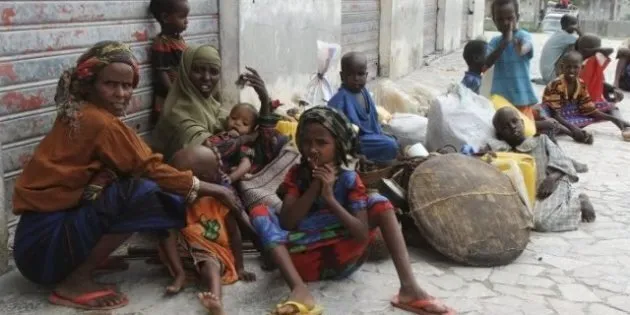
The images coming from across the Horn of Africa are bleak: skeleton-thin babies being held by their underfed mothers, crying for food in refugee camps, wasting away in front of the lens.
The drought in East Africa is being called the worst the region has seen in half a century. An estimated 12.5 million people are facing starvation in Somalia, Ethiopia and Kenya, along with parts of Uganda, Eritrea and Djibouti. It's so bad that aid workers have dubbed this region "The Triangle of Death."
To international aid organizations, this famine is no shock. "Unicef and others have been trying to raise the alarm that this was going to happen since about January," says David Morley, CEO and President of Unicef Canada.
Before the UN can officially declare a famine in the Horn of Africa, there are a few legal requirements. The first is that there must be at least two adults and two children dying per day per 10,000 people, according to Morley. Also, no fewer than one in three children under five must have acute malnutrition. One way to measure this is by looking at the size of the child’s bicep.
"When the bicep is the size of a toonie or less, that's malnourished," Morley says. "In some places in Southern Somalia, we've got half the people have their arms the size of toonies."
Five of Canada's top charities have combined to address the need for aid with The Humanitarian Coalition. The group comprises Oxfam Canada, Oxfam-Quebec, Plan Canada, CARE Canada, and Save the Children. With all these organizations and layers of complexity, it isn't always clear exactly how your money is going to help.
Groups like Unicef Canada, the Canadian Red Cross and Human Concern International use local agencies to distribute aid in affected regions. These groups have an ear to the ground on how aid should be distributed and have better access than international groups entering the country to deliver aid.
Heidi Vallinga, the Events and Communications Coordinator at Human Concern International, says money donated to famine aid is taken straight to Somalia. Their partners in the area provide food aid, water tankards, tents and baby food, just to name a few resources. HCI provides the funds to these groups so aid can be delivered, who then provide a report on how they've used the money.
Vallinga estimates that so far, HCI has only taken in $300,000 in donations from Canadians, which, considering their $1-million goal and the US$2.5 billion estimate the UN says is needed to save all drought victims, is a drop in the bucket. More than half of that estimate has been raised internationally thus far from governments across the globe and other aid organizations. "There's always appeals for different crises and things going on in Africa," Vallinga says. "I think sometimes people are slow to donate because they see it as another problem in an area that's already very troubled."
International aid groups are ramping up their relief efforts, but more help is needed. Ottawa has pledged another $50 million on top of the $22 million already dedicated to humanitarian aid. They've also pledged to match every dollar donated by Canadians. Unicef Canada has raised $1.1 milion, and internationally the organization has raised US$36 million. They're appealing for a total of $300 million.
Hossam Elsharkawi, Director of Emergencies and Recovery at the Canadian Red Cross, estimates that they've raised $5 million: $1 million came from the Ontario government, $2 million from Canadian donations and $2 million from the Pindoff family, founders of Music World Limited. "[The famine] comes in the context of a 20-plus year conflict in Somalia and three or four seasons now of repeated, failed harvest," says Elsharkawi.
Somalia has arguably been hit hardest by the drought, but the al-Shabab militia has made it even more difficult for international aid groups to bring food aid into the region. The group which controls a great portion of Somalia has banned the UN's World Food Programme from entering the region. "For a lot of them, their livelihoods are being completely wiped out," Vallinga says.
Humanitarian aid groups aren't just bringing emergency food supplies to East Africa; they're also bringing tools for locals to sustain their families in the long term. The Red Cross is distributing seeds, planting tools, hygiene and kitchen kits, and food staples like locally grown sugar, flour and oil.
Feeding Somalis is comparatively cheap. Elsharkawi says a single high-energy biscuit package, which has 2200 calories and is the minimum caloric requirement for an adult, costs only three dollars to purchase and deliver. An aid kit, which provides a family of seven with around a month's supply of food, pots, pans, cutlery, tools to filter water, and a hygiene kit including bars of soap and washing materials, is only $300.
But the money just isn't there. "Generally, droughts tend to generate less interest from the public than what we call rapid onslaught immediate disasters," Elsharkawi says. "The emotional messaging isn't there with droughts versus other types of disasters."
It also takes money to keep these humanitarian aid groups alive so they can continue bringing emergency help. Morley says it takes Unicef around 10 cents to raise a dollar. Elsharkawi says the Canadian Red Cross uses seven to 10 per cent of donations for administrative upkeep. Vallinga wasn't sure how money was distributed within HCI. Ultimately, however, it's almost impossible for each cent of your donation to make it to an affected region.
To donate, Canadians can visit Human Concern International, The Humanitarian Coalition, Unicef Canada or the Canadian Red Cross. If you don't have the income, there are other ways to help, like with Free Rice, which donates 10 grains of rice through the World Food Programme for every trivia answer you get right.The Canadian government will be matching donations until September 16, so every dollar donated by individuals is more valuable sooner than later.
Between stories about political instability and famine, it's easy to feel pessimistic about the situation in Africa. But Morley says it isn't as bleak as it may feel.
"In North America, we only shine the light on places like Ethiopia or Somalia when something bad happens so it feels like an endless treadmill," he says. "But I'm an optimist, and [I] take a generational view."
Morley concedes that progress in the region has been slow, but there's been progress nevertheless. While funds are desperately needed, consistent awareness of Africa's food crisis is also needed.
"If Canadians believe we have a role as global citizens, we should be telling our politicians because they'll listen to us," Morley says. "It's on the other side of the world, but we're all people."
See photos of East Africa's famine: