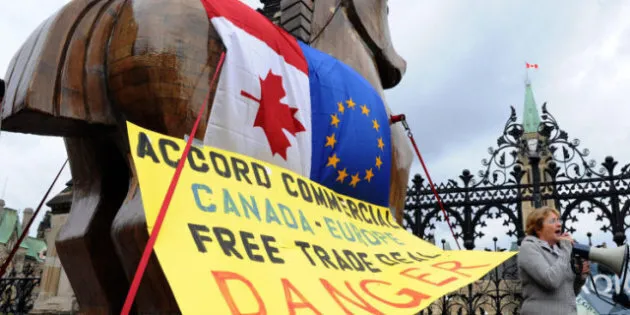
As Canadian and European Union negotiators sit down Monday for the ninth round of talks on a sweeping and controversial trade agreement with the EU, The Huffington Post has learned European officials expect Canada will get the short end of the stick.
"At the moment Europe will be able to export more than what Canada will be exporting," Anna Robash, a Danish member of the European Parliament, recently said.
"We will gain a bit more," a European official closely linked to the trade talks also suggested.
"A good deal today is a win–win," he said. "But of course, there will be some losers, there are always losers."
Fears over which Canadian sectors will lose when the final text of the Comprehensive Economic and Trade Agreement (CETA) — the largest and most ambitious trade deal Canada has ever negotiated — is concluded weigh heavily on opposition politicians in Canada and industry groups who feel they have been left in the dark.
Will Canada trade too much away in exchange for preferential EU access to beef, fish and manufacturing exports? Will municipalities be banned from implementing 'buy local' policies? Will the deal open up public services to further privatization? Will foreign milk and cheese flood the domestic market and offset supply management in the dairy industry? Will CETA lead to higher drug prices through the introduction of tougher European patent protection legislation in the pharmaceutical industry? Will Canada’s copyright law be bent to European demands? Will jobs be lost?
Those questions have mobilized anti-trade groups such as the Council of Canadians and the Canadian Union of Public Employees (CUPE), who will demonstrate Monday on the steps of Parliament Hill wheeling a 14-foot tall wooden Trojan horse representing the agreement.
"This is one of the stupidest trade agreements Canada has ever seen," said Stuart Trew of the Trade Justice Network. "I think what we will lose out of this far outweighs any potential gains for limited sectors in Canada."
"Municipalities have become just bargaining chips so the Harper government can sell more fish," Trew said.
Anti-free-trade groups, however, aren't the only ones worried about the deal.
The Conservative government says CETA will provide Canada with preferential access to the world's largest single market, the European Union's 27 countries with a population of more than 500 million.
It will result in 80,000 new jobs, according to International Trade Minister Ed Fast.
"The potential benefits to Canadians under a free trade agreement with the European Union are immense," Fast told MPs on the International Trade committee earlier this October.
"Canadian businesses, workers and families in every region of our country will benefit from the tens of thousands of jobs that this agreement will create."
Trade deals might improve the quality of Canadian jobs, said Michael Hart, a trade policy expert at Carleton University’s Norman Paterson School of International Affairs, but they certainly don't increase the quantity of jobs.
"Trade agreements do not create jobs. Never have. Never will. But ministers have never accepted that economic insight," Hart said.
"A good agreement would probably be beneficial to Canada but there is just not enough in (CETA) to make it worthwhile," Hart added.
According to the trade minister, CETA would add $12 billion to the Canadian economy annually and boost two-way trade by 20 per cent.
Fast finds his numbers in a three-year-old study, completed before negotiations began, that assessed the potential impact of a closer partnership with the EU. The findings, however, assumed a closer integration in a whole range of spheres, such as government procurement, labour mobility and tariff-free trade in sectors such as automotive vehicles and parts and fish and seafood.
The study was not based, as the opposition points out, on what Canada or the EU is actually negotiating. For example, rules of origins might freeze out a large part of Canada's auto-sector because it is so closely intertwined with the United States, and affect the calculations.
While both the NDP and Liberal Party say they support the idea of diversifying Canada's trading partners, both parties are worried the federal government hasn't done its homework by preparing a real cost-benefit analysis of what it is prepared to negotiate.
"We haven’t seen enough details to convince us that the negative impacts that we are concerned about won't come true," said Robert Chisholm, the NDP's international trade critic.
Chisholm cites a study commissioned by the Canadian Generic Pharmaceutical Association published earlier this year which suggests that if Canada extends its patent protection for brand-name drugs, as the EU would like, the cost to the public health care sector would rise by close to $2.8 billion a year.
"Whether that is precisely the case or not, I think the point they are raising is that undoubtedly it will increase cost to the health care system," Chisholm said.
"We asked the trade negotiator (Steve Verheul) last November when he appeared before committee whether he had done any impact studies and he said no. I asked him again in this meeting if he had done anything further on this to examine the impact and he said no. That to me is a problem. What we are doing is we are kind of negotiating without really knowing what we might be trading away," he said.
Wayne Easter, the Liberal’s trade critic, said he is concerned the government and the department of international trade will sign a deal just for the sake of signing a deal.
"You should only sign a deal if you are net beneficiary," he said.
Easter doesn't know whether the Europeans are right about obtaining the winning hand in this deal because, he said, the federal government hasn't provided Parliamentarians with enough information.
Milos Barutciski, a trade lawyer with Bennett Jones who has been leading CETA updates and conferences with Verheul and business groups, believes Canadians shouldn't read too much into the Europeans' grandstanding comments.
"When the Europeans say there is good for everybody but we'll get out somewhere ahead. I kind of say, well yeah, what is a politician going to say? What is a trade policy guy going to say? They have to say they got the better deal. So I would just discount that," he said.
The 736 members of the European Parliament will have to vote on the trade deal when negotiations wrap up in what is expected to be the early part of 2012.
EU politicians on the left and right of the political spectrum raised concerns with HuffPost over key issues they would like to see addressed in the deal, as well as trade irritants such as Canada's liberal use of genetically modified organisms (GMOs) and the need to recognize geographical indicators.
"Your Canadian milk quota, for me is a big point, because we will go out of our quota in the European Union," said Elisabeth Jeggle, a former farmer and a German member of the European People's Party.
"I hope in the end we will have established and equal base, a fair base. We can give European products to Canada and Canada may send products to the European Union," she said.
(Canadian officials insist they have given nothing away on supply management although dairy has yet to be fully discussed and insiders believe it will be one of the last items on the table.)
"For me, some of the very important (issues) are labelling on goods, that you know where goods come from," said Robash, the Danish politician. "We also want to know if the meat ... has been fed by genetically modified organisms."
"We do not really see the need for GMOs. It is extraordinary expensive. I could understand if it was for scientific research, but for food? It makes no sense to me," she said.
"Then there is the protection of international property right, which is for us in Europe quite important. You know in Europe if a cognac, or champagne or cheese Roquefort or you name it, if they do not come from exactly that part of the country they cannot be called that. You can call it ham but you cannot call it this very famous ham from Italy, for example. Or this Roquefort cheese, if it doesn’t come from Roquefort, it is a blue cheese but it is not a Roquefort. It might even taste better," Robash said smiling. "But you are not allowed to call it that. And we get a lot of copy products from other places around the globe and for us that is quite important to see that traders are serious when it comes to that."
Some MEPs even said they believe Canada's appeal to the World Trade Organization (WTO) on the EU's seal parts ban could derail negotiations when CETA comes up for a vote.
"I must say that is not very helpful for the trade agreement because if you want a trade agreement with a partner, you should not have any conflicts at the WTO level. That is not helpful," said Jörg Leichtfried, an Austrian member of the Progressive Alliance of Socialists and Democrats.
"There are some colleagues who have already said that if that issue is not cleared there will be no agreement. I mean that is quite a radical position here but some are acting like that. And that has to be noticed I think," he told HuffPost in his office in Strasbourg, France where the European Parliament meets.
That, however, is a minority viewpoint expressed mostly by Green Party members.
For the EU, the agreement with Canada is an easy one to wrap up as Europe aggressively pursues bilateral trade deals in the absence of movement at the multilateral level through the grounded Doha talks.
Canada is seen as a good, friendly, closely-aligned partner where the EU can lay the groundwork for wider acceptance of its norms (such as business investment protection and intellectual property rights) and shape the terms of future agreements with other countries.
Phil Rourke, the executive director of the Centre for Trade Policy and Law in Ottawa, believes it is too early to say whether Canada is on the losing end of CETA.
"They (the EU) are in a stronger position, they've always been and nobody is denying that. We are the demandeur on this, we are the smaller economy and we asked for this and they have been playing the role of provocateur every time so I'm not surprised that they would be saying that," he said. "It's all positioning. It's a game… (But) are they going to reject a deal with Canada because they didn’t get enough?"
While European negotiators seem unwilling to go as far as Canada would like on items such as labour mobility, Canadian negotiators seem willing to bend on intellectual property rights, investment protection and recognition of some geographical indicators.
Regardless of the final outcome, when the federal government signs the deal, Parliamentarians will have few options at their fingertips.
Fast's press secretary Rudy Husny confirmed the trade deal would be presented to Parliament, but unlike their European counterparts, politicians in Canada won't have a chance to send negotiators back to the drawing board if they really don't like what they see.
The minister, however, promised the federal government won't sign a deal unless it benefits Canadians.
"We will only conclude a free trade agreement that is in the best interest of Candians," he said at the Commons committee this month.