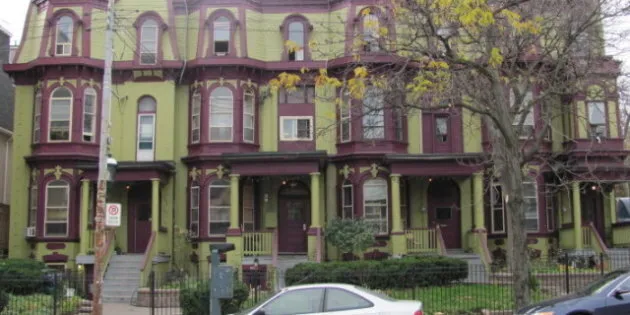
Canada Income Inequality: Toronto's Cabbagetown A Prime Example Of Shrinking Middle Class

Income Gap Canada Cabbagetown Disappearing Middle

The Huffington Post Canada   First Posted: 01/22/2012 9:32 am Updated: 01/22/2012 9:48 am

This feature was produced by Daniela Costa, a student in Ryerson University's School of Journalism, in partnership with The Huffington Post Canada.

In 2003, $350,000 bought Toronto resident Steven de Blois and his wife a house in the city’s colourful Cabbagetown neighbourhood. Eight years and two children later, the couple was looking to buy again. They settled on purchasing another home in the same neighbourhood -- this time for just under $1 million.

“We didn’t really see ourselves moving out. I saw myself in that [first] house forever,” 36-year-old de Blois says. “But there was an opportunity and we jumped on it.”

With the world economy in a state of flux, de Blois admits it perhaps wasn’t the most advisable option.
“I don’t enjoy taking on more debt,” he says. “You never know what tomorrow holds, but today my money is on Cabbagetown.”

For de Blois, a product manager for online and mobile channels married to a real estate agent, those million-dollar figures may not be too daunting when it comes to buying a stately Victorian home. But the numbers reflect a new reality in Toronto, as well as elsewhere throughout the Western world: The disappearance of the middle class.

Cabbagetown, once an eclectic mix of rich, poor and everything in between, is losing its middle class, and an ever-larger proportion of its population hails from either the top of the income ladder, or the bottom. It’s a phenomenon that is repeating across the city of Toronto -- and around the Western world, the seemingly inevitable result of a growing income gap.

The mixed-income neighbourhoods that used to define Toronto are disappearing. Two-thirds of the city’s residents were in the middle-income bracket in 1970, compared to about one-third in 2000. According to one study, there will likely be more neighbourhoods with very high incomes than those in the middle by 2020.

Cabbagetown is one of the clearest examples of shrinking middle-class neighbourhoods in the city.
According to real estate agent Daniel Bloch, homes in the area now sell in a range between $750,000 and $1.4 million -- twice to four times the national average.

Yet Cabbagetown is not twice to four times as wealthy as the country as a whole.

In 2005, median household income in Toronto was $52,833. The median income by private household was $54,654 in Cabbagetown-South St. James Town -- nearly the same as the city as a whole.

However, of the 6,050 households in the neighbourhood, the largest group of households -- 1,325 or 22 per cent -- had incomes above $100,000. The second-largest group -- 830 or 17 per cent -- had incomes of $10,000 to $19,999. Of these households, slightly more than half made less than the city’s median income.

These numbers -- showing plenty of high-income earners, even more low-income earners and little in between -- suggest that Cabbagetown’s middle-class past is far behind it.

Carlton St. in Toronto's Cabbagetown, looking east to Parliament St. Tibor Kolley/The Globe and Mail

“The question of affordability has long been rendered moot because these houses aren’t affordable,” says Amy Lavender Harris, a geography teacher at York University. “How do you pay for a $700,000 house on a $50,000 income?”

Admittedly, the large differences in earnings and demographics are part of what make Cabbagetown the colourful neighbourhood that it is.

Cabbagetown’s residents often say they enjoy the mix of new and old the area offers. The neighbourhood boasts the largest continuous area of preserved Victorian housing in North America.

As a result, preservation work is a constant in Cabbagetown life.

“Obviously keeping the ambience of the neighbourhood as we see it today brings potential buyers into the neighbourhood, which helps the prices of homes stay as they are,” says David Pretlove, chair of the Cabbagetown Preservation Association.

The current trend in Cabbagetown can be traced back to the 1970s, when the area was a less-than-desirable part of town. Entrepreneurs began buying properties inexpensively and fixed them up, beginning a long process of gentrification.

At this point, Cabbagetown’s official boundaries were altered, leaving out a housing project on its southern borders -- a move some urban development experts say was a blatant attempt at social exclusion.

“When what we now know as Cabbagetown gentrified, there was a desire to separate itself from the housing project to the south,” Harris says. “Over a period of time the whole area south of Gerrard [Street] was actually erased from history as ever having been associated with Cabbagetown.”

In 2004, a large area of Cabbagetown was declared a heritage district. Heritage conservation designation means that when a property owner applies for a building permit, a secondary review with a focus on the streetscape of the building is required.

“It’s [a sort of] stature. I know homeowners take huge pride in that,” says Bloch. “It definitely does help the value.”

While heritage conservation is a positive undertaking at its core, the motivations behind it, at least in the case of Cabbagetown, are questionable.

“Neighbourhood preservation ... has become a problem because property values are basically the chief consideration that individual property owners make in deciding to go along with a proposal for heritage conservation. ‘Will it increase my property value?’" Harris says.

Cabbagetown is hardly an anomaly, and what’s happening there is telling of dissipating middle class communities throughout the Western world, Pretlove says.

“It plays out in a neighbourhood like this too," he says. "There were those in the middle who were able to aspire up in the last 40 to 50 years but it’s perhaps going to be a little more difficult for the new generation.”

Yet it may be too early to declare the demise of Toronto's middle class neighbourhoods. Just as Cabbagetown gentrified and eventually became an affluent neighbourhood, low-income areas may become home to middle-income residents as they redevelop.

Regent Park, the low-income neighbourhood cut out of Cabbagetown in the 1970s, is currently going through its own redevelopment. As the area dismantles, it will give way to dynamic change in that part of the city. The rebuilt Regent Park will include about 2,000 subsidized housing units and close to 3,000 condo units.

“The whole idea is to mix up the income levels,” says Pretlove. “Mix up the income levels and people can work it out and hopefully it will help rise up a certain sector of society.”

Such economic diversity should mean positive change for Regent Park and surrounding communities, including Cabbagetown.

“Would I want to live in a more homogeneous area? No, I don’t think so,” says de Blois. “I’m sure I’d be happy in other parts of the city but this is what is home now.”

De Blois and others like him have the good fortune of being able to pick and choose where in the city they would like to live. But as Cabbagetown shows, that freedom is becoming a luxury fewer and fewer can afford.

WHICH CANADIAN CITIES ARE SEEING THE GREATEST GHETTOIZATION?

Percentages represent the difference that the income gap has grown between the richest and poorest neighbourhoods in Canada's largest metropolitan areas. The numbers indicate the degree to which residents of those cities are segregating themselves economically.

Loading Slideshow...
  • 8: Quebec City -- 22 per cent

  • 8: Quebec City -- 22 per cent

    With a 22 per cent increase in the gap between its richest and poorest neighbourhoods, Quebec City has seen the smallest growth in neighbourhood inequality. However, the city also saw the largest proportion of neighbourhoods in decline. The numbers suggest some six in 10 neighbourhoods saw their income decline from 1980 to 2005.

  • 7: Winnipeg -- 31.5 per cent

  • 7: Winnipeg -- 31.5 per cent

    Winnipeg saw a 31.5 per cent increase in the gap between its richest and poorest neighbourhoods from 1980 to 2005, with its poorest neighbourhoods suffering a 7.6 per cent decline, while its wealthiest 10 per cent of neighbourhoods saw income grow 24 per cent.

  • 6: Montreal -- 34 per cent

  • 6: Montreal -- 34 per cent

    Montreal saw a 34 per cent increase in the gap between its richest and poorest neighbourhoods from 1980 to 2005, with its poorest neighbourhoods suffering a 10 per cent decline, while its wealthiest 10 per cent of neighbourhoods saw income grow 24 per cent. <em>Correction: An earlier version of this text misidentified Montreal as Winnipeg.</em>

  • 5: Vancouver -- 36.5 per cent

  • 5: Vancouver -- 36.5 per cent

    Vancouver saw a 36.5 per cent increase in the gap between its richest and poorest neighbourhoods from 1980 to 2005, with its poorest neighbourhoods suffering a 10.5 per cent decline, while its wealthiest 10 per cent of neighbourhoods saw income grow 26 per cent.

  • 4: Ottawa -- 37 per cent

  • 4: Ottawa -- 37 per cent

    Ottawa saw a 37 per cent increase in the gap between its richest and poorest neighbourhoods from 1980 to 2005, with its poorest neighbourhoods growing 1.3 per cent in income, while its wealthiest 10 per cent of neighbourhoods saw income grow nearly 36 per cent. Ottawa is unique in that none of its neighbourhood deciles suffered an income decline during the period.

  • 3: Edmonton -- 39 per cent

  • 3: Edmonton -- 39 per cent

    Edmonton saw a 39 per cent increase in the gap between its richest and poorest neighbourhoods from 1980 to 2005, with its poorest neighbourhoods suffering a 7.8 per cent decline, while its wealthiest 10 per cent of neighbourhoods saw income grow 31.5 per cent.

  • 2: Toronto -- 68 per cent

  • 2: Toronto -- 68 per cent

    Toronto saw a 68 per cent increase in the gap between its richest and poorest neighbourhoods from 1980 to 2005, with its poorest neighbourhoods suffering a 5.5 per cent decline, while its wealthiest 10 per cent of neighbourhoods saw income grow 62.5 per cent.

  • 1: Calgary -- 81 per cent

  • 1: Calgary -- 81 per cent

    With an 81 per cent increase in the difference between its richest and poorest neighbourhoods, Calgary wins Canada's ghettoization crown. It's worthwhile to note that Calgary's large increases in income in the wealthiest neighbourhoods has not pulled up its poorest areas, which have seen declines in income on the same scale as low-end neighbourhoods in other Canadian cities.

FOLLOW HUFFPOST CANADA BUSINESS

This feature was produced by Daniela Costa, a student in Ryerson University's School of Journalism, in partnership with The Huffington Post Canada. In 2003, $350,000 bought Toronto resident Steven ...
 
 
  • Comments
  • 60
  • Pending Comments
  • 0
  • View FAQ
Post Comment Preview Comment
To reply to a Comment: Click "Reply" at the bottom of the comment; after being approved your comment will appear directly underneath the comment you replied to.
View All
Favorites
Recency  | 
Popularity
Page: 1 2  Next ›  Last »  (2 total)
12:14 AM on 01/24/2012
I have stayed in Cabbagetown on my 35-45 visits there from Indiana over the past 40 years. It has always been eclectic and delightful. Too bad it's out of reach for most people now. Should have bought there in 1970 when I first stayed in the area. Unfortunately Toronto has become too expensive even for extended visits with price increases, fluctuating exchange rate and GST and PST. Too bad because it's a wonderful city-vibrant, cosmopolitan, great museums and shops and markets, superb transportation. I just park my car and take public transport. The people are friendly and helpful. I can't afford to go twice a year or to stay for more than a week. Alas!
photo
GeoToronto
Nik Nak Paddy Wak, Still Ridin' Caddy-Laks
09:44 AM on 01/23/2012
The only positive about this story is the old timer Greek, Italian and Portugese immigrant seniors can get a big windfall for their old homes, regardless of the homes condition.
I grew up in the Cabbagetown area and for a senior who paid 10K-60K in the 60-70's for the home, they can cashout for close to a million. They can pick up a condo for 400K, buy a small home in the old country and bank the rest.
Not bad...
11:52 AM on 01/23/2012
I live in Hawkesbury,ON and we have seen an influx of retiring Torontonians selling their home in TO for $600K to $1M+ and buying a 3 bedroom home here for $200-$300K. They are then left with $400K-$800K in the bank. We live 1 hour from downtown Ottawa and also 1 hour from downtown Montreal which is about the time it takes to get anywhere from point A to point B in Toronto these days.
photo
HUFFPOST SUPER USER
oxjr
06:22 AM on 01/23/2012
I loved living in Cabbage town. I lucked out and found a basement apartment destroyed by the previous tenants. The landlord did not have the money to fix it up (he had bought the building not realizing how run down it was) He gave me a free month, and cheap rent and I started pumping out the elbow grease. It was large, clean, and while still run down - kinda fun. He never raised the rent and I lived in dwnt Toronto for under $650 inclusive. I lived there for 8 years and to this day it is still my favorite place I ever lived. Thank god he never figured out that just a few grand of renos and he could have charged twice the rent. Everyone in the building fixed up their own space and lived there for half of what the people in the identical building beside us paid.
12:51 AM on 01/23/2012
Thought I'd be able to buy a place in Vancouver this year, but after looking around I see that what I can afford is a ramshackle room in some aging building.

I refuse to make a weak downpayment and struggle to pay mortgage payments for anything pricier - a 600 square-foot, uninspired, one-bedroom "condo." I sure hope I don't have to pay higher taxes to cover those who do otherwise and fail, but not holding my breath.

P.S., I gross over $70 000 a year. Thank you foreign investors and stupid Canadian laws!
08:46 PM on 01/22/2012
How do you even write this article without even commenting on monstrous debt levels in Canada?
08:19 PM on 01/22/2012
The definition of middle class has shifted. $50,000 has become $75,000 to $100,000. People in that higher bracket are not the "rich" 1% you have to be over 1/4 mil annually to get there. My two cents anyway.
07:31 PM on 01/22/2012
The townhouses shown above are actually city operated rooming houses for indigent men (conveniently located right next door to a liquor store!). There are many similar properties in Cabbagetown mixed in with the Million Dollar homes. If you live in Cabbagetown you are either wealthy or very poor. Very few in between.
photo
HUFFPOST SUPER USER
gravescanada
04:52 PM on 01/22/2012
More light has to be shone on the problem of income inequality. We Canadians need to see what has already happened in the USA, the systematic destruction of the middle class and expansion of poverty and stop it here in Canada. The only way this will be accomplished is invest in technologies and industries with a shot at providing jobs that pay higher wages to the middle class. The problem of the past 20 years is that with the rich got alot richer, while the middle class wages remained stagnant as we hemorrhaged jobs to eastern countries like China and India. We were sold the lie with NAFTA that we would transition to a service economy but that never happened. What did happen was the loss of manufacturing.
This user has chosen to opt out of the Badges program
photo
06:36 PM on 01/22/2012
YOU want equality? Then read Marx and Engles you find how to get there and it equals to COMMUNISM . Many tried...............
photo
HUFFPOST SUPER USER
Rex Devious
If you don't vote, don't bitch
11:04 PM on 01/22/2012
Many tried, but no one has ever actually achieved Communism. Not that you can't call a dictatorship or whatever by some other name, but there's never been a whole country that's figured out how to have equality of possessions.

The weird thing is, the family structure *is* Communism pretty much. Everyone does what they can, and gets as much of what they need as possible. But the arrangement doesn't scale up very well at all, because very few people care as deeply about other people's families as they do their own. You'll never find a whole *country* of people like that.

That said, too much inequality is terrible. Instead of large numbers of people trying to find solutions to common problems, you have most people just struggling to stay alive; leaving only tiny numbers of people able to focus on problems like curing disease or creating technology that would improve everyone's lives - rich and poor alike. Then you wind up with a world with 7 billion solutions to how to eat on meager wages, and zero solutions to curing cancer.
photo
HUFFPOST SUPER USER
gravescanada
07:23 AM on 01/23/2012
I want a country that values its citizens. I want a country where you can form a union to negotiate with the employer. I want a country who's Captains of Industry work to make OUR nation a better place. Multinational Corporations come to Canada buy a business, milk it for every dollar they can, then pack everything up and move the business to another country. This is what has been happening to North America.
11:58 AM on 01/23/2012
The focus has to be on the working poor first. Too many jobs that used to pay half decent wages are now part-time casual and just over minimum wage. I know a lot of young people working two jobs in order to pay rent and food and try to save a little for further education; others live at home and forgo the car and other extras in order to help out with family finances.

It's not just retail jobs that have lost financial ground. Even computer techs have crappy wages because so many kids came into the job market with no idea of what their skills were worth and accepted barely over minimum wage. By the time they learn better, well, they can be laid off and replaced by a new set of naive beginners.

There has to be a living wage at the bottom or the middle class won't thrive either.

Of course the companies "can't" afford to pay front line workers more because they have to keep all those stockholders happy and/or pay exorbitant wages to keep the top "talent" in the corner offices. What the stockholders expect is based on the share price of the company, which is artificially inflated by the buying and selling of shares, which is encouraged by stockbrokers who make a commission on every deal. So the stock market system is basically sucking out all the money that should be used on employee wages and industry innovation, growth and expansion.
This user has chosen to opt out of the Badges program
photo
CanadaStan
Cogito ergo spud, I think, therefore I yam
04:24 PM on 01/22/2012
So is every HP headline going to highlight the class warfare the Demoicrats are pushing?
Will they be happy when there is blood in the streets?
photo
HUFFPOST SUPER USER
SeanMartin
Everything in moderation.
04:44 PM on 01/22/2012
We have Democrats in Canada? Wow, who woulda known..
HUFFPOST SUPER USER
Henk Bos
06:07 PM on 01/23/2012
No great revelation. The Liberal Party of Canada has been importing US style Democrat Party policy and tactics for years. The Liberals are not the political party for Canadian nationalism.
photo
HUFFPOST SUPER USER
tokenblackman
10:08 PM on 01/22/2012
This the progressive left leaning Huntington Post. If you want right wing babble go to the Daily Caller or the National Post.
12:07 PM on 01/23/2012
Why must "news" sites be segregated? We all survive together in the same city, county, state, province, whatever, but when reading news were supposed to surmize whether that news is coming from a liberal or conservative slant? AND... if leaving a comment we're meant to taylor our thoughts to their adjenda? Gimme a break!
HUFFPOST SUPER USER
Henk Bos
06:03 PM on 01/23/2012
You are absolutely right. I am on the babble threads - looking for those with any intelligence and something to offer to society as a whole. But I learned in my military days. Know your enemy !
04:08 PM on 01/22/2012
Maybe coming up with a catchier name than "Cabbagetown" is the first step in the right direction.
photo
HUFFPOST SUPER USER
SayBlade
This micro bio intentionally left blank.
11:59 PM on 01/22/2012
Names are funny like that. Every time I hear the name "Washington" it makes me think of laundry.
12:10 PM on 01/23/2012
It's Washing"ton" not Washing"town".
This user has chosen to opt out of the Badges program
12:23 AM on 01/23/2012
It used to be a poor immigrant community so the smells of boiled cabbage permeated everything.
photo
HUFFPOST SUPER USER
SayBlade
This micro bio intentionally left blank.
10:46 AM on 01/23/2012
Cabbagetown has the largest collection of Victorian era houses in North America.
11:58 AM on 01/23/2012
During the Depression, people resorted to growing cabbage in front of their homes. This is where the name comes from.
photo
HUFFPOST SUPER USER
see-ellen2001
04:04 PM on 01/22/2012
Thought that building looked familiar. I had the basement apt in the one on the left. Interesting tenants back then. Especially loved the early morning police raid...unfortunately they got the wrong apt.; it was the one on the other end. Luckily they never broke down my door but hearing voices outside your door "are they in there" "you ready" off the bedroom is quite alarming. Someone alerted them to their geographic error.
03:36 PM on 01/22/2012
I'm a bit confused. 22% are high income earners and 17% are low income earners. Who are the majority, the 61%? Are the not the middle class?
photo
turkeylurky
Just keepin it real........
03:17 PM on 01/22/2012
I guess all those "poor" people living in the Toronto making $50K per annum, who can't afford the $1M+ homes will have to do what the rest of us are doing - living in the 'burbs where good housing is still in the $200K - $300K range.
photo
HUFFPOST SUPER USER
oxjr
06:28 AM on 01/23/2012
And commute 4 hours a day? It is a total catch 22 situation. You great mid-level job is in Toronto, but it is getting harder to actual live in Toronto, so to keep your job you have to live in poverty or add hours of commuting a day.
HUFFPOST SUPER USER
coutnac
03:12 PM on 01/22/2012
STOP HUFF P. CANADA IS NOT AMERICA WE DON'T LIKE THAT REPUC. HATE !
12:13 PM on 01/23/2012
aaahhhhh, what does that mean?
photo
HUFFPOST SUPER USER
Kristopher Leang
training to take down the elite
02:02 PM on 01/22/2012
and it begins in canada too..just like we saw it in the US. good are much more expensive now, and yet minimum is unmoving.. the recent tax cut to corporations along could have paid the tuition for 5X the number of students at university we have in canada, invest the rest in healthcare, R&D. stop spending on militarization, reinves tthis, stimulate the economy, let the middle class grow back and bring back stability to our country.