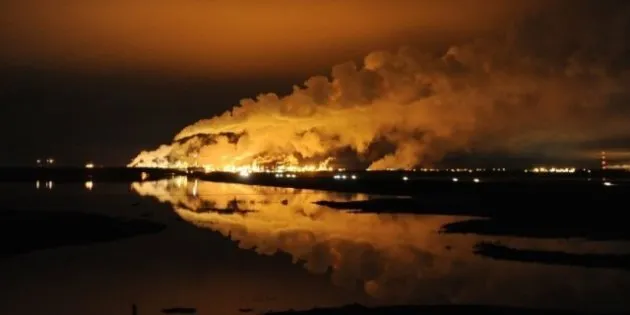
EU Oil Sands Fight: Canada 'Threatens Trade War' Over Possible Oil Sands Ban, The Guardian Reports

Oil Sands

The Huffington Post Canada   First Posted: 02/20/2012 10:16 am Updated: 02/20/2012 10:19 am

Canada is threatening a trade war with the European Union over a proposal that would effectively ban oil sands bitumen from Europe, the Guardian reported on Monday.

"Canada will not hesitate to defend its interests, including at the World Trade Organisation," Canadian envoys stated in multiple letters to European energy officials. The letters were obtained by activist group Friends of the Earth Europe under freedom of information requests.

The EU is debating whether to issue a Fuel Quality Directive that would label oil sands product 22 per cent more polluting than conventional oil, effectively banning it from being used in the 25-country area. A vote on the move is scheduled for Feb. 23.

"If the final measures single out oil sands crude in a discriminatory, arbitrary or unscientific way, or are otherwise inconsistent with the EU's international trade obligations, I want to state that Canada will explore every avenue at its disposal to defend its interests, including at the World Trade Organisation," said one letter, from Canada's ambassador to the EU, David Plunkett, to Connie Hedegaard, the EU's climate action czar.

Canadian officials reiterated the assertion that a ban on oil sands product would "unscientific" in a statement to the Guardian, an assertion the EU rejects.

"The Commission identified the most carbon-intensive sources in its science-based proposal. This way high-emission fossil fuels will be labelled and given the proper value. It is only reasonable to give high values to more polluting products than to less polluting products," Hedegaard told the Guardian.

The Guardian's revelations come as a new Canadian study has found that Alberta's oil sands have relatively little impact on carbon emissions, and that coal and natural gas pose a much larger problem.

Loading Slideshow...
  • Canada's Top Polluting Provinces

    As Canada begins the process of withdrawing from the Kyoto Protocol this year, here's a look at the country's top polluting provinces. (Mt CO2 eq refers to megatonnes of carbon dioxide equivalent, which is the standard international unit of measurement for reporting GHG emissions. It expresses all greenhouse gases emissions in terms of the global warming potential of carbon dioxide, CO2. One megatonne is equal to one million tonnes.) * Signatories to the Kyoto Protocol submit greenhouse gas emissions inventories to the United Nations Framework Convention on Climate Change annually, but the data itself lags two years behind. ** Facility-reportedemissions are those reported by large industrial facilities like fossil-fuel-powered power plants, mining An activist wears a mask depicting the face of Canadian Prime Minister, Stephen Harper, during a protest in Durban on the sidelines of the UN climate talks, on December 5, 2011. (ALEXANDER JOE/AFP/Getty Images) <em>With files from CBC</em>

  • 7. Quebec - Per capita: 10.4 tonnes CO2 equivalent

    Emissions target: 20 per cent below 1990 levels by 2020 2009* emissions: - Total: 81.7 Mt CO2 eq. - Per capita: 10.4 tonnes CO2 eq. % change from 1990: -1.9 per cent % of Canada's total emissions: 11.8 per cent (**facility-reported emissions: 8 per cent) LEGISLATION: Cap and trade -- Quebec will be the first jurisdiction in Canada to adopt a cap and trade system for reducing emissions, effective January 2012. The first year will be a transition year in which participants are to get a feel for how the system works but are not obliged to comply with the caps. Under the system, the province establishes an overall emissions objective and then sets specific caps on individual sectors based on average emissions in that sector or on a company by company basis. Emitters whose emissions are below the cap will be able to sell emissions credits to companies whose emissions exceed the cap. Quebec will be part of the same cap-and-trade system as California since both are members of the Western Climate Initiative. Some environmental groups, including the Pembina Institute, have said the auction price for emissions credits that Quebec has set --$10 per tonne in 2013 and $15 per tonne in 2020 -- is too low to motivate significant reductions in emissions and have urged the province to raise them. Carbon tax -- Quebec was the first jurisdiction in North America to introduce a carbon tax in 2007. The tax applies to about 50 fuel producers and distributors that use a large amount of hydrocarbons. The $200 million collected annually through the tax goes to fund projects that are part of the province's Climate Change Action Plan. The tax rate varies depending on the amount of carbon released during combustion: - Gasoline: 0.8 cents/litre - Diesel: 0.9 cents/litre - Propane: 0.5 cents/litre - Light heating oil: 0.96 cents/litre - Heavy heating oil: 1 cent/litre - Coke used in steel making: 1.3 cents/litre - Coal: $8/tonne Energy -- It's no accident that Quebec is one of the few provinces to have reduced its emissions from 1990 levels: 96 per cent of the province's electrical power comes from renewable sources. While hydro power is its biggest strength, it has also invested heavily in wind power and aims to develop 4,000 MW of wind-generated electricity by 2015. (Alamy)

  • 6. Ontario - Per capita: 12.6 tonnes CO2 eq.

    Emissions target: 15 per cent below 1990 levels by 2020 2009* emissions: - Total: 165 Mt CO2 eq. - Per capita: 12.6 tonnes CO2 eq. % change from 1990: -6.5 per cent % of Canada's total emissions: 23.9 per cent (**facility-reported emissions: 20 per cent) LEGISLATION: Energy -- The province passed the Green Energy Act in 2009, which set the course for the province's transition to cleaner sources of energy and greater energy efficiency. It came with financial incentives for the development of wind, solar and biomass power-generation projects and created the feed-in tariff program by which producers of renewable energy are paid premium rates to supply the province's power grid. The Act also includes provisions to promote energy conservation and green construction in the public sector. Coal -- The province plans to phase out all of its coal-fired electricity generation by 2014 and replace it with wind, solar and other clean-energy sources. A total of 19 units at five coal plants will be shut; eight have been closed already. In the past decade, the province has gone from relying on coal for 27 per cent of its electricity needs to seven per cent. Cap and trade -- Ontario is part of the Western Climate Initiative and has the legislation in place to implement a cap-and-trade system but has not yet done so. In the last election, the Liberals said they were still committed to setting up the system but did not say when that might happen. Fuel -- Along with the federal regulations on renewable content, Ontario has committed to reducing carbon content in transportation fuels by 10 per cent by 2020. Emissions -- In 2009, Ontarioamended its Environmental Protection Act to allow greenhouse gas emissions to be regulated and laid the groundwork for a cap-and-trade system. As of 2010, any facility emitting more than 25,000 tonnes of CO2 equivalent has to report its emissions annually, but there are no limits on these emissions as yet. (GEOFF ROBINS/AFP/Getty Images)

  • 5. B.C. - Per capita: 14.3 tonnes CO2 eq.

    Emissions target:33 per cent below 2007 levels by 2020 2009* emissions: - Total: 63.8 Mt CO2 eq. - Per capita: 14.3 tonnes CO2 eq. % change from 1990: +28.1 per cent (2 per cent below 2007 levels) % of Canada's total emissions: 9.2 per cent (**facility-reported emissions: 5 per cent) LEGISLATION: Carbon tax -- B.C. introduced a tax on fossil fuels in 2008. It started at $10/tonne and will rise by $5 a year until 2012. It is currently at $25/tonne and applies to gasoline, diesel, natural gas, heating fuel, propane and coal -- and to peat and tires when used to produce energy. Revenue raised from the tax is put toward lowering other taxes. The tax covers about 70 per cent of B.C.'s emissions. Electricity -- B.C.'s Clean Energy Act requires that 93 per cent of the province's electricity come from renewable sources and aims to make B.C. not only self-sufficient in terms of its electricity supply but also to be a net exporter of clean electricity. Some have criticized the legislation, because it reverses B.C.'s past policy of generating only enough electricity to meet the province's own needs and allows the government to exploit rivers and the environment by selling surplus power. It also mergers the generating and transmission sides of the electricity sector that past governments had taken pains to separate. This can undermine the oversight authority of the B.C. Utilities Commission, particularly its ability to reject certain hydro power projects, critics say. Coal -- B.C. has abandoned coal-fired electricity generation in favour of renewables but is still Canada's biggest exporter of coal. In 2010, it exported about 23 million tonnes. Fuel -- B.C.'s Renewable and Low Carbon Fuel Requirements Regulation has targets for reducing emissions from transportation fuels. Its overall target is to reduce the carbon intensity of fuels by 10 per cent by 2020. Carbon intensity measures the CO2 equivalent emissions of fuel per unit of energy. The regulations also stipulate that gasoline must have five per cent renewable content beginning in 2010 and diesel must have five per cent renewable content by 2012. The province is also testing a fleet of 20 fuel-cell buses that have zero tailpipe emissions. The $89.5 million federal-provincial project runs until March 2014. Public sector -- In June 2011, the province announced it had succeeding in making government operations carbon neutral, meaning that by reducing emissions and purchasing carbon offsets for reductions made in other sectors, the net contribution to the province's emissions from the public sector would be zero. Many have questioned the government's methodology in declaring itself carbon neutral, pointing out that it exempted some government-owned operations, such as BC Ferries, and didn't give credit to some institutions for reducing certain heavy-emitting activities, such as commuting. Cap and trade -- B.C. is a member of the Western Climate Initiative formed in 2007 between several U.S. states and four Canadian provinces. The members of the initiative have agreed to set a regional target for reducing greenhouse gas emissions of 15 per cent below 2005 levels by 2020, which is less ambitious than the federal target Canada and the U.S. agreed to under the Copenhagen Accord; and to establish a regional cap-and-trade program. Although B.C. has the legislation in place to implement a cap-and-trade system and had initially said it would launch the program in 2012, the Liberal government under new leader Christy Clark has not committed to carrying out the plan and is currently reviewing whether a cap-and-trade model is the best way to meet the provincial target. So far, only Quebec and California have moved forward with the cap-and-trade plan. Both are to begin a trial year of operation in 2012. Christy Clark, Premier of British Columbia, Canada, speaks during the World Economic Forum - India Economic Summit in Mumbai on November 14, 2011. (PUNIT PARANJPE/AFP/Getty Images)

  • 4. Manitoba - Per capita: 16.6 tonnes CO2 eq.

    Emissions target: none 2009* emissions: - Total: 20.3 Mt CO2 eq. - Per capita: 16.6 tonnes CO2 eq. % change from 1990: +9.6 per cent % of Canada's total emissions: 3.1 per cent (**facility-reported emissions: 1 per cent) LEGISLATION: Emissions -- Under the NDP government of Gary Doer, Manitoba passed the Climate Change and Emissions Reductions Actin 2008, which committed the government to reducing emissions to six per cent below 1990 levels by 2012. It abandoned that target this December, after Canada withdrew from the Kyoto Protocol -- although, with 2012 fast approaching and Manitoba's emissions nowhere near six per cent below 1990 levels, the move was largely moot. Carbon tax -- The provinceintroduced a small carbon tax of $10 a tonne of CO2 equivalent on coal-fired electricity generation in July 2011, but it only affects three companies that are large emitters of greenhouse gases. Cap and trade -- Manitoba is a member of the Western Climate Initiative but has not yet laid the legislative groundwork for setting up a cap-and-trade system in the province. Manitoba Legislature in Winnipeg. (<a href="http://www.flickr.com/photos/jezz/">Flickr: Jezz's Photostream</a>

  • 3. Nova Scotia - 22.3 tonnes CO2 eq.

    Emissions target: 10 per cent below 1990 levels by 2020 2009* emissions: - Total: 21 Mt CO2 eq. - per capita: 22.3 tonnes CO2 eq. % change from 1990: +10.5 per cent % of Canada's total emissions: 3 per cent (**facility-reported emissions: 4 per cent) LEGISLATION: Electricity -- Almost 90 per cent of Nova Scotia's electrical power comes from fossil fuels, mostly coal. In 2009, the province passed regulations limiting emissions in the electricity sector. It set caps on any facility emitting more than 10,000 tonnes of CO2 equivalent per year. Clean energy -- The province passed an Environmental Goals and Sustainable Prosperity Act that sets targets for reducing emissions and increasing energy efficiency and the use of renewable fuel sources. The province aims to get 25 per cent of its electricity from renewable sources by 2015. Two Canadian bagpipers play in front of the town clock in Halifax. (Tim BREAKMEIE/AFP/Getty Images)

  • 2. Alberta - Per capita: 63.6 tonnes CO2 eq.

    Emissions target: 14 per cent below 2005 levels by 2050 2009* emissions: - Total: 234 Mt CO2 eq. - Per capita: 63.6 tonnes CO2 eq. % difference from 1990: +36.7 per cent % of Canada's total emissions: 33.8 per cent (**facility-reported emissions: 47 per cent) Alberta has also expressed its target as a 50 per cent reduction in emissions intensity below 1990 levels by 2020, which according to the Pembina Institute, translates to a reduction of 60 megatonnes in annual emissions below the business-as-usual level by 2020. Emissions intensity doesn't measure emissions in absolute terms but instead factors in GDP to measure GHG as a unit of production. This means that if production increases, emissions can increase and the province can still meet its target. Alberta's 2008 climate change strategy expresses its reduction targets as a cut in annual emissions of 50 Mt by 2020 and 200 Mt by 2050, a cut of 50 per cent below business as usual level. LEGISLATION: Emissions -- Alberta was the first province to implement regulations limiting greenhouse gas emissions when in 2003 it passed the Climate Change and Emissions Management Act. That act gave the province the right to regulate emissions, require mandatory reporting of emissions from certain facilities and set an overall provincial target of reducing emissions intensity to 50 per cent of 1990 levels by 2020. In 2007, the province added the Specified Gas Emitters Regulation. Under those laws, as of March 2008, existing facilities that emit more than 100,000 tonnes of greenhouse gas per year had to cap their emissions intensity at 12 per cent below the average for 2003-2005. Facilities built from 2000 on have a three-year reprieve before they have to start reducing emissions intensity by two per cent a year for five years. Emitters can choose to pay a penalty for exceeding their targets of $15 for every tonne over their limit. The money goes into the Climate Change and Emissions Management Fund, which as of September 2011 had collected $257 million -- from about $40 million in 2008. In 2009, the province set up a Climate Change and Emissions Management Corporation to invest the fund money into "emission reduction technologies." They can also purchase credits to offset their own emissions from emitters that have already reached their reduction targets or from companies that are not subject to the regulations (i.e. those who emit less than 100,000 tonnes a year) but have voluntarily reduced emissions. Environmentalists have criticized Alberta's emissions regulations for several reasons: - Measuring emissions intensity instead of absolute emissions allows the province to keep increasing emissions. The Alberta Environmental Law Centre has said that studies have shown that the province will be able to meet its emissions intensity target of 50 per cent below 1990 levels even if absolute emissions grow by 60 to 80 per cent above 1990 levels. According to the Pembina Institute, between 1990 and 2009, Alberta's greenhouse gas emissions increased more than those of any other jurisdiction in North America. - The regulations apply only to large emitters. - The $15/tonne penalty for exceeding reduction targets is not high enough to motivate changes in behaviour. Electricity -- Small-scale producers of renewable energy can feed the provincial grid and are compensated at the retail, rather than wholesale, price for electricity. As of 2005, almost all of the electricity in government buildings comes from renewable sources like wind and biomass, but overall, renewables still make up only five per cent of the province's total generating capacity. About 45 per cent comes from coal, and 40 per cent from natural gas. Coal --About 59 per cent of the province's electricity generation is fuelled by coal. Alberta angered many environmentalists in August 2011 when it approved a new $1.7-billion coal plant at a facility near Grande Cache owned by Maxim Power. The company plans to build a 500-megawatt generating station next to its existing 150-megawatt H.R. Milner plant, which is to shut down in 2012. The Pembina Institute estimates the new plant will emit more than three million tonnes of greenhouse gases each year -- the equivalent of adding 590,000 vehicles to the road. Source: Canada's 2011 national greenhouse gas inventory submission to the UN Framework Convention on Climate Change. Aerial view of the Suncor oil sands extraction facility near the town of Fort McMurray in Alberta on October 23, 2009. (MARK RALSTON/AFP/Getty Images)

  • 1. Saskatchewan - Per capita: 71 tonnes CO2 eq.

    Emissions target: 20 per cent below 2006 levels by 2020 2009* emissions: - Total: 73.1 Mt CO2 eq. - Per capita: 71 tonnes CO2 eq. % change from 1990: +69 per cent % of Canada's total emissions: 7.3 per cent (**facility-reported emissions: 9 per cent) LEGISLATION: Emissions -- The province passed a Management and Reduction of Greenhouse Gases Act in 2010 that allows it to regulate emissions but has not yet implemented emissions limits on facilities or required them to report their greenhouse gas emissions. Regulations to that effect are expected to be introduced in 2012, with the first caps coming into force in 2013. The province plans to set a price on carbon and have facilities that exceed the caps pay into a green technology fund similar to the one that exists in Alberta. Saskatchewan's emissions have grown more than those of any other province since 1990, increasing by 69 per cent. This is largely due to the explosive growth in the province's oil and gas sector, which accounts for 37 per cent of its total emissions. Saskatchewan is Canada's second largest producer of oil after Alberta and accounts for about 20 per cent of the country's oil production. Potash mining and the expansion of coal-fired power generation have also contributed to the growth in emissions. Coal -- About 60 per cent of Saskatchewan's electricity comes from coal-fired generation. The province has no plans to phase out coal but instead aims to retrofit existing units to include carbon capture and storage technology to reduce emissions. (<a href="http://www.flickr.com/photos/justaprairieboy/">Flickr: Just a Prairie Boy's photostream</a>)

  • Canada - Per capita: 20.5 tonnes CO2 eq.

    Emissions target: 17 per cent below 2005 levels by 2020 This is the target Canada agreed to under the 2009 Copenhagen Accord, which laid out the broad outlines of a possible agreement to replace the Kyoto Protocol once it expires in 2012. It is a smaller cut over a longer period than what Canada originally agreed to under Kyoto, which would have required Canada to reduce greenhouse gas emissions to six per cent below 1990 levels by 2012. The target mirrors the one proposed by the U.S. during the Copenhagen negotiations. After announcing on Dec. 12 that Canada will withdraw from Kyoto, Environment Minister Peter Kent said the government will stick to the Copenhagen target, even though it is not legally binding as the Kyoto target was. Canada's 2009*emissions: - Total: 690 Mt CO2 eq. - Per capita: 20.5 tonnes CO2 eq. % change from 1990: +16.9 per cent LEGISLATION: Coal -- federal emissions limits for coal-fired power plants are to come into force in July 2015. They will limit emissions to 375 tonnes of CO2 per gigawatt-hour of electricity produced per year. Emitters will be able to use carbon capture and storage to meet their emissions caps. The regulation will apply to any coal-fired unit commissioned after July 1, 2015, or at the end of its useful life -- which is the lesser of 45 years or the year 2020. Some critics say this limits the effectiveness of the law since about two-thirds of Canadian coal plants won't be subject to the regulations until 2020, and nine plants won't have to comply until 2030. Some also fear that the 2015 starting date for newly commissioned plants could prompt a rush to get new coal plants online before then to avoid being subject to the regulations. Indeed, one example of this already happened in Alberta, where Maxim Power received approval in August 2011 to build a new coal plant that won't have to comply with the emissions caps. Canada has 51 coal-burning electricity plants, which account for 13 per cent of the country's greenhouse gas emissions; 33 of the plants will be at the end of their life by 2025. Fuel -- In 2010, the government passed a regulation requiring an average of five per cent renewable content in gasoline and an annual average of two per cent in diesel fuel and heating oil. It adopted fuel emissionsstandards for passenger cars and light trucks for model years 2011-2016 that mirror those introduced in the U.S. Cars and light trucks account for 12 per cent of Canada's overall greenhouse gas emissions (and 43 per cent of transportation emissions). The transportation sector as a whole accounts for 27 per cent of overall emissions. Parliament Hill is blanketed in snow 18 December 2007 in Ottawa, Canada, (MICHEL COMTE/AFP/Getty Images)

FOLLOW HUFFPOST CANADA BUSINESS

Canada is threatening a trade war with the European Union over a proposal that would effectively ban oil sands bitumen from Europe, the Guardian reported on Monday. "Canada will not hesitate to def...
 
 
  • Comments
  • 215
  • Pending Comments
  • 0
  • View FAQ
Post Comment Preview Comment
To reply to a Comment: Click "Reply" at the bottom of the comment; after being approved your comment will appear directly underneath the comment you replied to.
View All
Favorites
Recency  | 
Popularity
Page: 1 2 3 4 5  Next ›  Last »  (5 total)
photo
Liz Wilson 2
“a small group can change the world
03:08 PM on 03/06/2012
I suspect that Alberta would be the province least impacted by a trade war with EU
photo
Jay from Ottawa
sovereignty sale, 1.3T OBO
02:51 PM on 02/21/2012
Europe survived when the USA engaged in a 'trade war with Europe' over American GMOs, I'm betting they can survive whatever Canada can dish out.

I don't want other countries coming to Canada and dictating who's resources we should and shouldn't buy ... If they don't want oilsands, that's fine. Ontario and Quebec are still buying foreing oil, so why bother shipping it abroad when you have provinces that need it ? Also, if eastern provinces are going to buy oil, why not buy Canadian oil and keep the money in Canada ?
HUFFPOST SUPER USER
Ansdlmol
07:55 PM on 02/21/2012
I agree 100% and as a rider the people of Canada should stop buying EU automobiles for a year. There are plenty of excellent cars made elsewhere and that would point out to the EU just how intertwinned we are and how they need us as much as we need them, maybe more so.
HUFFPOST SUPER USER
sgillhoolley
Occupy the discussion.
10:05 AM on 02/21/2012
I think we need to get over it. Even the Americans don't want our dirty oil. Most people realize that we are destroying the planet, so they want to actually do the right thing, not pursue the worst thing. Canada should be ashamed that our government continues to push this filth. We have become that which we used to mock only a few decades ago. We think we are great lovers of the natural world, yet we are one of the worst when it comes to pollution. It is time to start caring about our planet again.
10:54 AM on 02/21/2012
Another coal lover.

*sigh*
photo
Jay from Ottawa
sovereignty sale, 1.3T OBO
02:47 PM on 02/21/2012
I seriously doubt that someone concerned with oilsand pollution would support coal. Everyone has their reasons.

I don't support either of the two proposed pipelines, and that's simply because I want to see Canadians working in Canadian refineries refining Canadian crude, and since eastern Canada buys foreign oil, I'd rather see Albertas oil sent to the east rather than to the south (USA) or west (China).

Also, if eastern Canada is buying foreign oil, why even bother talking about Europe ? Shipping it to Europe means sending it eastwards, and if it's going to go eastwards, why not have Ontario and Quebec buy it instead of shipping it across the Atlantic ?
photo
laymancanuck
IGNORANCE has used up its quota of TOLERANCE
12:15 PM on 02/21/2012
You live with a lack of awareness of how dependent the Canadian economy is on this resource. This is one of the biggest projects on the planet and all Canadian benefit from it's development. We all feel shame but the same people who shame us are not standing on moral high ground either.
HUFFPOST SUPER USER
sgillhoolley
Occupy the discussion.
02:17 PM on 02/21/2012
It is a disgusting environmental disaster-waiting-to-happen and is a blight on the Canadian reputation. We should be ashamed for even considering it. If our economy depends on a finite resource that is running out quickly, we are in deep trouble.
12:03 AM on 02/22/2012
I'm one of the people who is ashamed of the oil sands. And I stand on the moral high ground of thinking it is not money Canada needs. It is ethics.
photo
psandysdad
The older you get, the more excuses you have.
09:04 AM on 02/21/2012
I love it when Canada gets assertive.

They can just sell us here in the USA all the energy from the tar sands. We'll surely gobble it up. We're gluttons that way, as the whole world knows. My personal carbon footprint is probably obscene.

I'd love to say, as a country, that we're sorry you're going to devastate the ecology of Alberta to feed the hunger, but you know it isn't sincere. As long as my lights turn on with the flick of a switch, I'm good.

(It's Satire! Don't be annoyed!)
07:20 AM on 02/21/2012
it takes 4 barrels of water to process a barrel of tar sand -------

the plan is to ramp up production to 4 to 6 million barrels per day

where is the 20 million barrels of WATER PER DAY going to come from
07:48 AM on 02/21/2012
and where do you put it afterwards
photo
HUFFPOST SUPER USER
tooldude
09:19 AM on 02/21/2012
and why are you using 20 year old, outdated information?
12:27 PM on 02/21/2012
After it's cleaned, anywhere you want it!
HUFFPOST SUPER USER
sgillhoolley
Occupy the discussion.
10:07 AM on 02/21/2012
Canada has LOTS of fresh water. Probably more than any other country on the planet. That does not mean we should waste it to extract this nasty stuff from the earth, but we do have quite a bit. Of course water is worth more than oil, but people don't seem to realize that. And not only does it require a great deall of water to extract the oil, but it requires a great deal of energy to extract it...more than we get from what I hear.
photo
HUFFPOST SUPER USER
John D Rachel
Expat living in Japan writing a new novel.
06:39 AM on 02/21/2012
If this type of oil extraction is indeed so polluting and promoting it is irresponsible, it is hardly a move to "single out oil sands crude in a discriminatory, arbitrary or unscientific way." In fact, someone has to draw the line somewhere on these environmentally-sensitive issues. Regardless of the impact on the economy of Canada, the EU should be applauded.
HUFFPOST SUPER USER
sgillhoolley
Occupy the discussion.
10:10 AM on 02/21/2012
I agree. I used to live in Japan as well (Tomobe, in Ibaraki prefecture, near Mito). How are you liking it there?
photo
HUFFPOST SUPER USER
John D Rachel
Expat living in Japan writing a new novel.
05:58 PM on 02/21/2012
I love living in Japan. I live in a small, rural village not far from Osaka, Kyoto and Kobe. When I need the city life, it is easily accessible. My town is a very traditional setting with many festivals and fascinating cultural events. Most important for me as a writer is that it is quiet. The loudest thing there is the ringing of the temple bells three times a day. It is like living in a fairy tale.
HUFFPOST SUPER USER
Ansdlmol
08:09 PM on 02/21/2012
For EU think France. The French have always been a petty people and they have never forgotten that they took a drubbing at the hands of the English Canadians at Quebec thus robbing them of what they still see as their share of the spoils. If you want to see real pollution travel to Poland, Hungaria, Romania, all of which make Canada look pristine.
06:02 AM on 02/21/2012
nationalize the oil industry ..only way for canada to reek these profits
HUFFPOST SUPER USER
Skookum1
truth can't be bought, but lies sure can be sold..
09:17 AM on 02/21/2012
I think you mean "reap", but "reek" works just fine...
12:47 AM on 02/21/2012
There is nothing surprising here. Canada and the US regularly take each other to the WTO to settle trade disputes. The EU action is largely symbolic, in any case , since little or no Canadian oilsands production will ever be sold in Europe.
11:50 PM on 02/20/2012
stick to it Canada, with the Iranians not selling fuel to Britian and France the fuel price should hit 6$ per gal by Easter here in the US. When they come to you begging for your oil then tell them you dont feel comfortable selling oil to them when it compromises THIER morals and then sell it to China for a bundle--------where do i buy the stock?
HUFFPOST SUPER USER
sgillhoolley
Occupy the discussion.
10:11 AM on 02/21/2012
At any stock exchange that sells life for cash.
HUFFPOST SUPER USER
Ansdlmol
08:13 PM on 02/21/2012
You are ill informed. Gas prices in both the UK and France have been north of $10/gallon or years. They compenste by driving less and driving cars that get 75+miles/gallon.
HUFFPOST SUPER USER
yishai ettebe
11:40 PM on 02/20/2012
This will be enjoyable to watch.
11:14 PM on 02/20/2012
God Bless Canada Stick to your guns
HUFFPOST SUPER USER
Skookum1
truth can't be bought, but lies sure can be sold..
10:51 PM on 02/20/2012
http://thetyee.ca/News/2012/02/18/Sinopec/index.html

Had followed this link from another post somewhere below, the last paragraph burned holes in my eyeballs:
---------------

"In one celebrated case, a bribery scandal involving the company's former chairman Chen Tonghai put a spotlight on the extreme level of corruption in China's powerful state-owned companies.

In 2010, Beijing No. 2 Intermediate People's Court convicted Chen, former chairman of Asia's largest oil refiner, for taking $29-million yuan in bribes (US$4 million) between 1999 and 2007. Chen allegedly helped individuals "seeking illegal interests." The verdict did not name the bribers.

According to the China Times, the Sinopec chairman confessed to his crimes and received a suspended death sentence. Sinopec did not comment on the case at the time but later urged Beijing to crack down on "corrupt" foreign business practices. "

-------------

Now, gee, who could that be.....??

"corrupt foreign business practices" pretty much means "corruption with foreigners", instead of the usual run-of-the-mill domestic corruption (a lot of it - most of it? - party related or military related, or both). It's not like there's such business practices in China's corporate life, I mean; it's just that because this one involved foreigners....not that Sinopec hasn't greased corporate and government and media people in Canada with meals, largesse etc - it can't NOT have happened; it's "business as usual" in the resource economies, how things are done.....
photo
Add In Canadia
Egotism is a weakness
09:55 PM on 02/20/2012
From the USA to Europe, it seems that the world really wants Canada to sell it's oil to China... you know despite Canada being a more ideologically aligned nation with them. A bit head-scratching that they'd rather continue to get their oil from the relatively unstable middle east.
HUFFPOST SUPER USER
Skookum1
truth can't be bought, but lies sure can be sold..
10:20 PM on 02/20/2012
They'll take anything they get.

The increasing Chinese economic stake in Canada, to me, is reminiscent of the way Britain sloughed off Canada as a way of paying the US back for saving their skins; with an increased stake - and not-quite-control - ownership of Canadian resources is a geopolitical payback between Washington and Beijing; it may yet cause tension of Canada becomes too much China's fool in what's going on; the bizarre unholy alliance of Maoists and Tories ... their authoritarian natures finding common ground and, it would seem, the Tories picking up Chinese political/media tactics. Yielding ground in North America to Chinese interests is a stop-gap measure by the US and it's all they can do because of their debt, we're just an asset to be tossed around and traded upon, not a real country. Our government structure is still colonialist, so is the mentality of the entrenched resource elites who control our current government. We were Britain's, we were increasingly becoming the US', now we're becoming China's (what happened to the Monroe Doctrine anyway?)....one day we may be somebody else's, too, if all the world's resources are not consumed by the time China's rising star starts to fall, or fail....as will we all in the process....
09:27 PM on 02/20/2012
I say sell the oil to China and get back some of our money from the crap we buy from there.
07:22 AM on 02/21/2012
the key word is "some" ---and it is a prescription for going broke ---look at the china /us situation
photo
Mastiff
Via ovicipitum dura est.
01:44 PM on 03/06/2012
We currently have a $31 billion dollar trade deficit with China. Shipping oil to China would cover $18 billion. It may only be "some" but it's still significant.
08:53 PM on 02/20/2012
Who needs Europe?

As soon as Germany sputters, the whole continent will fall like a house of cards.
HUFFPOST SUPER USER
sgillhoolley
Occupy the discussion.
10:13 AM on 02/21/2012
Yeah, they aren't the economic powerhouses that we are...ROFL!!!! Just waiting for the next shoe to drop.