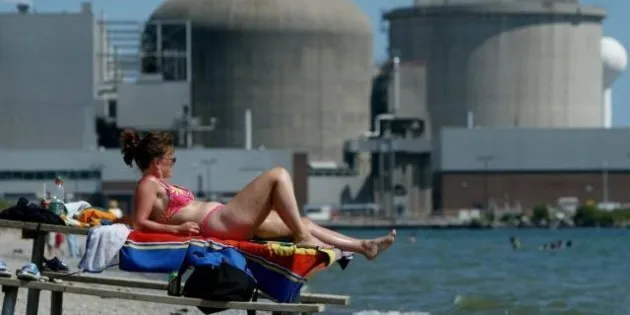
Japan Earthquake Anniversary: Canada's Nuclear Industry Stands Pat In Fukushima's Wake

Fukushima Anniversary Canada

First Posted: 03/ 9/2012 4:57 am Updated: 03/ 9/2012 6:56 am

Canadian nuclear industry officials are lining up to espouse the strength — and safety — of a sector rattled by the political fallout of last year's Fukushima disaster.

“While other jurisdictions may be scaling back their nuclear energy commitment because of Fukushima, we are not,” Tom Mitchell, the president of Ontario Power Generation (OPG), the province’s electricity generator, told an industry gathering in late February.

“But neither are we ignoring the lessons that event is teaching us,” he said.

The sentiment, echoed by many of Miller’s colleagues in recent weeks, reflects Canada’s commitment to stay the course with nuclear power in the wake of the worst nuclear disaster since Chernobyl.

While the series of meltdowns that followed an earthquake and tsunami at Japan’s Fukushima Daiichi nuclear facility last March prompted countries like Italy, Switzerland and Germany to rethink their nuclear strategies, this was never seriously contemplated in Canada.

Even as demand and public support for nuclear waned in the aftermath of the disaster, nuclear industry officials and regulators have focused on shoring up existing reactors and mounting a public relations offensive that stressed the sector’s potential for growth.

The decision may be one born of necessity: Canada’s 17 operational reactors generated 15 per cent of the country’s power supply in 2010, and that piece of the energy pie is expected to grow as provinces like Ontario seek to replace coal generation with a mix of nuclear and renewable sources.

As Canadian Nuclear Association president and CEO Denise Carpenter explains, efforts to move to clean energy sources have in large part meant relying on nuclear.

“We didn’t have big hydro, and Ontario has made the commitment to stay off coal,” she said.

A month after the disaster, regulators began what they say has been a thorough investigation of Canada’s nuclear power stations.

“We concluded the stations are robust. We concluded that the emergency measures in place are adequate to protect the public but we haven’t sat on our laurels,” said Phil Webster, a nuclear industry regulator and one of the principal leads of the Canadian Nuclear Safety Commission (CNSC)’s Fukushima Task Force.

The task force released a summary of its actions earlier this month, including a list of new regulations that have been imposed on nuclear power plant operators — among them an order to beef up each layer of defence to keep radioactive products and combustible gases contained in the event of a serious accident.

According to Webster, Fukushima didn’t prompt any new measures that hadn’t already been contemplated, it just fast-tracked the improvements already in the works.

“Whatever happens to the station there is a back-up system, and then a further back-up and now a further back-up, [so that] you don’t get into the kind of multi-unit accident that Fukushima suffered,” he said.

READ MORE ON HOW U.S. REGULATORS RESPONDED

The CNSC also looked at its own regulations and the stations’ emergency response procedures. It found room for improvement in the way plants engaged with their provincial emergency preparedness offices, as well as with two federal agencies, Public Safety and Health Canada.

Josée Picard, a spokeswoman for Public Safety, said her department is currently working with Health Canada to ensure their two separate emergency response plans are aligned.

Officials from Canada’s nuclear industry have also been involved in safety reviews on the international level — proof, said Carpenter, of the country’s commitment to remaining at the forefront of nuclear power generation.

IN PHOTOS: BEFORE & AFTER THE TSUNAMI

In October, OPG’s Mitchell was named chair of the World Association of Nuclear Operators Fukushima Response Commission, which will share lessons learned from the crisis with operators of all nuclear facilities around the world.

“For the Canadian industry to take such a leadership role was significant,” said Carpenter.

Faced with renewed public scrutiny, Canada’s nuclear industry also launched a public relations campaign, both provincially and at the national level.

As Carpenter explains, “Right from the start we moved really quickly to mobilize people in our industry to talk with Canadians to assure them of the safety of the nuclear units.”

It’s difficult, however, to gauge how effective these efforts have been.

In June, only 36 per cent of Canadians who participated in an international poll by Ipsos Reid said that they “strongly support” or “somewhat support” nuclear power — a smaller proportion than in most of the 24 countries surveyed. Meanwhile, among the nearly two-thirds of Canadians who indicated that they oppose nuclear power to produce electricity, 19 per cent said they “decided recently to oppose it because of events in Japan.”

Opposition to nuclear power was evident in Quebec last week, where Greenpeace protesters infiltrated the office of Premier Jean Charest amid a province-wide debate about refurbishing the Gentilly nuclear facility.

Quick Poll

In the wake of Japan's nuclear disaster, Canada should:

VOTE


Attention Shifts Away From Nuclear

Though Carpenter insisted in a press release in February that Canada’s nuclear industry is “as strong as ever,” others argue that this shift in public opinion — both nationally and globally — stands to take a significant toll on the industry, if it hasn’t already.

“The accident has dampened some — but not all — of the enthusiasm for a renewal in the nuclear sector, especially as an alternative to fossil-fuelled electricity,” Peter Nemetz, an economist at the University of British Columbia’s Sauder School of Business, told The Huffington Post Canada.

According to Nemetz, reassurances about improved nuclear safety and technology are "somewhat irrelevant in light of the changed public mood, which I am sure will ultimately affect any future decisions in this area.”

Tom Adams, an independent nuclear energy analyst based in Toronto, also dismisses the industry bravado, maintaining that the drop in interest in nuclear has coincided with an increase in the availability of alternatives, such as natural gas.

“You’ve got this dynamic situation where you’ve got this shift of attention away from nuclear,” he said. “So the number of jurisdictions that are seriously looking at nuclear gets smaller and smaller all the time.”

Greenpeace nuclear analyst Shawn-Patrick Stensil concurs.

“Green energies are at a point where they’re ready to step in and supplant the nuclear industry’s role in major world power’s energy systems,” he told HuffPost. “This is changing the game a lot internationally, and I don’t think we here in Canada, and especially Ontario, quite recognize that.”

Canada, which — as the world’s largest uranium producer — accounts for 22 per cent of world output, has also been affected by the declining price of the radioactive metal.

Raymond Goldie, a senior mining analyst at Salman Partners, estimates that the reactor shutdowns in Japan and Germany in the aftermath of Fukushima resulted in a “permanent, three per cent destruction of demand” for uranium worldwide, which is equivalent to losing “a year of growth in the uranium business.”

But he said future growth in demand for uranium remains unaffected by Fukushima.

“No one else has cancelled any plans for consumption for uranium, so growth will be two-and-a-half to three per cent for the next 10 years,” he said, adding that, unlike other commodities, demand for uranium “stayed steady all throughout the financial crisis.”

But Adams said major mining companies like Saskatoon-based Cameco, whose stock has lost more than a third of its value in the past year as uranium prices dropped, have yet to acknowledge how significant the implications will be.

“The company has maintained this line, right from March 12 onward, that this is a blip and it’s going to blow over,” he said. “I don’t buy it. I think Fukushima is a really big deal. It really changed a lot of things.”

In a webcast to investors in late February, Tim Gitzel, president and CEO of the Saskatoon-based firm, insisted that apart from a temporary shutdown of all but two reactors in Japan, and plans to phase out nuclear in Germany, Belgium and Switzerland, “not much has changed since Fukushima, especially with regard to the long-term outlook, which has always been the real story for nuclear.”

But despite reporting stronger-than-expected quarterly results, and growing demand from emerging economies like China and India, the company recently lowered its forecast on sales for 2012, saying that revenue could dip by five per cent due to uncertainty about the future.

— With files from Althia Raj

EARTHQUAKE ANNIVERSARY: In the last 12 months, some progress has been made in rebuilding lives, but much remains unfinished. Associated Press photographer David Guttenfelder, who chronicled the devastated towns in the aftermath of the disaster, has revisited these communities to see what has changed — and what hasn't.

Loading Slideshow...
  • In this combination photo, Tayo Kitamura, 40, kneels in the street to caress and talk to the wrapped body of her mother Kuniko Kitamura, 69, after Japanese firemen discovered the dead body in the ruins of her home in Onagawa, Japan, on March 19, 2011, top, and a newly built home sits at the site of the now-cleared but destroyed area on Wednesday, Feb. 22, 2012. (AP Photo/David Guttenfelder)

  • A few homes have been rebuilt in the year since an earthquake and tsunami roared across Japan's coastline, killing 19,000 people. But most communities remain unrecognizable, and their residents' futures uncertain. (AP Photo/David Guttenfelder)

  • The tsunami that slammed into Japan's coastline one year ago was merciless, sparing little in its path. Homes were reduced to rubble, cars tossed about like toys, and boats -- such as this one photographed in Kesennuma, Japan, on March 28, 2011 -- flung from the sea into streets and onto roofs. The ocean's fury, and the earthquake that preceded it, left around 19,000 people dead, hundreds of thousands homeless, and sparked the worst nuclear crisis the world had seen in a quarter century. (AP Photo/David Guttenfelder)

  • In this combination photo, Japanese vehicles pass through the ruins of the leveled city of Minamisanriku, Japan, on March 15, 2011, top, four days after the tsunami, and vehicles pass through the same area on Thursday, Feb. 23, 2012. (AP Photo/David Guttenfelder)

  • The earthquake and tsunami, which killed around 19,000 people, delivered one of their worst hits to the once-scenic, blue-collar fishing town of Minamisanriku, Japan, photographed here on March 15, 2011. The wall of water spared little in its path, sweeping away nearly every business and every job, and leaving more than half the town's residents dead or homeless. (AP Photo/David Guttenfelder)

  • A year after the earthquake and tsunami people across Japan and leveled this town, there are hints of progress _ the main roads are free of debris, and some temporary houses have been built. But many in Minamisanriku, and elsewhere across Japan's battered coastline, remain in a hellish state of limbo. (AP Photo/David Guttenfelder)

  • In this combination photo, a ship washed away by the tsunami sits in a destroyed residential neighborhood in Kesennuma, northeastern Japan, on March 28, 2011, top, and the same ship sits on the same spot on Thursday, Feb. 23, 2012. (AP Photo/David Guttenfelder)

  • A year after an earthquake and tsunami ravaged the country's coastline and killed around 19,000 people, many of the boats carried inland by the wall of water have been removed. But some, like this one, remain _ providing a stark reminder of nature's fearsome power. (AP Photo/David Guttenfelder File)

  • One year later, more than 3,200 people presumed killed in the earthquake and tsunami have yet to be found. They are among the 19,000 people who lost their lives on March 11, 2011. (AP Photo/David Guttenfelder)

  • In this combination photo, Japanese residents of Kesennuma, northeastern Japan, pass through a road that was cleared by bulldozer through the ruins of the city on March 17, 2011, six days after the tsunami, top, and people cross the same street on Thursday, Feb. 23, 2012. (AP Photo/David Guttenfelder)

  • In the days after the earthquake and tsunami ravaged Japan's coastal towns, the bulldozers began to arrive, clearing away the rubble that littered the roads, such as this street in Kesennuma, Japan, photographed on March 17, 2011. Those tasked with clearing away the wreckage faced a monstrous task: towering piles of twisted metal and wood, boats perched atop roofs, mountains of family heirlooms, sodden furniture and children's toys. They also faced the grim reality that many of the 19,000 people killed lay entombed in the rubble, waiting to be discovered. (AP Photo/David Guttenfelder)

  • One year after a powerful tsunami battered Japan and killed around 19,000 people, the streets have been cleared and the wreckage removed from town centers. But the process of destroying all that debris has been slow, with much of it still sitting in huge mountains in temporary holding areas. (AP Photo/David Guttenfelder)

  • Also On The Huffington Post...

    A 132-ton concrete dock from Japan has washed ashore at Oregon's Agate Beach State Park. Ripped loose from Japan during last year's tsunami, it's now drawing thousands of gawkers to the shoreline.

FOLLOW HUFFPOST CANADA BUSINESS

Canadian nuclear industry officials are lining up to espouse the strength — and safety — of a sector rattled by the political fallout of last year's Fukushima disaster. “While other jurisdic...
 
 
  • Comments
  • 97
  • Pending Comments
  • 0
  • View FAQ
Post Comment Preview Comment
To reply to a Comment: Click "Reply" at the bottom of the comment; after being approved your comment will appear directly underneath the comment you replied to.
View All
Favorites
Recency  | 
Popularity
Page: 1 2  Next ›  Last »  (2 total)
12:22 PM on 03/11/2012
The nuclear industry is known to have one of the worst cases of REGULATORY CAPTURE.

"regulatory capture occurs when a state regulatory agency created to act in the public interest instead advances the commercial or special interests that dominate the industry or sector it is charged with regulating. Regulatory capture is a form of government failure, as it can act as an encouragement for large firms to produce negative externalities."

Thus we cannot really trust anything they say and must look to external sources if we want accurate data/info.
12:18 PM on 03/11/2012
Here's a great site where you can find some of the TRUTH about how Fukushima fallout has affected Canada and lots of other great info you'll never see on the corporate controlled MSM:

http://enenews.com/category/u-s-canada/canada
12:17 PM on 03/11/2012
The worst case scenario for nuclear power is a horrific nightmare, massive solar flares knocking out the power grid and destroying much electrical equipment so that nuclear plants back up power fails.........and we have multiple meltdowns.

Massive solar flares, much larger than any we have seen recently, have happened before like in 1859, and they will happen again, it is only a question of when.

http://www.aesopinstitute.org/dire-warnings.html

This would be an ELE. Not worth the risk, sorry.
This user has chosen to opt out of the Badges program
photo
north of 60
Quando Omni Flunkus Moritati
04:38 AM on 03/11/2012
Go Amish or go Nuclear, the choice is yours.

Small scale nuclear power plants have an enviable safety record, especially in Canada and the US.

Comparing Fukushima era nuclear facilities with the small scale nuclear we can build today, is like comparing an Edsel with a VW TDI.
12:19 PM on 03/11/2012
I would choose Amish over seeing my child get cancer, always, without a doubt.
12:17 AM on 03/11/2012
Wiser and weaker.
09:13 AM on 03/10/2012
At a time When Ontario is faced with massive Deficits that will impact Schools, Hospitals and other Government Services, OPG is planning to spend >$40Billion to refurbish aging Nuclear reactors.

To make matters worse, this is apparently being done without a competitive bidding process for new Nucelar plants.
11:45 PM on 03/09/2012
The only problem with Nuclear power is that they have to be properly maintained and upgraded as long as the people controling the purse strings on an 60 year reactor are runing in a 4 or 5 year window there will always be challenges associated with nuclear facilities. They still represent the majority of Power generation and will continue to do so in the foreseeable future. The only way Green Energy works is if everyone doesn't mind paying 5 times as much as nuclear even at that they hide to true cost of Green by Mining the maintenance requirements of the grid to keep the costs associated with green down, as it is we can go green and we will conserve substaintially on power simply because all manufacturing and value add services will get the heck out of the Province. Another well thought out win win for the Liberal Government.
Genders
Love, Tolerance, Enlightenment
02:48 PM on 03/10/2012
Big business will cut corners till things breaks. Right now, the nuclear reactors are being run past design lifetimes and with the the least maintenance time in history.

Nukes supply a tiny amount of your energy. About 10%. Hydro is more than that.

http://earthtrends.wri.org/pdf_library/country_profiles/ene_cou_124.pdf

Wind is half the price of nuclear. Waste bio char bio fuels too, and Canada has plenty of that.

Cheaper energy without the waste and disasters.

That really is win win for the liberals.
03:27 PM on 03/10/2012
The actual fact is that Nuclear in Ontario represents 56.9% of the Hydro production output, where as Wind has a production foot print of 4.4% but only actually produced 2.6% in 2011 roughly a 50% efficiency. Other sources represent .8% other meaning biogas and Solar, even water turbine generation only sits at around 22.6 %. There is no way that the supposed Green energy is going to replace nuclear unless we have a major technological breakthrough. Reality Bites.
HUFFPOST SUPER USER
jazzman71
09:15 PM on 03/09/2012
A recent world wide poll voted Canadians the 2nd least liked people in the world, beat out only by the Germans. In Florida, they are the most least liked. Come on down, and bring your money--lots of it. Better yet, send your money and stay home. Thank you.
HUFFPOST SUPER USER
jazzman71
09:04 PM on 03/09/2012
I think Canada should stand pat on the 55million pounds of yellow cake (which is weapons grade uranium) it is selling to China. This sale constitutes a clear and present danger. I wonder how many Canadians know about this? At best, it is hypocrisy. In any case, it is typically devious.
photo
HUFFPOST SUPER USER
Nick Hatch
I'm So Meta Even This Acronym
02:09 PM on 03/09/2012
Proud to be Canadian. What a rational response to the Fukushima disaster and an intelligent assessment of our future needs - Go OPG!
01:54 PM on 03/09/2012
I'm continually dismayed by how crappy human beings are at assessing risk. The second you mention "nuclear" almost everyone's alarm bells go off. Few people worry about the Sun doling out skin cancer to millions every year. But nuclear, ZOMG!
Genders
Love, Tolerance, Enlightenment
03:53 PM on 03/09/2012
I am continually amazing at how easy it is to buy the public mind and convince the dupes the zero people have died from USA and Canadian nuclear power.

All you have to do is deny the millions of excess cancers.

http://foodfreedom.wordpress.com/2012/01/18/thyroidcancer-fracking-nuclear-power/ thriod cancer way up, and more near reactors too.

400k deaths http://www.llrc.org/fukushima/subtopic/fukushimariskcalc.htm The UCS analysis, released earlier this week, also estimates there will be some 50,000 excess cancers due to the accident.

http://www.euradcom.org/2011/ecrr2010.pdf 64M deaths including military, before japan.

http://fukushima-diary.com/2011/10/breaking-news-children-have-started-to-get-thyroid-disease/

http://enenews.com/usatoday-thyroid-cancer-cases-on-the-rise-say-specialists-there-is-definitely-something-going-on-i-used-to-see-4-a-year-now-it-can-be-4-a-month

Not to mention the huge costs of nuclear.

Without their 500m$ per reactor per year, in breaks, there would be no nuclear power reactors.
05:54 PM on 03/09/2012
You just demonstrated that you know zero about risk. I suppose I shouldn't be surprised, even mildly. You've entirely focused on the tragedy of an event, in isolation. You don't even bother to consider it against the context of everything else.

An accident is an event, not a risk. Risks from nuclear accidents absolutely pale in comparison to a basketful of other risks. Driving. Heart disease. Lung disease. Diabetes. These threats kill millions every year. Nope, these are all unsexy and don't cause people to freak out so you ignore them and focus on the evils of nuclear energy.

But by all means carry on and be a part of the problem.
This user has chosen to opt out of the Badges program
photo
north of 60
Quando Omni Flunkus Moritati
04:44 AM on 03/11/2012
What this rant conveniently ignores is that more radiation is spewed into the environment by a coal fired power plant than by any nuclear facility.

Most cancer is caused by toxic hydrocarbon pollution and food additives.
12:26 PM on 03/09/2012
With some estimates saying Fukushima is at least 68X worse than Chernobyl, I think it's safe to say the Nukes Industry is on its last leg. Just think of the hundreds of thousands of new cases of cancer down the line.

The world needs real leaders who will stop jerking around meaningless issues and start allocating serious budgets towards the development of real alternative energy. We don't need no stinking F-35s.

Even fuel derived from hemp would be an improvement (i.e it's still combustion, but growing the plant sucks up 5X the CO2 a tree does, so it 'cleans' after itself, so to speak.)
photo
HUFFPOST SUPER USER
Joffan
Time is an illusion. Lunchtime doubly so.
12:37 PM on 03/09/2012
"some estimates" are wrong. I think it's safe to say you're not going to read anything that shakes your prejudices, particularly your wild and unjustified cancer fears.
08:58 AM on 03/11/2012
If that were true then how come none of the Heroic 50 are sick? At least check your info before you bring it forward as having some kind of basis in the truth.
12:12 PM on 03/11/2012
Nobody knows where they are, they are probably all dead.
11:57 AM on 03/09/2012
There is more pollution in Ontario from home wood burning fireplaces than all the coal plants in Ontario combined. A better decision (also much more cost effective) would be to outlaw home fireplaces and BBQ's.
photo
Blodo
Time to build a better world
01:55 PM on 03/09/2012
BBQ's? Aren't most of them propane or natural gas now? Or is this just an unwarranted attack on my beer-butt chicken?
02:25 PM on 03/09/2012
Its the burning grease
you can imagine what kind of stuff is in that...
02:27 PM on 03/09/2012
PS, the beer butt chickem is great, just no bacon wrapped bear butt chickens :)
11:54 AM on 03/09/2012
Even Germany is smartening up has turning back on some of their Nuclear plants that they turned off. Its like giving up driving a car because you had a fender bender.

Japan will also reevaluate their situation, choice freeze and starve or use nuclear power, they have no coal or oil.
photo
HUFFPOST SUPER USER
Joffan
Time is an illusion. Lunchtime doubly so.
12:26 PM on 03/09/2012
Unfortunately not so, on Germany. They have kept closed the nuclear plants that were initially suckered into turning off for a three month evaluation period. Reports indicating otherwise were in error.

Japan shows no signs of coming to its senses and turning back on their nuclear plants. It is a total failure of leadership, and a significant backsliding on climate protection.
photo
HUFFPOST SUPER USER
Nick Hatch
I'm So Meta Even This Acronym
02:12 PM on 03/09/2012
Both those countries, former paragons of climate responsibility, have taken actions that will wipe out any gains made in reducing their CO2 footprints within a year.
11:21 AM on 03/09/2012
Fact: there are things other than Tsunamis that cause nuclear meltdowns. Unfortunately we don't usually know what they are till they happen. Do we really want to keep playing this game?
photo
HUFFPOST SUPER USER
Joffan
Time is an illusion. Lunchtime doubly so.
12:28 PM on 03/09/2012
Putting "Fact" in front of a statement you admit to having no basis for. You should definitely give up that game.