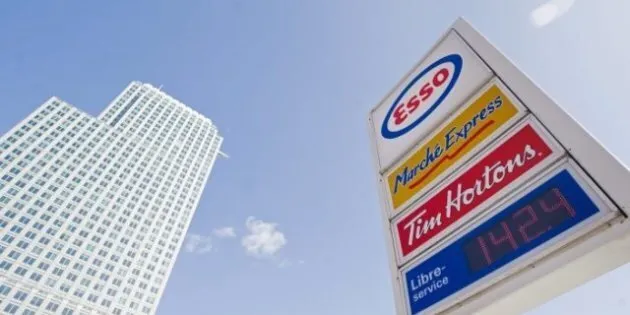
Canada Gas Prices: Pain At The Pumps Fuels Calls For Gas Boycott

Canada Gas Prices Spike

The Huffington Post Canada   First Posted: 04/ 4/2012 7:00 am Updated: 04/ 7/2012 11:25 am

Is it time to boycott gas stations?

That’s what some consumers and gas-price watchers are urging in the wake of another large gas-price jump across Canada this week.

Gas prices reached 140.1 cents per litre in Toronto and 147.9 in Montreal Wednesday morning, and rose between a penny and 4 cents per litre across the country. They are now 8 per cent higher than they were at this time last year, even though oil prices are slightly lower than they were in April of 2011.

And this week’s jump is just the beginning, say forecasters who expect to see more record-high prices at the pumps this month and next.

Gas price watcher Dan McTeague says the oil industry usually tries to explain the increase by saying it's to cover the cost of converting from winter to summer fuel.

But McTeague, a former Liberal member of Parliament and a harsh critic of the oil industry who runs the website Tomorrow's Gas Price Today, calls that a "lame and well-worn excuse."

He says fuel specifications in Canada — unlike the U.S. — don't change with the seasons.

David Detomasi, an assistant professor of international business at Queen's University in Kingston, Ont., calls the latest increases "pretty shocking." For the most part, he says, there's no reasonable explanation.

En Pro oil price analyst Roger McKnight told the National Post he expects drivers in Ontario to experience all-time high gas prices this month.

Even when we had the Katrina disaster, (Canadian and U.S.) gas prices never reached over a $1.40,” he said.

Gas prices usually rise in the spring as refineries shut down to convert from producing diesel to gasoline as the summer driving and vacation months approach. This year, however, shutdowns of four refineries in Pennsylvania and five in Europe have severely cut North American supplies, McKnight said.

A former employee of Texaco and Esso, he told the Toronto Star he thinks a boycott of gas companies would be “a great idea.”

“That’s the way to do it,” he said. “That will force them to lower their prices and everybody else will follow.”

In recent days, a chain email has been circulating urging Canadians to boycott the two largest gas retailers in the country -- Esso and Suncor-owned Petro Canada -- starting on May 1.

We need to take aggressive action to teach them that BUYERS control the marketplace, not sellers,” the email states, setting as its goal a return to one-dollar-a-litre gas.

Another boycott call, this one international, calls for drivers not to buy any gas from any retailer on April 15.

“In April 1997, there was a ‘gas out’ conducted nationwide in protest of gas prices. Gasoline prices dropped 30 cents a gallon overnight,” the boycott campaign, which is circulating online, claims in its letter.

But the website Snopes.com declares this assertion to be “false.”

“Gas-outs” have been proposed before, but have largely fizzled, Snopes argues, “because consumers not buying gasoline on one particular day doesn’t affect oil companies at all.” In order to affect gas prices, consumers would have to place sustained pressure over time on retailers, or reduce their consumption of gas overall.

McTeague's website includes these other price increase forecasts per litre in Canada compared to a year earlier:

- Ottawa: 133.7 cents (126.4).
- Winnipeg: 115.9 cents (113.9).
- Calgary: 113.9 cents (110.9).
- Vancouver: 143.2 cents (135.3).

-- With files from The Canadian Press

WHAT'S BEHIND THE PRICE OF GAS?
Loading Slideshow...
  • 1. Crude Oil Prices

    It starts with crude oil. Although Canada may produce more oil than it consumes, the country is at the mercy of global markets for the commodity. Increased Middle East instability, sparked by popular uprisings, has lead to concerns about supply. Better-than-expected economic growth, especially in developing nations such as China and India, has also increased demand. (AP Photo/Hasan Jamali)

  • 2. Refining Oil into Gas

    The next link in the supply chain is refining. In order to turn thick, black crude oil into useful products such as gasoline, diesel, heating oil and jet fuel, it must be sent through a mind-boggling array of pipes and tanks, heaters and condensers to sort the components of the substance from lightest to heaviest. This is a complex and costly process, and is paid for by what is known as the "crack spread," or refining margin. This represents the difference between prices fetched for the products produced, and the cost of crude oil inputs.. (AP File Photo)

  • 3. Transportation to Retailers

    Once the oil has been refined into gasoline, it must be transported to retail outlets across the country. This is accomplished through a network of 23 terminals - from St. John's to Nanaimo, B.C. -- forming the backbone of the distribution network. (AP Photo/Jessica Hill)

  • 4. Retail Mark-Up

    The retail mark-up averaged 7.6 cents per litre in April. This national average masks wide variation, from lows of 4.6 cents in Calgary up to highs of 25.8 cents in Whitehorse, according to Kent Marketing Services, an industry consulting group. (AP Photo/Orlin Wagner)

  • 5.Taxes at the Pump

    Emily Corbett of Mechanicville, N.Y., pump gas at a station in Mechanicville, on Wednesday, May 11, 2011. New York, Indiana, Illinois and New Hampshire are among the first states talking about temporarily suspending part or all of the state and local taxes that can add 14 cents to nearly 50 cents to a gallon of gas. (AP Photo/Mike Groll)

FOLLOW HUFFPOST CANADA BUSINESS


  • Comments
  • 215
  • Pending Comments
  • 0
  • View FAQ
Comments are closed for this entry
View All
Favorites
Recency  | 
Popularity
Page: 1 2 3 4 5  Next ›  Last »  (6 total)
This user has chosen to opt out of the Badges program
12:38 PM on 04/09/2012
They got us, and they know it. We could all opt for one of those french fry powered diesels or go back to the horse and buggy, but the days of cheap fossil fuels are gone.
02:29 PM on 04/07/2012
Why do most people complain about the price of gas when most will willingly pay 3-4 times more for a bottle of water, and it's free from the tap. Quite complaining people, suck in up it's part of car ownership.
This user has chosen to opt out of the Badges program
photo
north of 60
Quando Omni Flunkus Moritati
04:32 PM on 04/06/2012
A smart government would invest our tax dollars in more refinery capacity in Alberta, sell aviation fuel at the lowest price in the world and become an international hub and fueling stop.
Canadians could have the same low price at the pumps.

Build pipelines to export value added petroleum products, not crude.

Electing a smart government requires an intelligent population of voters.
12:14 PM on 04/06/2012
I'm no commie but if nationalizing oil and gas means I don't have to get fiscally raped every year I'm all for it, I heard Chavez got gas at 12 cents a gallon in venezuela I need some of that, hell quadruple that I'll be happy as hell lol.
This user has chosen to opt out of the Badges program
photo
north of 60
Quando Omni Flunkus Moritati
06:10 PM on 04/07/2012
Fine, then move to Venezuela if you want cheaper fuel.
06:45 PM on 04/07/2012
Is that you dick cheney?
08:00 PM on 04/05/2012
Canadians should have allowed Petro Canada to remain a Canada owned company, and should have allowed it to grow so that the foreign companies could not gouge us. But....there were those who said they would push there car for miles rather than fuel up at a Petro Canada station. If we would have retained ownership, we could have built more refineries and not be held hostage by our international friends. Alberta imports thousands of rail cars loaded with fuel each year from the US....does that makes sense??? We should be refining and exporting it, then they couldn't hold us hostage. We could charge less for our domestic fuels instead of getting hosed at the pumps. We have more oil offshore and in the oilsands than Saudia Arabia. Most major oil producers in the world subsidize their domestic fuels for their citizens. Google gas prices in Venezuala, Saudia Arab, and other middle east countries....you will be shocked to see the prices, prices we haven't seen for over decades.
This user has chosen to opt out of the Badges program
photo
north of 60
Quando Omni Flunkus Moritati
04:15 PM on 04/05/2012
"Gov't needs to provide more incentives for buying Hybrid and smaller, more fuel efficient cars."

NO - - Why should my tax dollars support specific users? If people want 'Hybrid and smaller, more fuel efficient cars' then they can buy them; interest rates have never been lower. Otherwise they can pay more to feed their gas guzzlers.
This user has chosen to opt out of the Badges program
photo
north of 60
Quando Omni Flunkus Moritati
04:11 PM on 04/05/2012
Boycotts do nothing useful. The oil companies will happily sell any fuel you don't want to a fuel-hungry world who pay more per liter than Canadians do.

Higher fuel prices are the only effective way to get wasteful people to conserve, and the government gets more taxes in the process.

It's not going to change, get used to it.
05:27 PM on 04/05/2012
Conservation will not solve the problem.

We need fuel for transportation and agriculture, but oil is a limited resource - it will run out. Conservation only serves to slightly delay the inevitable .
photo
OuterBanx North12
Now with 33% MORE caffeine!
03:05 PM on 04/05/2012
why are the prices so high? because they can, and nobody can stop them. their excuses for doing so become laughable except for the fact that they still succeed in accomplishing what they want.

a day-long boycott will mean nothing to them.
02:56 PM on 04/05/2012
Oil prices will not go down. Period.

Gov't needs to provide more incentives for buying Hybrid and smaller, more fuel efficient cars.

I drive a major gas guzzler and desperately wish I could afford a new car. I'd be ALL OVER a Hybrid!

Oil isn't the problem, our consumption of it is.
02:39 PM on 04/05/2012
There is a reliable, steady demand for oil. And a very small number of suppliers. This means inevitable profiteering - to the detriment of our economy which relies so much on oil for transportation of EVERYTHING.

Public policies need to shift towards higher taxes on gasoline, with an exemption for commercial use. These taxes must then be used to fund public transit systems. This will help in the long run. In the short term, the outrageous profiteering by speculators and oil developers will have to be curtailed. Currently it is far too free a market - and as good as a free market is, when the supply is in the hands of a virtual monopoly it does NOT work. Simple things like eliminating speculation by only allowing consumers of crude oil to bid on delivery, and taxing all profits over a certain amount (say - 8%, just to be generous?) will help curtail the abuses that the monopoly position has enabled.
photo
HUFFPOST SUPER USER
RocketPower
02:23 PM on 04/05/2012
a long term pressure strategy is, if everyone that can telecommute actually does it, that would dent demand quite a bit. How many office jobs can be done at home with internet and a VPN connection? A LOT. I'm a fly-by-wire engineer and I work from home when not in the lab so just imagine how many others can manage this with willing bosses?
photo
turkeylurky
Just keepin it real........
02:04 PM on 04/05/2012
Ummmm, if there was no rioting in the streets when when gas went up almost 200% from $.50 to $1.40 over the past few years, then why would expect a consumer uprising when it goes up another 10 - 15% to $1.60?
02:00 PM on 04/05/2012
Its pretty difficult to achieve any long term success with a boycott,because the Government is complicite in the oil industries gouging of the consumer,because their tax profit is tied to the price of the product as a percentage. There is no political will to lower prices to a realistic level. What we need to do is pressure government to change to a fixed tax on the product,say for instance 20 cents per litre to be split federally and provincially,and any increase in this tax would be tied to inflation or some other method where the people would have input. This would create a uniformity in the price nationally,however each city would have to deal with their transportation systems reliance on the public teat as well. There is no easy solution, but the bottom line is we need to put a stop to the Governments gouging first before we even have a hope of reining in the oil companies.
photo
HUFFPOST SUPER USER
tnanimation
01:58 PM on 04/05/2012
Just tell me when and I'm in!
01:33 PM on 04/05/2012
Any story published about high gasoline prices should start with the BIg Picture, which is that the planet no longer allows humans a growing supply of crude oil. There has been no increase in world oil production since 2005. Even the most conservative establishment source of production statistics, the International Energy Agency, now predicts that conventional crude oil production will never be higher than the current plateau.
03:08 PM on 04/05/2012
Absolutely correct. And what are our plans, beyond selling our oil as quickly as possible?

When oil hits $150 per barrel, synthetic fuels produced by the Fischer Tropsch process become viable. This process can be fed from either coal or biomass, but in either case F-T is also a big emitter of carbon dioxide. There simply ain't no free lunch.

Our only solution is nuclear in the form of thorium fueled liquid salt breeder reactors, and lots of 'em. Given sufficient electrical energy, hydrogen from splitting water could be used to reduce carbon dioxide to carbon monoxide and, with more hydrogen, feed the F-T process to provide us with transportation fuels, carbon neutral, for the next millennium.