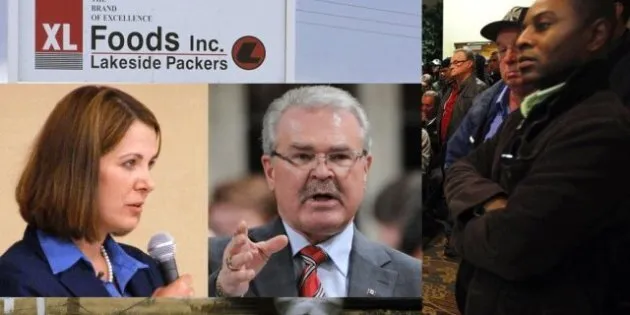
Working conditions, safety standards and greed were all cited as root causes for what became the biggest beef recall in Canadian history. Since then, millions of kilograms of meat have been discarded in dumps and more than 1,500 beef products have been recalled from across Canada, the U.S. and as far away as Hong Kong.
The resulting investigation by the Canadian Food Inspection Agency found faults that weren’t coincidental or accidental but, to a great degree, systemic. Accusations also surfaced that a lot of what was wrong at the plant may have actually been dictated, or forced through cuts or re-allotment of resources, by government officials.
STORY CONTINUES AFTER GALLERY..
Loading Slideshow
August 23
Cows are slaughtered at XL Foods Inc. plant in Brooks, Alta. Beef slaughtered that day will later be recalled.
August 24, 27, 28 & 29
Beef processed at the Brooks facility on these days is later recalled.
September 23
Canadian Food Inspection Agency (CFIA) is alerted by U.S. officials that beef from the Brooks plant has tested positive for E. coli bacteria. An investigation begins.
Septemeber 4
Four consumers who bought Kirkland Signature brand strip loin grilling steaks from Edmonton Costco at 13650 50th St. N.E. later become ill.
September 4
A Calgary girl, 4, is hospitalized for symptoms caused by E. coli bacteria.
September 11 & 12
Four in Edmonton who ate Kirkland strip loin steak seek medical for symptoms of E. coli poisoning. Two went to hospital but all four are recovering.
September 16
The CFIA issues their first warning, telling people not to eat, sell or serve 26 ground beef/ground-beef products sold at several major stores because they “may be contaminated with E. coli.” Although XL Foods Inc. voluntarily issued the recall, no reported illnesses have been linked to this recall.
September 17
55 more ground beef and ground-beef products are added to the list of products recalled across Canada. All were manufactured at the XL plant in Brooks, Alta.
September 18
Fourteen more products are added to the recall list.
September 19
XL Foods releases a statement saying XL Foods prides itself on providing safe and high quality beef products. Meanwhile, the recall list by the CFIA grows to add 75 more items.
September 20
The United States Food Safety and Inspection Service issues a public-health alert, while the CFIA adds another 37 products to the recall.
September 21
Another 47 products are added to the recall.
September 22
Another 10 products are added to the recall.
September 24
An in-depth review uncovers “several deficiencies” during an investigation into the Brooks facility.
September 25
- 60 products to the Canadian recall.
- U.S. recalls products in California, Oregon, Michigan, Nebraska, Utah, Texas, Washington and Wisconsin.
- Alberta Health Services (AHS) investigate a total of eight E. coli cases - four in Edmonton, three in Calgary and one in central Alberta. The tests confirm Edmonton patients were infected by E. coli-tainted steaks bought at Costco. The CFIA is notified about the test results.
Spetember 26
- The CFIA recalls Kirkland steaks packaged and sold September 4-7 from the Edmonton Costco.
- It is confirmed the steaks were processed by XL Foods Inc. in Brooks.
- Costco stores are asked by top doctors to stop using a meat-tenderizing machine that could potentially move E. coli bacteria from the surface of the meat to the centre.
- Ten states are now affected by the The United States Food Safety and Inspection Service recall.
September 27
AHS investigates a fourth case of E. coli in Calgary. AHS is investigating what caused E. coli poisoning in the Calgary patient and the central Alberta patient.
September 28
The Canadian Food Inspection Agency suspends the operating licence of XL Foods' Brooks plant.
September 28
The Canadian Food Inspection Agency suspends the operating licence of XL Foods' Brooks plant
September 28
There was no initial reason to order a public recall or shut down the XL Foods facility in Brooks, say officials from the Canadian Food Inspection Agency, defending their delay in alerting the public.
September 28
The Canadian Food Inspection Agency comes under fire. Alberta Premier Alison Redford and NDP MP Linda Duncan question the delay in alert.
September 28
The Canadian Cattlemen's Association says it's possible federal regulators will clear the XL Foods beef plant to resume operations by next week but the real challenge will be getting U.S. to accept beef exports from the plant again.
September 29
The beef recall expanded to Co-Op, Metro and Walmart stores in Canada.
September 30
The beef recall gets expanded to include dozens of cuts of meat.
September 30
Alberta Premier Alison Redford says Alberta beef is safe and that the province breeds a high quality product with the highest standards possible.
October 1
The Liberals and the NDP gang up on the Conservative government over the safety of Canada's meat supply.
October 2
Beef recall is expanded again. This time to include dozens of additional products including roasts and sausages.
October 2
The XL Foods beef recall gets expanded to B.C. More than 20 B.C. retail chains pull beef products from their shelves as the Canadian Food Inspection Agency continues to expand the recall from the plant.
October 2
The XL foods beef recall becomes the biggest beef recall in Canadian history.
October 4
XL Foods finally breaks silence, issuing a press release in which they took responsibility for the circumstances that led to the recalls. Not much was made available in terms of explanation or courses of action. Meanwhile, the recall is expanded yet again.
October 5
Workers at the XL plant in Brooks speak out and what they have to say is not pretty. They describe high output demands, low staffing levels of disgusting hygiene issues. Meanwhile, the CFIA says the plant failed to maintain or update it's E. coli plan.
October 5
Five new E. coli cases are linked to the tainted meat. Recall expands again.
October 8
The beef recall, the largest in Canadian history, got much bigger with meats being pulled off shelves in Hong Kong.
October 9
Federal inspectors begin a detailed assessment of the Brooks XL Foods Plant. The investigation would last weeks.
October 10
This little baby starts making its rounds...
Meanwhile, the union at the plant said it was a case of greed over health that led to the massive recall and claim the plant is nowhere near safe.
October 11
A partial reopening of the plant is considered and Alberta Premier Alison Redford rejects calls for a provincial inquiry into the recall.
October 12
The U.S. announces it will audit the Canadian Food Inspection Agency, as Quebec E. coli cases are linked to the Alberta plant and new E. coli cases are confirmed in B.C.
October 13
2,000 workers at the XL Foods plant in Brooks are temporarily laid off.
October 14
800 of the 2,000 workers temporarily laid off the day before are recalled so that CFIA can continue its investigation in the plant.
October 17
JBS USA announce they're taking over the management of the plant and reserve the option to purchase XL Foods. Earlier that day, workers at the plant were laid off again, as the recall of beef products expands yet again.
October 17
Also on the 17th, B.C. residents announce their intent to sue XL Foods over E. coli-tainted meat, as Brooks declares itself in a state of crisis due to the thousands of workers, many of them of foreign origin and of modest means, are left without income and in need of services.
October 17
JBS USA announces it intends to work with the union and the community to fix the conditions in the plant that led to the massive beef recalls.
October 19
The CFIA announces that some of the meat stored in warehouses after the recalls may end up on your dinner table once the recalls end. Meanwhile, remaining carcasses at the plant test negative for E. coli.
October 21
Tons of meant from the XL Foods plant is tossed into Alberta landfills.
October 22
Former XL Foods manager says CFIA inspectors require better training. Later that afternoon, it is announced that all workers would return to the plant on Oct. 29 for further training and to partially reopen the beleaguered plant.
October 25
JBS CEO Bill Rupp addressed the Brooks plant, the community and the media and vowed that safety at the plant would be the number one priority, adding the culture at the plant would change for the better.
October 29
Production at the XL Foods plant in Brooks resumes for the first time since E. Coli tainted meat from the plant resulted in the largest Canadian beef recall in history.
October 30
R-CALF, a U.S. ranchers lobby group, asks U.S. courts to block the possible sale of the Brools XL Foods plant to JBS USA, which is at the time managing the plant but which has reserved the option to buy the Alberta facility, as well as some U.S. plants. (Getty)
Nov. 1
Another case of E. coli is linked to the XL Foods Inc. plant in Alberta.
The Public Health Agency of Canada says the case was in Quebec, bringing the total number of confirmed cases across the country to 17.
Nov. 4
The Canadian Food Inspection Agency discloses that its staff observed a number of problems at XL Foods the previous week, as the plant worked to get back to normal operations.
They included meat areas that weren't adequately cleaned and water sanitizer that wasn't maintained at a high enough temperature.
Nov. 14
The total number of e-coli cases across the country linked to the XL Foods Brooks plant climbs to 18.
The Public Health Agency of Canada said the new case is in Alberta.
For three months, accusations were leveled against the plant’s management, owners group, staff, the CFIA, the provincial government and the feds. The crisis was personal for those affected by the bacteria but it rapidly also took on a political and economic tone, as the tainted meat scandal hurt production and international confidence in Alberta’s largest agriculture sector.
As a result of the crisis, the plant was shut down for almost two months, Canada’s biggest economic partner, the U.S., shut its door to products from the plant and international consumer of Alberta beef, such as Hong Kong, followed suit. The contamination resulted in wide-spread fear of Alberta beef, in loss of income and tax revenue, and it threw the City of Brooks into a state of economic and social crisis.
But beyond the health and economic impact generated by XL Foods’ practices at the plant, it was also the way the company handled the situation that kept pushing the meat packers front and centre in the news. The company remained mum during the entire ingestation of the crisis and when it finally broke silence, it shed little light on the situation.
But it wasn‘t just XL Foods that drew criticism as the crisis grew in scope and in severity. The provincial and federal governments – including the CFIA themselves – were criticized for either setting the stage for the health and economic disaster or for not doing enough when the full magnitude of the problems at the plant came to light.
Almost three weeks after E. coli was first confirmed at the plant, the CFIA suspended the plant’s operating license. By then, the recall contained more than 1,000 items and had expanded to nearly three dozen states.
But criticism over the crisis started to fester when the public heard the U.S. had already banned meat from the plant from entering the country back in Sept. 13 but no action had been taken to protect consumers north of the border until four days later. Later, critics demanded to know why it took more than three weeks for the government to shut down the plant, as recalls continued to expand at a frantic pace and more E. coli incidents were reported and alleged to be connected to tainted meat from the XL Foods plant.
Meanwhile, the leader of the provincial opposition and the Wildrose Party, Danielle Smith, was also criticized for being absent for most of the crisis.
If things looked grim politically and economically at the provincial and national levels, it was a lot worse at the municipal level. With 2,500 employees, Lakeside Packers is by far the biggest employer in the small, southern Alberta city of Brooks.
When the plant was shut down for investigations and waited for a clean slate from the CFIA, a large chunk of the city’s workforce was thrown into limbo, with no pay and uncertainty of if and when they would ever return to work. Conditions were made worse by the fact many of those employees are temporary foreign workers.
Even political commentator Rick Mercer weighed in the crisis, throwing some pointed jabs at the ‘Secret Society,’ that is XL Foods and at the food inspection system put in place by the feds.
The meat dump caused for the leader of the opposition a crisis of her own, when she agreed with a tweet that suggested that rather than throwing out the meat, the beef should've been used to feed the poor and homeless?
I agree. We all know thorough cooking kills E. coli. What a waste. MT @lyechtel: Is there no way to cook it so its safe and feed the hungry?
It was one of Smith’s first attempts to weigh in on the issue. But she soon found herself backpedaling, after critics condemned her for agreeing that food that wasn’t cleared for market should be fed to the less fortunate, in what became known as the ‘Tainted Tweet affair.’
The E. coli crisis claimed personal victims but also cost XL Foods directly, not only was their reputation tarnished – employees, the union and even former supervisors at the plant charged that profit and increased production outweighed food safety at the plant – but is now at the receiving end of a class action lawsuit by those who contracted the bacteria by eating tainted food from the plant.
The U.S.-based, Brazilian-owned company has come down hard on its predecessor and promises organic changes in the way the plant will be run, claiming the number one priority for the new management is food safety. JBS USA CEO Bill Rupp said he aims to restore Canadians' confidence on the plant.
Problems at the southern Alberta beef plant had obviously been brewing for a while.
By the time the lid blew off what was going on inside XL Foods’ Lakeside Packers meat plant, beef markets aroun...
Problems at the southern Alberta beef plant had obviously been brewing for a while.
By the time the lid blew off what was going on inside XL Foods’ Lakeside Packers meat plant, beef markets aroun...
Gerry Ritz and the Conservatives are dismissing a leaked memo directing meat inspectors at the XL Foods plant in Brooks to ignore contamination on beef...
Federal beef inspectors at the XL Foods plant in southern Alberta whose E. coli crisis sparked the country's largest meat recall were ordered to turn...
EDMONTON - Canada's food safety regulator says it suspended an Alberta meat packer's operating licence because the company gave wrong information about a product that...
Certainly Smith did not create the XL Food crisis nor hunger. What she did create however, is the digital political petri dish for those issues to come together to breed the perfect storm. The volatile combination of being the leader of the opposition, a nationwide food crisis, epic associated chaos in the form of millions of pounds of recalled meat and then add a deeply revealing, albeit unintentionally insensitive comment and voilà, you have the equivalent of a social media-driven bench brawl.
Next week will be the first Canadian check USDA has conducted in over three years and it comes in the middle of the Canada's biggest meat recall in history, so this portends to be a big deal. The fact that Canada has not had an audit visit in over three years immediately sent red flags up for me. It was another example of how Canada has received special treatment from USDA over the years that I believe can jeopardize the health and safety of U.S. consumers.
With that as a historical backdrop and with the massive XL Foods recalls still on everyone's minds, what are the Canadian and U.S. governments proposing? Deregulation of the border inspection system. Food safety is not an area that should be deregulated. History dictates that we should strengthen and not weaken the food safety inspection system. Trade should not trump food safety.
The Harper Conservatives are ramming another "omnibus" budget Bill (C-45) through Parliament. Coupled with "closure" to kill debate, it's all designed to be so humongous, convoluted and fast that no Parliament could possibly scrutinize the details and expose all the mistakes. (Sort of like the inspection system the Conservatives are responsible for at XL Foods -- a lot of contamination got through.)
Canada remembers a milestone this week -- the 25th anniversary of the signing of the Canada-U.S. Free Trade Agreement. Former Mulroney government officials and the business community that supported the first-of-its-kind project are running predictable victory laps in commentaries this week. Well, I'm sorry to crash this little party but there is something seriously wrong with this picture.
The management of XL Foods Inc., which has been in the news for causing the biggest beef recall in Canadian history, has not figured out the most important issue is how the company governs food safety. Neither XL foods or its parent company appear to have any independent directors, who are essential to ensuring internal management does not cut corners.
No one likes to be controlled, least of which entrepreneurial employees. However, ask yourself if defective internal controls are worth the price, in terms of reputation and financial loss. It can indeed be a run on the bank if consumers don't have confidence, and it can get worse unless governance checks are put in place.
Establishment 38 is not a lunar outpost operated by Weyland-Yutani. It is a slaughterhouse and meat processing plant in Brooks, Alberta, operated by XL Foods Inc. The CFIA (Canadian Food Inspection Agency) has suspended the operating license of Establishment 38 because of the detected presence of E. coli O157:H7. Another food recall, this one crossing almost all provincial borders, is today's sobering headline reality. While the scientists, researchers and investigators of the CFIA have E. coli O157:H7 under the microscope, Canadians have also placed Canada's food safety system on a slide and we're collectively scrutinizing how we got ourselves into such a pickle.
Our massively complex global food system involves billions of supply chain transactions daily.
The relationship with the consumer has evolved and citizens must diligently participate in the food equation in order to prevent food borne illnesses. But, do we have the skills to be active participants in a food system we interact with on multiple occasions daily?
I love beef. Burgers, steaks, roasts, tacos and even meatloaf. As an Albertan, I can proudly say I eat some of the finest beef in the entire world. My dad has been a Red Seal Chef for close to 40 years, and I'm not too shabby in a kitchen myself. So did we feel bad when we had throw out a ton of beef we bought on sale from Wal-Mart, because it might be contaminated by E.Coli? Yes we did.
Absolutely agree that this was a big story, and at so many levels. From the mistakes made to the victims who had to suffer, this story had it all.
But what this story really did, was to provide a true yet unfortunate example of the realities of the Federal right-wing Conservative Government and their ideology of: less government, less regulations, and having butt-heads for Ministers. Yes this story demonstrated the full spectrum of the Federal Conservative Government - and they did it in the back yard of Alberta (in front of all the Harper supporters)...
Yes this story really is deserving as Huff Post Canadian Story of the Year.
Livinlifenow1: Absolutely agree that this was a big story, and at
The Huffington Post Alberta | Posted: 12/24/2012 1:50 pm EST | Updated: 12/24/2012 1:50 pm EST