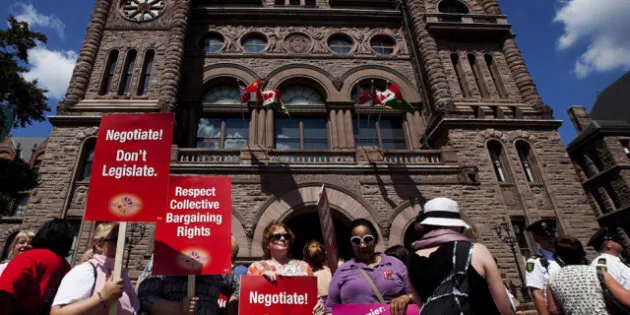
Evidence routinely demonstrates that strong education systems help build better health and social cohesion. To achieve strong school systems, one of the truisms of education now widely cited around the world is the critical importance of teachers. "The quality of a system," an influential McKinsey report noted in 2007, "cannot exceed the quality of the people in it."
What would it mean to improve the quality of teachers and teaching in Canadian schools? On this point ideas differ. One proposed solution is to improve pay and working conditions. From a very different point of view, others have advocated paying teachers based on student results, or making it easier to fire 'bad' teachers.
Both of these ideas have a kind of quick appeal, providing an easy way to address a difficult problem. But as H.L. Mencken said long ago, "For every complex problem there is a solution that is clear, simple and wrong." Much of what is being advocated in teacher policy fits that description.
The substantial international evidence on teaching quality suggests a few points to keep in mind. Teaching is a mass occupation, one of the largest in any country's labour force and involving 10 per cent or more of all university graduates. It cannot be highly selective and still produce the required numbers.
Teachers consistently report that the most powerful reward in their work is to see good outcomes for their students, or to have students tell them that their teaching made a positive difference. While pay matters (of course!), salary is not the primary reason people go into or stay in teaching.
Working conditions often matter more than pay. Many of the working conditions important to teachers are also quite consistent with research on good education policy, such as effective leadership or opportunities to learn and grow in their work.
By the way: High performing education systems tend to have strong teacher unions. There is no reason to think that strong unions are inconsistent with high quality education.
While pay for results is a seemingly attractive concept, virtually nobody in modern economies outside of sales people is currently paid based on measured outcomes as is being proposed for teachers. Other professionals may be paid on reputation or volume, but not directly on outcomes.
It is both more feasible and cheaper to help existing teachers improve their skills than it is to replace them with new people who might be better at the work. In that regard, it is helpful to focus on improving people's skills rather than improving teachers as persons. In other words, policy should focus on better teaching rather than better teachers.
Canada's 500,000 teachers already are already skilled and qualified compared to most other countries. It is hard to get into teacher education programs in Canada, and not easy, even after graduation, to get permanent employment as a teacher. We have low attrition among new teachers, meaning that people find the job satisfying. Since high attrition is expensive, low turnover is a good thing.
There are two important things we could do in addition to strengthen teaching in Canada. First, professional development for teachers continues to be a hit and miss affair that many teachers do not find valuable. Applying modern knowledge about staff development would see less focus on PD days and workshops, and much more on the integration of new learning into the daily fabric of life in schools.
Second, teaching would benefit from much stronger standards of practice, as exist in all other professions. These standards should be owned collectively by teachers, as they are by other professional groups. Based on research knowledge matched with practice experience, they would offer much more guidance to teachers than is currently given on effective ways to carry out their work.
The adoption of these two measures, which would largely be welcomed by teachers, would help Canada sustain a high quality teaching force and our current high levels of educational attainment.
Follow Ben Levin on Twitter: www.twitter.com/BenLevinOISE
The challenges in education are very complex. Your "solutions" and "analysis" are quite simply, ....wrong. Your solutions are vacuous, your analysis insipid, and your conclusions would make the Fraser Institute proud! By all means, go for it. You are a great source of mirth on this issue.
But as soon as ANY article appears in print about teaching, all the crazies come out of the woodwork. " They are overpaid and under worked". "They get all these holidays". "They are lazy and disinterested". "I know this because I met one like that once". And on it goes, ad nauseum. It is nigh on impossible to have a constructive public discussion of this subject because of all those armchair "experts" out there. We have all been to school, so we are all experts on "education".
I give you a quick example from below. I quote, "a more nuanced evaluations by the principals", is the path to better "teachers". So this writer actually believes there are Princpals out there who posses both the time and the expertise to sit in my classes and offer constructive criticism? How many Principals does this person believe, are examples of previous outstanding classroom teaching? Wouldn't have a clue. Why bother even writing, when their understanding of a simple school, is beyond their intellect?
No wonder teachers always feel they are under siege!
What does that mean exactly?
There are some bright stars out there who I feel deserve salaries of $200K or more. But there's also a lot of crappy teachers who impact students negatively, and they remain in the classroom simply because no one had the balls or the energy to fire them before they reached tenure.
If principals don't possess the skills to be excellent evaluators of teachers, then they should. They should be expected to have such evaluations.
Certain teachers should feel under siege. They don't teach our children how to read properly; they don't bother teaching any writing, spelling or grammar skills anymore. And instead of investigating why certain children are falling behind, they consult their DSMs.
There's a vast chasm between the good teachers and the bad teachers, and there are plenty of the latter. Until teachers' colleges weed out these bad teachers, have higher standards, and fix their rigid view of curriculum, then good teachers will never get the kudos and the pay they deserve.
Just talk to some high school teachers and university professors. They will tell you that elementary school teachers are, in general, failing our children, and not teaching them core skills necessary for future academic work.
Shame on you for sticking your head in the sand.
I actually taught in high schools for some thirty years and in that time worked closely with roughly a thousand teachers. "a lot of crappy teachers" is just your ignorance and prejudice showing through. Of all the people I worked with, only a handful would have met your criteria. You simply have no idea.
Principals should be "excellent evaluators of teachers". This one is a gem. It shows you have absolutely zero understanding of how many different styles and methods of teaching there are, and seem to think there is a template out there, against which we measure teaching performance. Just plain silly.
Then you prattle on about curriculum. So the teachers/colleges, are in charge of curriculum? Pathetic. Curricula are determined at the Provincial level, in consultation with local school boards. But don't let that stop you from arguing it is just another example of teacher incompetence.
All that comes across from your comments is that you have no knowledge of the topic, but feel you have to share that fact with the world. Try another subject and another day.
Beyond that, I've seen a lot of closed minded, apathetic teachers who are committed to one method of instruction and who believe that any child that can't learn under that method is learning disabled. Once so labeled, there's nothing more to be done than to just have negligible expectations of them.
I don't just blame the teachers. I blame the colleges that teach the teachers and the people who live in ivory towers who design the curriculum.
I wish these apathetic teachers could be fired; not for students' marks on standardized exams, but for a more nuanced evaluations by the principals and other school officials themselves. This would make room for the talented teachers who are committed to children succeeding. And for these teachers, they absolutely should get more pay for their better work.
We must be able to remove teachers who are under performing, something that cannot be done with the union power in Ontario.
We must fail children who are not qualified to move forward. I believe that the drop out rate is directly impacted by the attitude that no child fails. It must be very frustrating to reach grade 9 and find out you are only qualified for grade 5!
We must ensure the "basics" are being taught at every level, and stop the social engenering of our youth.
Get rid of the PD days, cut Christmas back to a one week holiday, stop taking a day off for marking grading report cards. In other words, maybe spend more time teaching!
It just seems to me that our educators are more concerned about benifits and retirement then they are the good of our children, and the childs education.
Ontario teachers are probably the highest paid in North America, yet still they strike!
We require a fundamental shift in attitude, and direction to get our education programs back on track.
When you say basics, what do you mean? Basics for whom? The artistic kid, the athletic kid, The learning disabled? The severely handicapped?
Why would you get rid of PD days? One would think that for a job as important as teaching one would build in opportunities for teachers to get better at their craft. Why cut back Christmas? Don't you think it is good for children to spend time with their families during this time of the year? Are you confusing school for daycare perhaps or teachers for parents? When would teachers calculate those marks for that last final exam or complete those report cards? Are you suggesting they pull an all nighter?
I would never come to where you work and tell you how to do your job. I probably don't know anything about your job. Why do you feel qualified to tell me how to do mine?
Full day-care in our schools, at an average of $83,000 in salaries per teacher is a crock. There are studies available that prove that there is a leveling of the field by grade three. All day child care is a boondoggle for the teachers and the unionized construction trade who get to perform the reno's.
Your points on "the basics" are "red herrings" What do you think I mean?
I would not expect a teacher to pull an all nighter to complete exams or grading, but how about from 3:30 -5, after school is out each day. Have you ever thought of, God forbid, taking the papers home to mark? Almost every person in the private sector take their work home, without getting the summer off.
PD days, you get over 2 months off a year. figure it out.
Confusing schools for day care, not at all, which is why I am totally against all day day care in our schools.
The biggest problem with the teaching industry, are the unions.
Time for private schools.
Let the tax dollars follow the student to whatever school they want to attend, The public system is proving to be an expensive failure, employing people who just want more $$, with zero regard for the kids.
A teacher called in the other day to a talk radio show in T.O. She was upset that she was losing her sick day bank. She said I earned those sick days by coming in when I felt like death warmed over.(paraphrase) No concern for the health of her students, just wanted her days off.
Teachers have earned the wrath of the parents in Ontario as well as their repution.