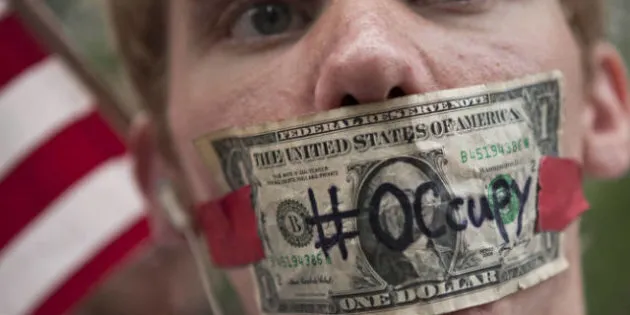
Occupy Wall Street (OWS) has finally broken out of the ivory computer towers of social media users, and spilled over into mainstream media. I say spilled over, because with the way things are currently going, there is no tsunami yet. The dam has not been broken, as the protesters would have hoped. There are several good reasons for this.
First, the media is not taking this seriously, and why should they? Frankly, the organization of OWS has been pitiful; a rally in Chicago, a rally in DC, a rally in NYC are all useless unless they can explain what it is they actually want. So far, this is not a movement; this is an emotion: anger. No political movement can survive on emotion alone. However, if this anger were harnessed and used to promote a specific agenda, OWS will undoubtedly be more successful in what it hopes to achieve.
Second, this lack of specificity has been something OWS detractors have been harping on, and they ought to. The general enemy is something called "corporate greed," a term so vague, an enemy so general, that I can almost hear Orwell groan from six feet under. But after this "greed," the protests are also aimed at topics such as fighting wars the United States shouldn't be fighting, the ravaging of our environment, and the list goes on. I suspect if one asks five protesters what they're protesting against, one will walk away with five different enemies. If Napoleon was unable to win a two-front war, Brooklynites have no chance.
In its rage to bring down the establishment, OWS seems to have forgotten that they need an establishment. And by this, I mean specific leaders, hierarchies, or at the very least, official spokespeople. This last point would prevent mainstream media outlets such as Fox News or CNN from portraying the protesters as economically-retarded trust-fund babies talking about things they have no idea about, as they wave around an iPhone. Promote the protesters who actually do know a thing or two about economics as spokespeople for OWS, and immediately, this "movement's" legitimacy will shoot up.
But so far, OWS refuses to do this; their official platforms is that there is no official platform.
Idiotic contradictions aside, they (never has this personal pronoun been so vague) claim this is an "open-source protest" in which anyone can join in. I find some humour in their terminology because after all, when was the last time one heard about Linux making any waves in market share?
Further insult can be added to the injury with the way the protests are actually getting their message across. While I find the concept of the protesters repeating the words of a sole speaker to bypass New York City's ban on sound systems an example of clever ingenuity, I cannot feel the same way about what is apparently called "UpSparkles." No it is not a level-up mechanic for a "My Little Pony" videogame, but rather, a term meaning "People lift their hands and wiggle their fingers," to quote Ms. Eve Ensler. It's a sign representing approval; effectively, the "Like" button of these social-network protests. Now, while the author of The Vagina Monologues might find this something to be lauded, I cannot help but laugh at the term, and frankly, condemn such a moronic use of the English language. "UpSparkles"? Really, Ms. Ensler? I am sorry, but this is a perfect example of why an executive from J.P. Morgan might laugh at the protesters. Certainly with the amount of out-of-work English graduates at the protests, they could put their degrees to coming up with a more serious, or meaningful term?
Now, terminology and specificity aside, there is one more thing that must be criticized about the current state of OWS. And that is aesthetics.
Saul Alinsky argues that "True revolutionaries do not flaunt their radicalism. They cut their hair, put on suits and infiltrate the system from within." With jobs being hard to come by, OWS protesters might have a hard time following Alinsky's word to the core. However, they can at the very least try not to look like homeless people. It may sound superficial, and it essentially is, but aesthetics cannot be ignored in protests.
When one goes for a job interview, it doesn't matter if at home he wears sweatpants and Bob Marley t-shirts, when he walks into the office, he wears a suit and tie; he plays according to the office's rules so he can get what he wants. If a CEO won't hire someone with no shoes on, why on earth would he ever listen to him when he's screaming outside on the street? I'm not suggesting everyone at OWS gets Brooks Brothered, but I am suggesting they break the stereotype that all protesters are sandal-footed, long-haired, bongo-loving, bong-smoking bums. Protesters must clean themselves up, or otherwise, act as mere fodder for the right-wing media cannons of Fox News, or people like P.J. O'Rourke, and not be taken seriously by the greater public. Clearly, these people do not represent everybody involved with OWS, but with the type of media coverage the protests have been receiving, there is no room for error.
Stories such as the one that appeared in the Daily Mail on Oct. 10 that speak of "opportunistic junkies and homeless people making the most of the free food on offer" and "naked youngsters happily [getting] together with just sleeping bags covering their modesty," can be avoided entirely by my generation waking up and realizing that while they may hate the establishment, they will give in. Butter them up because they will be a lot more hesitant to deal with people who have to be rushed to the hospital mid-protest because of "drinking a combination of liquor and cough syrup." This is no way to represent the angry and disenchanted and the intelligent. And stories involving protesters defecating on cars are an abomination.
Occupy Wall Street is the first time my generation, as a whole, has decided to emerge from their Facebook and Twitter accounts, and take their voices to the street. If their message is to be supported, their medium and attitudes must drastically change. This is an ideal opportunity for my generation to voice their frustrations about an economy that is cutting them down at the ankles (before some of them even have had the chance to walk in the real world). Maybe they could even have real impact. However, it is far too important a matter to be left in the hands of those who act and think with anger, rather than with sense. Promote those with knowledge to act as your leaders, keep them on the forefront of OWS and keep the "angry mobs" away from the cameras.