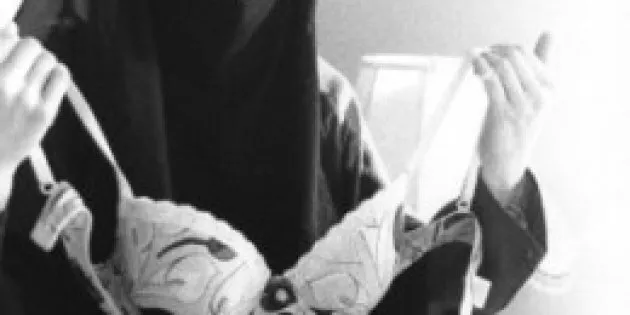
When I was asked by the Huffington Post if I wanted to write a blog post responding to "an article about a woman in Muslim dress photographed holding a bra," I thought "Really? There's an article about that?" I was told that the story had created a lot of buzz and I thought "Really?! What is the story?!" and "Will I have anything to say about it? Just because I'm a Muslim woman? Because I wear a bra? Or just because I've debated Canadian government policies banning Muslim veils?
So I did what any good researcher would do and began to investigate, analyze, reflect and try to get some answers to my questions. I turned to the article and was immediately mesmerized by Sooraya Graham's photo in question. A Muslim woman wearing a niqab holding up her bra while folding laundry. A simple photo capturing an ordinary moment garnering an extraordinary response.

I asked myself "Why?" There are as many layers to the response to that question, as there are to the photo itself.
And it looks like the conversations and controversies will continue. The cover of Foreign Policy's May/June 2012 issue is raising controversy for its photo depicting a nude woman with a niqab painted on her body, with the title "Why Do They Hate Us?" The cover story by Mona Eltahawy has generated strong responses from bloggers and commenters worldwide. Emotions are running high, particularly among the Arab women diaspora.
Their emotions and the perspectives behind them are being articulated strongly in posts such as Samia Errazzouki's "Dear Mona Eltahawy: You do not represent 'Us'" and Mona Kareem's "Why Do They Hate Us?' A Blogger's Response," and Nesrine Malik's "Do Arab men hate women? It's not that simple."Foreign Policy has responded to the controversy by asking "six smart observers to weigh in on Eltahawy's claim that many of the men of the Arab world hate women -- and the controversial cover image that accompanied it."
I am thrilled to see the debate raised to a level I have been longing for since my participation in Huffington Post Canada's first Great Debate focused on Muslim veil bans. I am even more thrilled to hear increasing voices of Arab and Muslim women around the world, expressing their perspectives on complex and hotly debated issues.
I immediately thought of Asif Rehman, a photographer I met in Ottawa last year, whose latest exhibit, "Muslims?!" captures "Canadian Muslims engaged in the ordinary and not-so-ordinary activities that are part of their daily lives." Rehman elaborates further on his website:
This exhibition illustrates that any label can only at best define a part of a person's identity, and seeks to break down stereotypes held by both Muslims and non-Muslims about what it means to be a Canadian Muslim...[It] attempts to build understanding between people by documenting the commonality of human experience.

Asif Rehman, Mombasa Boxer, PhD Candidate, 2011
I remember our engaging discussion about his exhibition just over a year ago, but I wanted to hear more from him, particularly in the context of this latest controversy. He generously agreed to share his perspectives with me.
FNM: What inspired you to create your photography exhibit?
AR: Over the years I've observed how stereotypically Muslim communities are portrayed in the media, rarely a positive image or story. I thought it was about time that Muslims took control of our own narrative. My project is one small voice along those lines.
FNM: What objectives do you hope to achieve with your exhibit?
AR: Initially I thought that it was going to provide food for thought for non-Muslims who don't know, or never interacted with Canadian Muslims to gain a better appreciation of who Canadian Muslims are, and the diversity in our communities. As the project progressed, (this is the third edition), I realized that this message is as important for Canadian Muslims to see, some of whom may have a pretty narrow idea of what it means to be Muslim.
FNM: What has been the response to your exhibit to date?
AR: People I've spoken to have been pretty positive about the work -- I think I've opened some eyes. Funny story: A former colleaque and friend of mine saw my exhibition in Ottawa last year, and commented on the photograph of Mombasa (Hijabi girl boxer and PhD student), "Well she must be the exception." Perceptions are hard to change! With photography it is hard to gauge reaction sometimes since I'm not at the gallery most of the time to see reactions. Guest book comments are positive.
FNM: Has there been any controversy over your photographs/exhibit?
AR: Surprisingly, I have not perceived any controversy. I expected some members of Muslim communities to be offended (we are so easily offended) by photographs like the one of a woman leading a mixed congregational prayer. Perhaps Ottawa is too polite. We'll see what happens in Toronto. I'm actually hoping to stir up controversy since the debate that ensues moves the yardsticks forward.
FNM: What is your perspective on the controversy over the photo of a Muslim woman holding a bra?
AR: In some ways it is a tempest in a teapot -- in other ways it is very disturbing. I think that the fact that someone had the audacity to remove the photograph because they were offended undermines freedom of expression and points to intolerance amongst certain Muslim university students. It's fine not to agree with a particular image, feel free to let people know, but you cannot be a censor. I'd like to ask the person who took the photo down, what they would think if the wearing the Hijab became near illegal as it is in France. Would they appreciate having to live under someone else's rules on appropriate dress?
With that, à vous la parole.