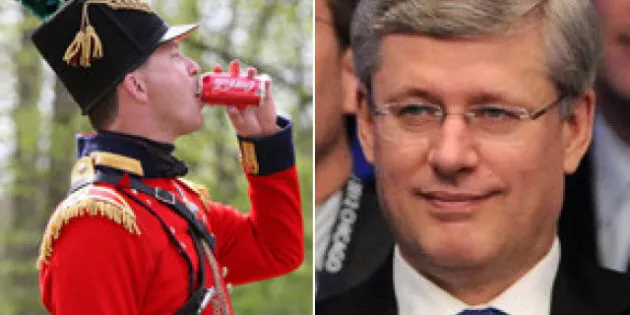
As has been widely discussed elsewhere, this year marks the bicentennial of the outbreak of the War of 1812. Although the conflict occurred before Canadian independence, it is nonetheless a critical episode in Canadian history. The repulsion of the American invasion, which Theodore Roosevelt had famously declared would be "a mere matter of marching," distinguished Canada from its newly independent neighbour to the south. In doing so, it set the stage for the development of a separate Canadian identity that would culminate in Canada's own peaceful independence half a century later.
It is right that Canadians recognize and celebrate the significance of the War of 1812.
It is also appropriate for the Canadian government to collaborate with the Americans to mark its anniversary. The war, which ended in a stalemate and a return to the status quo ante, settled once and for all the arrival of the United States to the international political stage. In addition, the end of the war marked the beginning of a positive and prosperous relationship between Canada and the United States.
Amidst the commemorations, however, it should always be borne in mind that the historic significance of the War of 1812 is provided by its complex consequences, not any simplistic essence. However one might assess the inherent valour of military action or the righteousness of monarchy, these are not by themselves what make the War of 1812 worth remembering and commemorating.
Yet it sometimes seems that these are the key soundbites the government wishes to extract from the bicentennial: that Canada was the product of military heroes, and that they fought for the Crown as well as the country.
The emphasis on military and monarchy are messages that the government is conveying elsewhere and in other ways as well, ranging from major investments in big-ticket defence equipment to the promulgation of royalty in person and portraiture.
Governments -- especially majority governments -- are certainly within their political and constitutional remit to determine which policy priorities they wish to pursue. And Canadian leaders have often sought to (re)shape the image of Canada, from William Lyon Mackenzie King's decision to wait a week before declaring Canada's participation in the Second World War to Lester Pearson's push for a new flag.
But something feels less right when our shared history is selectively co-opted to bolster a particular idea of what Canada was, is, and should be.
The War of 1812 is not the only event being commemorated this year -- it is also, for instance, the 30th anniversary of the patriation of the Canadian Constitution and the encoding of the Canadian Charter of Rights and Freedoms. Establishing Canadian control over all aspects of the Constitution was the culmination of a long process of increasing Canadian sovereignty. The Charter has formed the basis for many of the most important legal developments of the last three decades, and has been an inspiration to countries around the world struggling to establish an effective rule of law.
However, the government not only did not initiate a major celebration of this anniversary, but in fact vetoed a proposal from the civil service for such a commemoration. Conjectures about partisan motivations were given credibility as the government tried to play up Progressive Conservative Prime Minister John Diefenbaker's role in developing human rights in Canada at the same time as it played down the Charter associated with Liberal Prime Minister Pierre Trudeau. The 1960 Bill of Rights is worth commemorating, to be sure, but it should be celebrated in addition to rather than at the expense of the Charter.
Canada turns 145 years old this year. The vibrancy of Canada's democratic culture is demonstrated by the diversity of its political leadership during that time. Canada is a dynamic country with a complex history, and this dynamism and complexity are worthy of celebration.
To celebrate and commemorate only those parts -- indeed, those parts of parts -- of Canadian history that fit the talking points and policy direction of a particular government is to diminish the true greatness of the Canadian story.
"On Tuesday, Assembly of First Nations national chief Shawn Atleo presented Governor General David Johnston a silver wampum belt symbolizing the relationship between the British people and the First Nations. He stopped short of saying what we all know to be true, that the chain is almost rusted out. One of the central reasons for this breakdown is that non-aboriginal Canadians see all money and resources given to First Nations people as charity, while people in Atleo’s world see it as rent. If you’re handing out charity, you get to set conditions like submission to unelected managers. But people paying rent don’t get to interfere in their landlords’ business."
The belt shows that the Crown is linked by a chain to the First Nations peoples of this land, according to the AFN. The three links of the chain represent a covenant of friendship, good minds and the peace, and is made of silver symbolizing that the relationship will be polished from time to time to keep it from tarnishing.
Johnston gave Atleo a reproduction of a painting of the Battle of Queenston Heights, which he said depicts the co-operation of aboriginal and non-aboriginal soldiers in 1812."
http://www.huffingtonpost.ca/2012/01/24/indian-act-called-obstac_n_1228416.html
so read this & make your own decision:
http://news.nationalpost.com/2012/06/23/six-nations-aboriginal-delegation-drops-out-of-1812-ceremony/
Before the end of 1924, the Speaker of the Six Nations Council had returned to the United States, a disillusioned and discouraged man. An exile from Canada and from the nation he thought he had failed, he found refuge with Clinton Rickard in the house of the benign old chief.From their northern homes in Grand River Land, they journeyed here to see him and assure him of their loyalty. Though his disheartening experience had weakened him physically, his spirit took fire from their words and with never-ending courage, he kept up his battle.
Basic Call to Consciousness, edited by Akwesasne Notes
http://www.ratical.org/many_worlds/6Nations/BasicCtC.html
Here he repeated a passage from the Treaty of 1784, as worded by Sir Frederick Haldimand, governor-in-chief of Quebec and territories depending hereon:
“I do hereby in his Majesty’s name, authorize and permit the said Mohawk nation and such other of the Six Nations Indians as wish to settle in that quarter to take possession of and settle upon the banks of the river commonly called Ouse or Grand River…which them and their posterity are to enjoy forever.”
Many of the Haudenosaunee regarded their ally’s signing of this treaty with their enemy as a betrayal of their alliance.
Thus, the British General Frederick Haldimand responded to this by persuading his British government to give a tract of land six miles deep on both sides of the Grand River from mouth to source to the Iroquois loyal to the crown-“His majesty’s Faithful Allies.”
This awarded on October 25, 1784. This is how many Haudenosaunee people came to live along the Grand River, and partly how the Six Nations Reservation came to be.
Many traditional structures were threatened among people of the Six Nations with the allotment of reservation lands in 1840s.
From 1869 onward, Canadian law required a mandate of paternal descent.
In 1924, the rule of the traditional confederacy chiefs was terminated/forcibly removed in favor of an elected municipal government on the reserve. This is currently the only governing body on the reserve recognized by the Canadian government.
In 1959, and again in 1970, the confederacy chiefs and their followers attempted to seize control of the Six Nations government, but failed. On the whole, the abolition of the matrilineal decent system of the Iroquois has caused much confusion, throwing nation and clan membership into doubt for many people unable to trace their family history back.
dropped out or pushed out..you decide..
Located in southern Ontario, approximately 25 km southwest of Hamilton, the Six Nations of the Grand River First Nation is the most populated First Nation in Canada, with a membership exceeding 22,000. Over 11,000 members live within the First Nation boundaries.
Communities belonging to the Six Nations of the Grand River include Beavers Corner, Longboat Corners, Medina Corners, Ohsweken, St. Johns, Sixty-Nine Corners, Smith Corners, Smoothtown, Sour Spring and Stoneridge, covering a land area of 184.7 sq. kilometers or 71 sq. miles.
The Nations of Mohawk (Bay of Quinte Mohawk, Lower Mohawk, Upper Mohawk and Walker Mohawk), Oneida, Onondaga (Bearfoot Onondaga and Onondaga Clear Sky), Cayuga (Lower Cayuga and Upper Cayuga), Seneca (Konadaha Seneca and Niharondasa Seneca) and Tuscarora reside within the two adjacent areas of Six Nations Reserve Number 40 and Glebe Farm Reserve Number 40B, formally known as the Six Nations of the Grand River First Nation.
Arts and Culture
The Six Nations of the Grand River First Nation continues the tradition of functioning as a highly organized community. With the emphasis on respecting language, culture and the environment, a full roster of community oriented events are organized to encourage pride and participation within the Nation.
The “Grand River Champion of Champions Pow Wow”, held annually since 1980, attracts over 400 dancers from across North America.
Original land treaty agreements were recorded by Iroquois leaders in the form of beaded “wampum” belts, some of which are still in existence today.
Source: Six Nations of the Grand River Historical Summary, Indigenous Studies Program, McMaster University
The people who are from this reserve are called the Six Nations in English, or the Iroquois in French. The Six Nations was originally made up of five powerful Indian tribes or Nations: the Mohawk, Onondaga, Seneca, Cayuga and Oneida. These five groups founded The League of Peace or Iroquois Confederacy , which governed with a council of fifty chiefs elected by female elders from each Nation.
This system of government was one of the earliest forms of democracy.
Its organizational structure was used later as the basis of the United States government and the United Nations.
In 1712, the Tuscarora Nation joined the Five Nations.
Led by Joseph Brant, some of the Six Nations people fought for the British against the Americans during the War of Independence. After the defeat of the British, they emigrated to Upper Canada, where the British Crown gave them a large area of land to replace land taken by the Americans. The original tract, recognized legally in 1784, covered an area of six miles on either side of the Grand River, from its source to its mouth, in what is now the Province of Ontario near the present towns of Fergus, Brantford and Kitchener-Waterloo.
You say that you are our Father and I am your son. We say, We will not be like Father and Son, but like Brothers. This wampum belt confirms our words. These two rows will symbolize two paths or two vessels, traveling down the same river together. One, a birch bark canoe, will be for the Indian People, their laws, their customs and their ways. The other, a ship, will be for the white people and their laws, their customs and their ways. We shall each travel the river together, side by side, but in our boat. Neither of us will make compulsory laws or interfere in the internal affairs of the other. Neither of us will try to steer the other’s vessel.
The agreement has been kept by the Iroquois to this date.
The treaty is considered by Haudenosaunee people to still be in effect.
The 1613 treaty was recorded by the Haudenosaunee in a wampum belt known as the Two Row Wampum. The pattern of the belt consists of two rows of purple wampum beads against a background of white beads. The purple beads signify the courses of two vessels — a Haudenosaunee canoe and a European ship — traveling down the river of life together, parallel but never touching. The three white stripes denote peace and friendship. This wampum records the meaning of the agreement, which declared peaceful coexistence between the Haudenosaunee and Dutch settlers in the area.
Haudenosaunee tradition also records the specific meaning of the belt as follows, in the form of a
Indian Defence League of America:the oldest continuous Native protest movement in North America.
Perhaps people would like to know that idla has been upholding the Jay Treaty of 1794 & the 1812 Treaty of Ghent SINCE 1927.
Clinton Rickard -a chief of the Tuscarora Nation, Sophie Martin of the Six Nations Reserve along with my grandparents- Frank & Teresa Meness of Kitigan Zibi Anishnebeg organized the first march in 1927 after a fateful visit from a traditional Cayuga leader Levi General,Deskaheh,chief of the Younger Bear Clan.
Deskaheh was one of the first to assert Iroquois national rights in an international forum, traveling to Geneva, Switzerland, in the early '20s to petition the new League of Nations,forerunner of the United Nations.
While staying at Chief Rickard's house on the Tuscarora territory in New York, Deskaheh fell ill and sent for his traditional medicine man from the Six Nations Reserve in Canada. But the medicine man was not allowed across the border. The U.S. had just passed the Immigration Law of 1924, which denied entry to anyone who did not speak English. Although the measure was directed against Asians, it also barred the traditionally raised medicine man, who did not read or write English and only spoke his own language. He could not make it to Deskaheh, who passed away in Chief Rickard's house.
Rickard was so moved that he devoted his life to defending the right of free passage for Aboriginal people.
http://www.facebook.com/group.php?gid=13902305963
http://www2.warwick.ac.uk/fac/soc/law/elj/lgd/2003_1/woo
http://dspace.sunyconnect.suny.edu/bitstream/handle/1951/44779/100127322.sbu.pdf?sequence=1
http://www.biographi.ca/009004-119.01-e.php?BioId=42238&query=
http://cdm.amphilsoc.org/cdm4/results.php?CISOOP1=exact&CISOFIELD1=CISOSEARCHALL&CISOROOT=/languages&CISOBOX1=Indian+Defense+League+of+America
http://swcenter.fortlewis.edu/images/P003/P0033100101.htm
In so doing, as the Archbishop of Toronto Colin Johnson and the day’s homilist Cathedral Rector Douglas Stoute reminded the 700 sweltering bodies inside the Cathedral and the thousands lining King and Church Streets outdoors, the Queen honoured a relationship that pre-dates the existence of Canada by more than 150 years.
http://activehistory.ca/2010/07/the-queen-among-the-mohawks/
I guess Harper & David Johnson would like to forget the
Gustwenta is about four feet long and has two dark rows of beads to show the two governments as separate but equal. The Iroquois Confederacy, also known as the Haudenosaunee, began the Covenant Chain in 1692. This treaty is recorded in the Two Row Wampum belt called the Guswenta.
One row represented the white man's ship that contained all of his culture, religion, and laws. The other row represented the Iroquois in their canoe, with all of their traditions, beliefs, and laws.
It was called the Covenant Chain because the metaphor for that relationship was a silver chain that tied the white man's ship and the Iroquois canoe to the Tree of Peace.
An actual silver chain was made to symbolize their agreement. The three links of that chain were said to represent peace and friendship forever, the basic themes of all Iroquois treaties.
This is also the first written treaty to use the famous phrases: "as long as the sun shines upon the earth; as long as the waters flow; as long as the grass grows green, peace will last."
As the dominant European powers in North America changed, the Covenant Chain was continually renewed with the Haudenosaunee.
&
http://www.rickhendershot.com/history/how-the-iroquois-confederacy-got-to-the-grand-river