Featuring fresh takes and real-time analysis from HuffPost's signature lineup of contributors
Glen Pearson

GET UPDATES FROM Glen Pearson

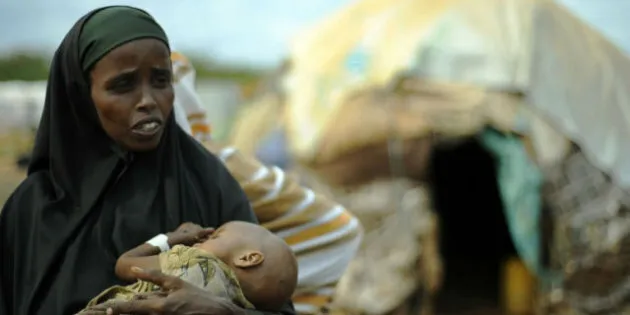
Famine in Africa: What Is the Long-Term Solution?

Posted: 08/08/11 01:04 AM ET

In Washington D.C. for a meeting with senators and members of Congress for a discussion on Sudan, I was then asked by an officer from the Pentagon if I'd like to grab some lunch. We got a table at a restaurant near the Supreme Court and furthered the discussion on the future for Africa. He was high up in the Defense echelons and knew his stuff. He then told me that one of the largest suppliers of funding to the humanitarian USAID was in fact the Defense department itself.

"What?" I exclaimed. "How can that be?"

It was a revelation of sorts. He spoke of how for decades the Pentagon had tried to figure out where the next conflicts would pop up around the world and that they were more often wrong than right. "That's when we turned to climate science," he stated, "and from that point on it was far easier to detect where the next regional wars would come from."

In an instant it all made sense. Years before the Darfur conflict emerged, for instance, UN climate scientists had predicted the region would be in conflict because of a lack of resources -- and they were right. The Pentagon had learned that at least with some science behind them they could prepare to defuse situations about to boil over. How? By funding humanitarian and development projects years in advance to relieve the pressure that would normally result in physical conflict over scarce resources.

All this is important because for years environmental scientists and researchers have been alerting the world community to the devastation that would soon befall East Africa unless long-term planning was put in place to avert a crisis. A sure sign few listened is the crisis we are watching on our television screens at present. Tens of thousands of people have died because warnings were ignored.

The major blame for all this falls directly at the feet of local African governments, not so much the West as so many like to presume. Local and national administrations have stood back, watched, or even abetted efforts to dam or curtail the flow of forested rivers into the regions where people need water for their very survival. Efforts exist to plant thousands, even millions of trees, in the region, but as long as African officials condone the cutting down of trees to grow plantations and diverting the rivers and streams to irrigate those plantations, there will never be enough water to save lives.

While political types in Canada and the U.S. continue to yawn over, or even deny, the catastrophic effects of a changing natural order, millions on the ground in Africa live with it as a daily reality. With rains coming later and later in the season each year -- especially in those regions close to the Sahara -- the stark choices they face can lead to life or death.

When the Ethiopian famine hit in the 1980s, international response was overwhelming and inspiring, but there was little follow-up when it was all over. Local African governments went back to their previous practices, and although the threat of famine always hung over the region, they refused to adopt the adaptations necessary to improve life for their people and to rid the region of famine's threat for good. There are many at blame for the present crisis, but chief among them have been local leaders who failed to enact measures required to save their own citizens.

Western intervention and generosity are necessary and life-saving, but unless new practices that promote new methods of conservation can be ushered in, we'll be hearing of regional famines for years to come.

Perhaps the United Nations, along with regional leaders, could host a follow-up conference, say in Nairobi, Kenya, to determine the measures required to bring new hope and life to East Africa itself. It will take Western science and generosity to resource preventive measures, but African leaders in the region must first acknowledge past failure and commit to future promises before famines like the one at present begin to decline. After all, if the Pentagon gets it, the time has come for significant reform.


Follow Glen Pearson on Twitter: www.twitter.com/glenpearson

In Washington D.C. for a meeting with senators and members of Congress for a discussion on Sudan, I was then asked by an officer from the Pentagon if I'd like to grab some lunch. We got a table at a r...
 
 
  • Comments
  • 10
  • Pending Comments
  • 0
  • View FAQ
Comments are closed for this entry
View All
Recency  | 
Popularity
10:12 AM on 08/09/2011
The author states, "African leaders in the region must first acknowledge past failure and commit to future promises before famines like the one at present begin to decline."

Yet we know that's not going to happen. And there is no mechanism for anyone outside the region to make it happen.

I have no criticism of most of the essay, only the premise that there's really anything to be done by outsiders. There's no tool in the toolkit with which donor nations or NGOs can alter any of the prevailing circumstances that produce these disasters. Not the climate, not the weather, not the corruption and ineptitude, not the greedy policies of short-term gain being pursued on the ground.
photo
HUFFPOST SUPER USER
hamp70
05:49 PM on 08/08/2011
An international army needs to be formed from the displaced peoples of the world while at the same time taking care of all of them. There are conflicts going on all the time through out the world. Many are fighting on one side or the other, only because they are forced to do so or because they do not have a viable alternative. They can only survive by choosing to fight for one war lord or another. Many if offered would jump at the opportunity to join in with other displaced peoples and form an International army.  Safe havens could be found for this purpose. The whole world could join the effort. Feed and house them while at the same time sending them to school, teaching them democracy, capitalism and constitutional government.(Especially the separation of church and state.)  Under the guidance of the US, those that wanted to become soldiers for the purpose of one day liberating their countries and forming a new democratic government, could do so. There is no doubt in my mind that all of this could be done a lot cheaper than the cost of what is going on now. The US is now spending untold amounts of money on weapon-try that can not be used in the fighting that is going on today. Half of what we have cannot be used due to not being able to identify the enemy. This army could identify the enemy.
11:05 AM on 08/08/2011
In early 1990s the US and Britain made sure Meles Zenawi and his ethnic party took power in Addis Ababa. The two nations' Embassies became ground zero for consultation and ... Mr. Meles promised “three meals a day”, “multiparty democracy”, and not to repeat anything Mengistu’s Derg had engaged in. For complying, he was granted legitimacy and shots of aid after aid after aid. Twenty years on the nation is still plagued by hunger, corruption, unlawful incarcerations, and absence free press. There was not a single year millions have not been starving and a single time Mr. Meles was not publicly denying the problem existed. But aid has been flowing in at the rate of 3 billions per year.
Amartya Sen has said:
"Famines are easy to prevent if there is a serious effort to do so, and a democratic government, facing elections and criticisms from opposition parties and independent newspapers, cannot help but make such an effort."
The ruling minority in Ethiopia reneged its pledges to the constitution and run every credible opposition out of town to establish a one-party state: a thinly veiled socialism labeled “developmental state”. Mr. Meles and his ethnic party will have been in power a quarter of a century by the end of this term. Under the guise of self-censorship, it clamped down on free press. This has been a return to the dreaded Mengistu-era governance.
More:
http://etrecycler.blogspot.com/2011/08/ethiopia-using-aid-as-weapon-of.html
photo
RabidRightRebel
Rebelling against wilful ignorance is a duty
07:21 AM on 08/08/2011
As has quite rightly been pointed out in this article one of the biggest obstacles the preventing famine is corrupt government officials.

Long term it is essential that these corrupt governments be eliminated, and the best way of doing that would be to require any government which receives aid from Canada or anywhere else to enact simple and irrevocable legal penalties for any government official that unjustly enriches themselves while in office. My recommendation would be a mandatory minimum sentence of 10 years for any official found guilty of unjustly enriching themselves of more than a million dollars. Any country that is not willing to commit to such anti-corruption measure quite simply should not receive any support because providing money to corrupt politician so they can stuff it in their Swiss bank accounts certainly does nothing to alleviate a famine and may in fact prolong it.

Countries that were willing to commit to such a anti-corruption measures would benefit not only from honest government but from an increase in support as a result of a diversion of the funds from corrupt countries to their countries. The assumption being that aid resources a kept constant and focused on honest countries as opposed to split between honest and corrupt countries. Hopefully this would encourage more countries to adopt anticorruption measures.
03:26 AM on 08/08/2011
The long term solution is birth control, empowerment of women through small business loans and education. But the pope will fight back tooth and nail. Better a baby should be starved to death than his mother not get pregnant.
photo
HUFFPOST BLOGGER
Glen Pearson
Director London Food Bank, former member of parlia
05:11 AM on 08/08/2011
We're talking about solutions to famine pinkies
05:20 AM on 08/08/2011
Glen - everyday, every ordinary day, everyday even when there is no famine, 25,000 children starve to death. Then there is the number who die of dirty water. Birth control will remove the population pressure on any given area and so reduce starvation which occurs routinely. Empowering women economically and education for girls reduces the number who will die from famine. I hate to tell you to look at the population growth of Ethiopia since the world rallied to help it through a famine. And its a fact that tens of millions of the money sent to Ethipia wound up buying munitions. Time to think Glen. Feed a man a fish or teach him how to fish. Feeding hasn't helped. I mean it hasn't helped in the long run.