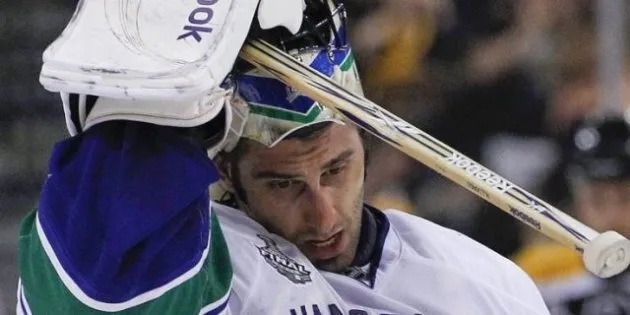
After Monday night's disastrous Stanley Cup playoff game that saw Boston Bruins forward Nathan Horton blindsided by the Canucks' Aaron Rome, I contemplated the brutal ballet of our 'national game.'
There is a grace to hockey even as there is an undeniable violence; a choreography amidst the chaos. Players, like dancers, play a high stakes game where the audience watches every move you make and a false turn can result in a career-ruining injury.
As a former dancer, I suppose it's not an unusual analogy to make. But as an umpteenth-generation Canadian, sadly unmoved by our "national game," I wonder if those of us in the cultural sector might have something to learn from sports fans.
'Our game' has of course become an international one. I discovered this during a surreal moment on assignment in Uzbekistan back in the summer of 2001. While at a Tajik wedding in Samarkand, amidst lovely ladies dancing in flowing silk robes, a man approached me for yet another ubiquitous vodka toast. "You Canada?" he smiled with a mouthful of gold plated teeth. "Yes," I said, as one does in these odd stranger in strange lands moments, "Me, Canada."
With a twinkle in his eye, the wedding guest raised his glass in a toast. "Mario Lemieux!"
In Russified, desert-ridden Uzbekistan, hockey is a very important sport, and it is our legendary hockey heroes who represent us internationally.
Now I'm the kind of Canadian who gets teary-eyed and nostalgic for home, when I hear, say, the first few strains of Leonard Cohen's "So Long Marianne" played by gypsy boys in the Madrid metro. Or when I listen to Joni Mitchell's "A Case of You" ("I drew a map of Canad/oh Canada/with your face sketched on it twice") in some damp London flat in mid-winter. That's when, infused with a strange new patriotism, I start to long for "home" and complain bitterly about the lack of maple syrup in my adopted one.
But hockey, as I'm learning, is a hugely emotional experience for many of my countrymen. It arouses more impassioned arguments and dramatic expressions of patriotism than, say, national elections or the war in Afghanistan (although, il faut dire, there was an unfortunate conflation of that war with hockey mania in recent CBC coverage -- with Strombo interviewing Prime Minister Harper about "our team,' followed by info on soldiers' deaths in Kandahar and Don Cherry's crypto-nationalist pro-war pronouncements).
Indeed hockey mania takes on an almost religious quality in certain fans. And beyond its inherent violence and potential for jingoism, it certainly has a positive side. As a non-verbal form of entertainment, it offers new Canadians a chance to participate as spectators in a 'national' sport.
And after a long, rainy spring in Vancouver, the Canucks winning streak and better-late-than-never sunshine conspired to make lotuslanders positively friendly and outgoing, even striking up conversations with strangers -- a ritual normally confined to banter between dog walkers.
At my local swimming pool, where ladies in Speedos routinely ignore each other, an eavesdropping middle-aged blonde woman who had listened in on my conversation with a friend about hockey, new Canadians and 'national' culture, came over afterwards to correct something my friend has said about score keeping. I immediately confessed my ignorance about hockey and my celebration of Canadian composers.
"Well," she said with a certain smugness, "if we're going to work together we need to understand each other's terminology." I was fascinated by her cryptic response. Who were these two sides she was referring to? New Canadians and old Canadians or was it sports fans and culture vultures?
And what was it about sports and sports fans that gave them so much power in our society, I wondered? Why is it that here in Vancouver we have half a billion dollars to install a retractable roof over BC Place Stadium but not enough money to keep the Children's Festival going? Is football more important to our identity than the next generation of Canadians?
And what is this magical power seemingly unique to organized sports that boosts both patriotism and endorphins when our team is winning, and despair when it's not? Can beleaguered arts organizations -- still reeling from massive pre-Olympics cuts -- somehow tap into this energy, and co-opt it for their own agendas?
Can we dream that one day, Vancouverites will have mass rallies downtown celebrating say, the VSO or independent theatre companies, or struggling but critically acclaimed authors? Will the names of local artists be chanted in unison, their mugs proclaimed on t-shirts and coffee cups? Will locals one day rise up and demand a decent opera house for our fair city? Or will Bruce Cockburn's "They Call it Democracy" be played at intervals during Hockey Night in Canada?
But really, we're not talking about polar opposites here, but rather a Canadian cultural gestalt. Hockey is as much an expression of who we are as our great tradition of singer songwriters. Sports stadiums are the new coliseums, and as Monday night's game especially showed us, they are rife with human drama.
So perhaps hockey is as operatic as it is balletic. I say it's time for a revival of "Game Misconduct" by Vancouver composer Leslie Uyeda and librettist Tom Cone, which premiered here in 2000. This modern opera was set in a hockey arena during the seventh game in a playoff series pitting an American hockey team against a Canadian one. In the stands, the fans are anxious for the game to end -- the stadium is to be demolished after this last game. "It's about identity, loss and change," said Uyeda over a decade ago.
As Canadian culture continues to get pummeled and blindsided, and important institutions demolished, let's hope that sports fans everywhere will take time to reflect on the nature of our national identity.