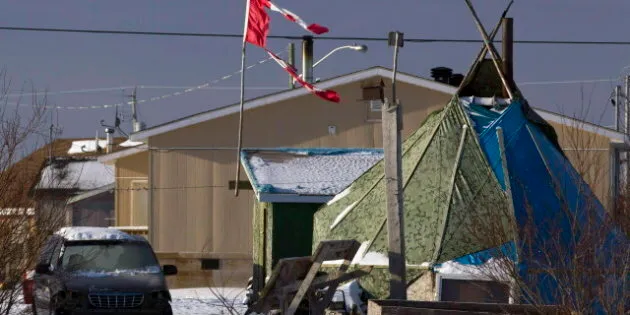
So the nation's editorial boards are all excited at the prospect that the federal government will soon introduce legislation to allow First Nations people living on reserves to own their own land. Which is interesting, because I'm not sure that's actually happening.
"The federal government said Tuesday it has no imminent plans to introduce legislation to allow First Nations people living on reserves to own their own land," writes Postmedia reporter Teresa Smith, which seems pretty unambiguous. But, oh, lookie here, it's that senator who couldn't beat up Justin Trudeau! He says he's in favour of such legislation! And since he's known to be one of the federal government's most credible, uh, decorations, it's safe to assume he speaks for the entire Harper administration, right?
No? Well, whatever, just use him as pretext to say the Tories have been "signalling" interest in the idea, or "seem poised" to do it. Or just cross the line into outright fantasy and claim they're going to introduce a bill without providing any corroborating evidence or citations whatsoever, I don't care. Point is, press people want to talk about native property rights so that's what we're gonna do, dangnabbit.
Surprise! Everyone loves property rights for natives! And why wouldn't they? Property's great! When you own property you get to enjoy a "sense of pride" that can't be beat, says the Winnipeg Sun. Not to mention that property ownership helps "contribute to economic development and wealth creation," adds Mark Milke at the Hamilton Spectator. Indeed, a federal government that denies property rights to our reserve-living friends is not only "racist and imperialist," scolds the Ottawa Citizen, but perpetuates an "economic model that's not very different from a social-housing project" -- which I'd say is an even crueler insult.
So full speed ahead with passing the non-existent legislation? Well, not quite.
The Globe and Mail board cautions that the "devil may yet be in the details," which I would say is a fair critique of a bill that, again, doesn't friggin' exist. Others worry that the uppity natives themselves might throw some roadblocks (figuratively!) in the way of a government that obviously knows what's best for them.
In particular, warn the Winnipeg Sun people, the country's assembled Indian chiefs will likely put up strong opposition to anything that threatens to "reduce their power," particularly their "right to boot people from the homes they've lived in for years on a whim."
The gentler souls at the Citizen, meanwhile, worry that the Harper regime has been so boorish on native issues lately it's probably "handicapped its own efforts" to make progressive reforms. As evidence of this handicapping, they can only cite the PM's supposed "mishandling of the Attawapiskat crisis," which, as we may recall, entailed giving the Attawapiskatis $90 million. So you can understand why he'd be unpopular.
There aren't a lot of First Nations pundits in this country, which isn't too surprising considering that most Canadian editorial pages aren't exactly a rainbow of diversity to begin with. The Winnipeg Free Press thus deserves kudos for at least commissioning the thoughts of one actual-factual native guy for a bit of balance, even if it was only for their online edition.
The real reason reserve Indians are poor, writes Trevor Greyeyes, isn't because they lack fancy pants property rights, but rather because reservations "were never meant to be functioning communities" in the first place. The things are just crappy chunks of land with scant resources where the white man found it economically convenient to exile races he was tired of dealing with. Sure, maybe in some rigid, technical sense natives were given what they wanted, but in practice the outcomes were so obviously flawed and inferior it was hard to view this supposed generosity as anything but a patronizing insult.
In a way, I imagine it was something like being published in the online edition of the Winnipeg Free Press.
***
Sadly, Quebec's big pointless waste of time provincial election which everyone agreed last week was a big pointless waste of time has continued to receive disproportionate media attention over the last couple of days, as columnists fuss to find some angle -- any angle -- to make this non-event seem compelling.
They found Jacques Duchesneau. He's some guy from Quebec's newfangled Coalition party we were all supposed to get excited about this week. Apparently he was once the beloved boss of the anti-collusion wing of the provincial transportation ministry, which makes him quite the high-stat Pokemon to bring to an election battle the press is increasingly insistent should be fought over corruption.
In the Gazette, Don MacPherson goes so far as to say Jacques' candidacy "might have changed everything," a la Jack Layton and the Orange Crush, since he too "inspires such unquestioning trust" among the Quebecois. Graeme Hamilton at the Post agrees, calling the Coalition's "coup" nothing less than a master stroke allowing the plucky third-place party to unexpectedly "seize control of the provincial election agenda." It's difficult to even read a straight news article about Duchesneau that doesn't make ample use of fawning pronouns like "star" and "hero," in fact.
Of course, "shaking up" an already dull and useless election is a bit like shaking up a hollow maraca -- fun in a way, but still unlikely to produce a fiesta. Duchesneau might be leading, but this conga line is still going nowhere.
Follow J.J. McCullough on Twitter: www.twitter.com/JJ_McCullough
I'm not saying it's entirely a bad idea to change the ownership model, but perhaps Native land titles should only be exchanged for equal property in the same reserve, and nothing else.
Opportunity or Temptation?
Plans for private property on reserves could cost First Nations their independence.
Pamela D. Palmater is a Mi'kmaq lawyer from New Brunswick who holds the new chair in indigenous governance at Ryerson University.
As a Poli Sci prof he greatly admire the philosophy that the use of power/force to advance the aims of the government, or political group, as well as to protect itself against criticism and perceived threats to its ideology was justified and necessary.
More of the 'you do as I say or you will be punished/excluded/eliminated' school of thought.
Most often found in dictatorships, fascist regimes, national socialist orders(Nazi) and repressive/suppressive political parties existing in supposedly free electoral systems.
After Tom's classes I followed his antics in the press as a "talking head expert" and then as an infuential advisory to Preston Manning through to Stephen Harper. We all know how ruthless they were suppressing free will and free speech/thinking in their groups.
As well, these politicians are about as openly fascist (Might Makes Right) as you can get and still survive in our political system.
'If you're not one of us then you're dead' school of thought.
State terror/suppression/brutality is justified as protecting the ignorant masses. Political and religous terrorists justify their actions in the same way.
Are you suprised: that Tom advocates a similar action towards a threat to the ruling political order? that Stephen Harper and his ilk govern as they do and do not allow their members free speech? that they refuse to be held openly accountable to the citizens?
There is danger in having our politicos rule by right of might, right here in Canada.
-
"Whether Canada ends up as one national government or two national governments or several national governments, or some other kind of arrangement is, quite frankly, secondary in my opinion…"
http://www.youtube.com/watch?v=x7XqoJ3N2Ug
"...Unless we work together with our other economic partners around the world and work with them closely and intimately...I know some people don't like it, it's a loss of national sovereignty..." - Stephen Harper
http://www.youtube.com/watch?v=dvhEjt9IQec
http://www.cgi.com/en/board-of-directors/thomas-p-daquino
http://www.canadians.org/tradeblog/?p=613
http://www.cbc.ca/news/canada/story/2007/08/20/nafta-summit.html
http://www.nupge.ca/news_2007/n22au07b.htm
http://www.canada.com/vancouversun/news/story.html?id=4b1bc1a3-32be-4aac-af56-5636db7ef5a3&k=32965
"Of course..increased collaboration with the Department of Homeland Security would raise privacy and sovereignty concerns"….
Like Harper & his CONS being partners with CGI who are key partners with U.S. Government & Military, including Department of Homeland Security...
"CGI...more than 30 years, we’ve partnered with U.S. defense, civilian, and intelligence agencies"... http://www.nhdf.org/7-national-symposium/exhibitors/whos-exhibiting/cgi
http://www.cgi.com/en/CGI-Awarded-Prime-Contract-Multiple-Award-ID-IQ---US-Army-Forces-Command
And Harper & his CONS awarding CGI contracts with our government worth BILLIONS, placing thousands of CGI employees into every department of our government, including our courts & law enforcement agencies, etc...
http://www.admfincs.forces.gc.ca/apps/dc/contract-contrat-eng.asp?q=3&y=2011&id=id105548
http://www.rcmp-grc.gc.ca/pd-dp/contra/2007-06-30/000489-eng.htm
http://www.justice.gc.ca/eng/dept-min/pd-dp/contra/details.asp?yr=2011&q=1&c=6227
"biggest cuts are to the Department of National Defence, at $1.1 billion over three years, & Public Safety, to trim $688 million"... http://www.cbc.ca/news/canada/story/2012/03/29/federalbudget-flaherty-public-service-cuts.html
AND Harper & his CONS cutting thousands of public service employees from Department of National Defence & Public Safety, directly following CGI setting up National "Defence, Public Safety & Intelligence Unit"...
http://www.canadianbusiness.com/article/48169--cgi-hires-military-transformation-leader-to-head-canadian-defence-unit
2nd Session, 40th Parliament,
57-58 Elizabeth II, 2009
house of commons of canada
BILL C-60
An Act to implement the Framework Agreement on Integrated Cross-Border Maritime Law Enforcement Operations between the Government of Canada and the Government of the United States of America
Her Majesty, by and with the advice and consent of the Senate and House of Commons of Canada, enacts as follows:
SHORT TITLE
TITRE ABRÉGÉ
Short title
1. This Act may be cited as the Keeping Canadians Safe (Protecting Borders) Act.
http://network.nationalpost.com/NP/blogs/fullcomment/archive/2010/03/23/john-ivison-return-property-rights-to-first-nations.aspx
http://myblahg.com/?p=5020
http://myblahg.com/?cat=17
Tom Flanagan is the only person ever to have lived in both Ottawa, Illinois, and Ottawa, Ontario. Born and educated in the United States, he immigrated to Canada in 1968. He is professor of political science at the University of Calgary and a fellow of the Royal Society of Canada. In the years 2001-06, Tom held various positions for Stephen Harper and the Conservative Party of Canada - including chief of staff, campaign manager and political adviser.
The Treaty 7 Indians alerted us long ago...about the Northern Foundation & Flanagan's "Calgary School "
http://www.walrusmagazine.com/articles/the-man-behind-stephen-harper-tom-flanagan/
Tom Flanagan, received a lot of media criticism for saying that " political attack" ( ads ) don't have to be true, they just have to be plausible."
A professor in the University of Calgary’s political science department since 1968 and lifetime advisor to Stephen Harper, Flanagan has unsurprisingly generated considerable controversy with his policy recommendations regarding aboriginal peoples. :“Call it assimilation, call it integration, call it adaptation, call it whatever you want: it has to happen.”
Guess what? The Conservatives want us to “sell” our homeland to help us get out of the poverty they’ve put us into. That’s what would-be comedian Tom “who’s-a-scalawag-like-his-zero-hero-Sir-Walter-Raleigh” Flanagan, a University of Calgary professor, said recently on the CBC. Did he ask us? No. “Selling reserve land could help solve poverty”, he said.
I wonder if Flanagan also thinks some firewater and beads would be a fair price.
http://www.svabhinava.org/HinduCivilization/Dialogues/MeeraNanda-frame.php
http://www.rabble.ca/babble/walking-talk/aboriginal-issues-and-culture
http://www.cfsontario.ca/mysql/HAN004-E.pdf
http://cmte.parl.gc.ca/Content/HOC/committee/362/aand/evidence/ev1039822/aandev14-e.htm
http://iec-csi.csj.ualberta.ca/Portals/3/revue/ISS12.PDF
http://plawiuk.blogspot.com/2007_06_01_archive.html
UBC: Books:::https://circle.ubc.ca/bitstream/2429/568/1/Trade_S05.pdf
After WWII the Joint Committee of the Senate House of Commons wanted to extend "human rights" to Indians. In 1969 the Federal Government's Statement of Policy declared total assimilation to be the goal within a short period of time. Indian Affairs was to be abolished. Special Indian legislation was to be repealed. Treaties and Land claims were to be considered insignificant. The provinces would evidentially provide all the services. The primary theme of the Statement of Policy was that the Federal Government would relinquish her responsibility for Indians and transfer it over to the Provinces.
The Red Paper of 1970 prepared by the Indian Chiefs of Alberta condemned the 1969 policy and described it as:
"A scheme whereby within a generation or shortly after the proposed Indian Lands Act expires, our people would be left with no land; and consequently the future generation would be condemned to the despair and ugly spectre of urban poverty in ghettos
Our report proposes a comprehensive strategy over 20 years to restore social, economic and political health to Aboriginal peoples and rebuild their relationship with all Canadians.
It entails the pursuit of two mutually reinforcing paths to change rebalancing political authority and economic resources; and a reinforcing effort to restore health and effectiveness to individuals, families, communities and nations.
It is important to understand the concepts on which this strategy rests.
There are four: the reality of societal and cultural difference; the right to self-government; the nature of Aboriginal nationhood; and the requirement for adequate land, resources and self-reliant Aboriginal economies. Each is linked to the others and all are critical for success.
more...
http://www.ainc-inac.gc.ca/ap/pubs/spch/spch-eng.asp
http://indigenouspolicy.org/Articles/VolXXNo3/TheApologiaCanadianalessonsforanIndianBoadi/tabid/79/Default.aspx
Ottawa announced a Joint Action Plan with the Assembly of First Nations to herald a "new phase" in its relationship with First Nations, with action promised on education, job creation, and improved governance.
Member of Parliament Carolyn Bennett revealed in the House of Commons that the 2011-12 Conservative budget cuts $127 million from housing on First Nation reserves.”
&
Read the AUDITOR GENERAL OF CANADA REPORT regarding Indian House ..sigh
http://www.oag-bvg.gc.ca/search/?q=Management+of+Indian+Housing&btnG=Search&filter=0&site=&entqr=0&output=xml_no_dtd&sort=date%3AD%3AL%3Ad1&ie=utf-8&lr=&client=e_frontend&ud=1&oe=UTF-8&proxystylesheet=e_frontend
Ottawa's display of indifference came at a disheartening time for the 3.4 million Canadians living in poverty.
The government delivered its response in October 2010 to the Senate's 2009 report, In From the Margins: A Call to Action on Poverty, Housing and Homelessness.
It rejected every one of the report's 74 recommendations.
http://www.parl.gc.ca/Content/SEN/Committee/402/citi/rep/rep02dec09-e.pdf
The bigger picture explains why Attawapiskat should not be seen in isolation. The situation there is the result of deliberate policies.
It begins with the Crown breaking the partnerships with First Nations that formed the basis of the treaties and ignoring their own laws, like the Royal Proclamation of 1763. Yes, history matters if you want to understand how we got to this point.
It is followed by a policy of segregation. They invented the idea of "status" Indians, as defined by the Crown, and created reserves, where the Crown chose what it thought was valueless land and compelled people to stay there.
That was followed by the policy of assimilation, where the Crown reversed itself and started encouraging people to leave reserves to join the rest of Canadian society. Encouragement took the form of legislation that stripped people of their "status" and denied them the right to live with their families and communities if they did things like get an education.
The policy of assimilation is still in place. Only now, the Government of Canada uses talk of formal equality -- treating everyone exactly the same -- to justify treating First Nations like they have no Aboriginal or treaty rights, despite the Constitution of Canada and the UN Declaration.
http://www.huffingtonpost.ca/romeo-saganash/attawapiskat-emergency_b_1125905.html