Featuring fresh takes and real-time analysis from HuffPost's signature lineup of contributors
Joel Wood

GET UPDATES FROM Joel Wood
 

The One Way B.C. Will Get a "Fair Share" of the Pipeline

Posted: 10/02/2012 5:12 pm

Following the U.S. government's delay in approving the much-hyped Keystone XL pipeline, many pundits turned their attention to the possibility of a new pipeline from the oilsands to B.C.'s west coast that would allow Canada to ship larger amounts of oil to world markets, which currently offer a premium price relative to the U.S. Midwest.

Securing higher prices for oilsands oil would bring tremendous economic benefits to Canada. However, as is often the case in a federalist country, domestic provincial considerations have complicated the viability of the proposed Northern Gateway pipeline project, which would bring oil from northern Alberta to Kitimat on the B.C. coast.

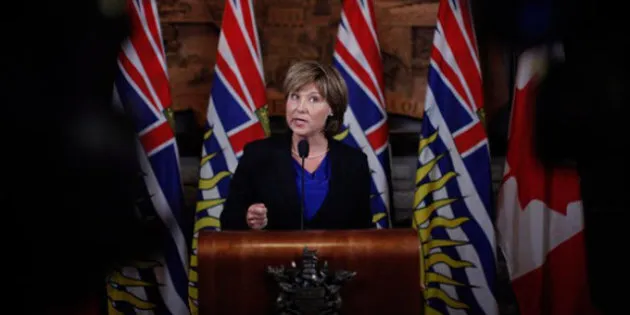
One major barrier to the development of the Northern Gateway pipeline as well as a second pipeline from Alberta to Vancouver is the parochial interests of B.C.'s premier, who has demanded a "fair share" of the benefits from the pipeline. Constitutionally, the premier has little to no ability to block the pipeline. However, politically she has a big microphone and is using it, particularly as she is facing re-election next year with dim prospects and an electorate and opposition party generally opposed to the pipelines.

To date, the federal government has remained relatively silent. However, the stated interests of the feds for Canada to become an "energy superpower" may coincide with a possible solution to the "fair share" problem.
Since 1972, there has been a federal moratorium on offshore oil and gas activity in B.C. The moratorium is not legislated but rather informal in that the federal government simply refuses to issue permits for offshore activity. The moratorium is so strict that it prevents basic scientific testing such as seismic surveys.

The potential size of offshore oil and gas in B.C. is substantial. A probabilistic assessment of B.C.'s offshore resource potential by the Geological Survey of Canada roughly suggests 9.8-billion barrels of oil and 43.4 trillion cubic feet of natural gas. In regards to oil, this endowment is similar to estimates for the coastal plain of the Arctic National Wildlife Refuge (ANWR) in Alaska. However, a 2004 report by the Royal Society of Canada indicates that many of the environmental questions that need to be answered prior to offshore drilling cannot be answered without lifting the moratorium. In other words, even the most basic steps necessary to assess the actual size and viability of the offshore resources are prevented by the moratorium.

Herein lies the opportunity. In exchange for the B.C. government's support of the Northern Gateway pipeline (and perhaps others), the federal government could lift this informal moratorium so that further information about the extent of B.C.'s offshore resources can be determined. Developing these resources will likely produce substantial economic benefits to B.C.

As a sign of the potential benefits, consider Newfoundland and Labrador. They have averaged more than $1 billion in annual industrial benefits from the offshore oil sector between 1990 and 2009. Furthermore, the offshore oil sector in Newfoundland and Labrador generated $43 billion in GDP between 1997 and 2007; around 25 per cent of the province's GDP over that period. An analysis commissioned by the B.C. government estimates that if B.C. were to proceed with offshore oil development, the majority of the profits from the sale of oil will flow to provincial and federal government coffers in the form of royalty payments and income taxes.

Such development will not jeopardize B.C.'s environment if proper precautions and interventions are established. For example, historical spill and oil production data show that Newfoundland and Labrador, as well as the United Kingdom, have had much safer experiences with offshore drilling than the U.S. Gulf of Mexico. Despite producing more than one billion barrels of oil, there has only been a single oil spill greater than 50 barrels since offshore oil production began in Newfoundland and Labrador. Furthermore, the number of oil spills from maritime traffic in Canadian waters has decreased substantially since the 1980s, and none have occurred in the past decade.

Learning from the experiences of Newfoundland and Labrador, the U.K., Norway, and the U.S., the government of British Columbia, in partnership with the federal government, can design and implement a world-class regulatory regime for offshore exploration and development. Having waited to develop its offshore fossil fuel resources leaves British Columbia in the enviable position of learning from regulatory improvements and mistakes in other jurisdictions. A well-funded and well-designed regulatory regime paired with appropriate liability laws can help mitigate the risks involved with offshore oil activity.

Lifting the moratorium on offshore oil and gas activity on Canada's west coast will contribute to the federal government's goal of making Canada an "energy superpower." And at the same time, it has the potential to resolve inter-provincial in-fighting over pipelines by ensuring British Columbia is a larger beneficiary of Canada's energy renaissance.

Loading Slideshow...
  • 10. Oil And Gas Accounts For 4.8 Per Cent Of GDP

    The oil and gas industries accounted for around $65 billion of economic activity in Canada annually in recent years, or slightly less than 5 per cent of GDP. Source: <a href="http://www.ceri.ca/docs/2010-10-05CERIOilandGasReport.pdf" target="_hplink">Canada Energy Research Institute</a>

  • 9. Oil Exports Have Grown Tenfold Since 1980

    Canada exported some 12,000 cubic metres of oil per day in 1980. By 2010, that number had grown to 112,000 cubic metres daily. Source: <a href="http://membernet.capp.ca/SHB/Sheet.asp?SectionID=9&SheetID=224" target="_hplink">Canadian Association of Petroleum Producers</a>

  • 8. Refining Didn't Grow At All As Exports Boomed

    Canada refined 300,000 cubic metres daily in 1980; in 2010, that number was slightly down, to 291,000, even though exports of oil had grown tenfold in that time. Source: <a href="http://membernet.capp.ca/SHB/Sheet.asp?SectionID=7&SheetID=104" target="_hplink">Canadian Association of Petroleum Producers</a>

  • 7. 97 Per Cent Of Oil Exports Go To The U.S.

    Despite talk by the federal government that it wants to open Asian markets to Canadian oil, the vast majority of exports still go to the United States -- 97 per cent as of 2009. Source: <a href="http://www.nrcan.gc.ca/statistics-facts/energy/895" target="_hplink">Natural Resources Canada</a>

  • 6. Canada Has World's 2nd-Largest Proven Oil Reserves

    Canada's proven reserves of 175 billion barrels of oil -- the vast majority of it trapped in the oil sands -- is the second-largest oil stash in the world, after Saudi Arabia's 267 billion. Source: <a href="http://www.ogj.com/index.html" target="_hplink">Oil & Gas Journal</a>

  • 5. Two-Thirds Of Oil Sands Bitumen Goes To U.S.

    One-third of Canada's oil sands bitumen stays in the country, and is refined into gasoline, heating oil and diesel. Source: <a href="http://www.nrcan.gc.ca/statistics-facts/energy/895" target="_hplink">Natural Resources Canada</a>

  • 4. Alberta Is Two-Thirds Of The Industry

    Despite its reputation as the undisputed centre of Canada's oil industry, Alberta accounts for only two-thirds of energy production. British Columbia and Saskatchewan are the second and third-largest producers. Source: <a href="http://www.nrcan.gc.ca/statistics-facts/energy/895" target="_hplink">Natural Resources Canada</a>

  • 3. Alberta Will Reap $1.2 Trillion From Oil Sands

    Alberta' government <a href="http://www.huffingtonpost.ca/2012/03/27/alberta-oil-sands-royalties-ceri_n_1382640.html" target="_hplink">will reap $1.2 trillion in royalties from the oil sands over the next 35 years</a>, according to the Canadian Energy Research Institute.

  • 2. Canadian Oil Consumption Has Stayed Flat

    Thanks to improvements in energy efficiency, and a weakening of the country's manufacturing base, oil consumption in Canada has had virtually no net change in 30 years. Consumption went from 287,000 cubic metres daily in 1980 to 260,000 cubic metres daily in 2010. Source: Source: <a href="http://membernet.capp.ca/SHB/Sheet.asp?SectionID=6&SheetID=99" target="_hplink">Canadian Association of Petroleum Producers</a>

  • 1. 250,000 Jobs.. Plus Many More?

    The National Energy Board says oil and gas employs 257,000 people in Canada, not including gas station employees. And the Canadian Association of Petroleum Producers says the oil sands alone <a href="http://www.capp.ca/aboutUs/mediaCentre/NewsReleases/Pages/OilsandsaCanadianjobcreator.aspx" target="_hplink">will grow from 75,000 jobs to 905,000 jobs by 2035</a> -- assuming, of course, the price of oil holds up.


Follow Joel Wood on Twitter: www.twitter.com/JoelWWood

FOLLOW CANADA POLITICS
Following the U.S. government's delay in approving the much-hyped Keystone XL pipeline, many pundits turned their attention to the possibility of a new pipeline from the oilsands to B.C.'s west coast ...
 
 
  • Comments
  • 8
  • Pending Comments
  • 0
  • View FAQ
Comments are closed for this entry
View All
Favorites
Recency  | 
Popularity
02:52 PM on 10/03/2012
HAHAHAHAHA.....was this meant as a comical piece or is the writter for real? He is of the opinion that the birkenstock bunch in BC who are firmly oppossed to a pipeline might somehow see it as a trade if the moretorium is lifted on off shore drilling....me I think its a great idea, but then I work for a living hahahah
02:44 PM on 10/03/2012
Regarding the pipeline, there are few benefits for BC and most of the risks. So nothing wrong with Alberta sweetening the deal, they need access more than BC needs the ($6 billion in tax revenue over the 30 year life of the project). Also interesting to note that Enbridge is using a shell company to build the pipeline - to limit their liability even more.

Also regarding whether or not BC has any power constitutionally to oppose the deal. I'm not sure, Quebec did it to Labrador hydro. Furthermore the First Nations are all opposed, and can tie it up in courts for years. More likely Keystone will be approved after Obama is re-elected and this will reduce the need for a second pipeline through BC.

But it is worth pointing out that Newfoundland & Labrador and the UK as well as Norway have developed their offshore oil with few spills. Norway has been doing offshore oil for decades and compare their heritage fund of $500 billion with Alberta's $18 billion. As much as I'd like to see a reduced carbon economy - it won't happen anytime soon. There really is nothing to replace it at the moment.

Since BC has a carbon tax, why not charge a carbon tax to Enbridge on the diluted bitumen going through the pipeline. We all pay it, why shouldn't Enbridge.
12:41 PM on 10/03/2012
Great idea Joel! While we're at it we can start hunting grizzly bears again and use the pelts to mop up the oil spills!
12:18 PM on 10/03/2012
That's some logic you got there Joel - I can see why you're an economist at the Fraser Institute.
photo
Gnomish
ego doctus ignarus
08:34 PM on 10/02/2012
We don't want the pipeline at all !
There is no fair share of environmental destruction it hurts all of us eventually but BC takes the loss.

Haggling over dollars is pointless BC needs control of it's own environment and projects.
07:17 PM on 10/02/2012
1 - "Such development will not jeopardize B.C.'s environment if proper precautions and interventions are established"... Because we all know that oil companies would never cut corners on safety or the environment.

2 - So B.C.'s solution (to a problem that the writer has created) is to allow more environmental impacts (on a potentially disasterous scale), and increase our reliance on carbon? Brilliant.
This user has chosen to opt out of the Badges program
12:06 AM on 10/03/2012
And never forget : If anything can go wrong, it will.
03:02 PM on 10/03/2012
Absolutely. Systems fail. And if they were more honest about what could/will happen they might have more support for such grandiose plans.