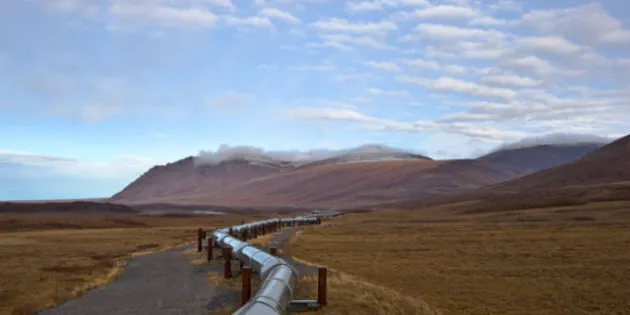
Whether we like it or not, this world runs on petroleum and petroleum-based products. Without oil manifested into its many forms, a far different civilization from the one we know would have developed on our planet. It is a fact of life in our modern world that we use and benefit in myriad ways from petroleum and its product derivatives.
Try to think of our world without the following: plastics, internal combustion engines for cars, trucks and ships. Almost all aircrafts use oil-based fuel -- with the arguable exception of hot-air balloons and gliders -- and good luck trying to manufacture them without modern petroleum products.
The benefits of the petroleum-based economy are far too numerous to detail here, but in the transportation, mining, medicine, sports, construction and technology sectors, we would not have excelled as a civilization without the oil-based economic model. Without oil, we would have achieved much -- just not as much!
Therefore, the question that needs to be asked: "How can our petroleum-based economy operate in an environmentally responsible way -- while costs to industry and consumers remain reasonable?"
As we speak, the future of the Keystone XL pipeline and the Enbridge Northern Gateway pipeline are under consideration.
What hasn't been a part of the debate is the most obvious discussion of all: How "clean" will that oil be while it is flowing through a pipeline or while being transported in a super-tanker? From this environmentalist's perspective, it can't be clean enough.
Both pipelines will cut across some of the prettiest scenery on the planet. Accidents do happen -- of that there is no doubt. There WILL be a spill somewhere, sometime, and other than building the best pipeline possible and following the safest route, the only other factor that could make a difference is the quality of the oil flowing through the pipe.
Kitimat, BC photo by: Amanda Lang
See, you're an investor in Canada's environment. I knew you were a good person! We are all environmental stakeholders when it comes right down to it.
Because B.C. has some of the most gorgeous scenery on Earth, I advocate strongly that every drop of oil loaded into pipelines should be highly-refined at or near the source of extraction to minimize transport of toxic crude oil over our environment.
Highly-refined oil -- prior to the addition of other ingredients -- is of lower toxicity. Shipping low-toxicity liquids would be light years better than the present practice of shipping toxic crude oil.
An interesting alternative to shipping raw crude oil employed by the world's number one oil exporter, Saudi Arabia, is to highly refine petroleum into ethane gas which is I think is a safer product to transport, from an environmental standpoint. If a leak occurs while the product is in transit, it doesn't destroy underground aquifers or kill ocean life.
Another 21st-century method employed in Saudi Arabia is to highly-refine petroleum into products. Saudi Arabia has just signed a $20.6 billion-dollar agreement to build another petro-chemical plant in Yanbu, Saudi Arabia for the purpose of manufacturing and exporting various plastic products which have been refined from Saudi crude.
So, dear reader, I have left the best for last. China is so thirsty for oil that it is happy to purchase petroleum product in any form we choose to sell it -- and their economy is cash-rich and oil-starved. How does that work for you?
China has financed many projects all over the world in recent years, including billion-dollar oil refineries and the $15 billion-dollar Lesotho Highlands Power Project (LHPP) which consists of 10,000 megawatts of combined wind turbine and hydro-electricity for Lesotho and South Africa's electrical grid and other large-scale projects.
There is no reason at all for Canada to be shy about approaching China with a financing proposal for a world-class petroleum refinery located near the tar sands site -- thereby earning a lifetime customer and committed partner to the project's success.
For once, getting the financing to build a world-class, environmental best-practices oil-refinery and the necessary transportation links required to get it to market isn't that much of a problem. Thanks, China!
We need to admit that this country is going to mine, upgrade, sell and transport tar sands product and there is no longer any thought about stopping it. Why not allow China to finance a world-class refinery to highly refine oil into a low-toxicity state so that at the very least it can be safely transported and shipped over our landscapes and seaways?
A win-win solution exists for both countries and the only worthwhile question remaining is: Which does China want to finance?
A) An "ultra clean oil product" pipeline
B) An ethane gas pipeline
C) Plastic products delivered to the coast by upgraded rail link
How does my environmentalist viewpoint compare to the present practice of flowing toxic liquids through pipelines and shipping toxic crude oil using single-hulled super-tankers?
Affix your gaze to the end result I propose: A world-class tar sands refinery located near the extraction site, dedicated to refining tar-sands into some of the safest and cleanest products available and then transporting it in that low-toxicity state using world-class land and sea transportation methods -- all financed by China. Think of all the value-added activity, as opposed to merely exporting a raw resource. Just try to estimate the number of jobs this would provide for Canadians.
No doubt, it will take leadership to bring this improved environmental vision to completion.
Follow John Brian Shannon on Twitter: www.twitter.com/@JBSCanada
David Suzuki: Screw the Environment! The Pipeline Will Hurt Our Economy.
It can't. Next question.
How will we do without, cars, trucks, trains, airplanes, plastic, synthetic rubber, medicines, roads, insulated buildings, modern mining equipment, modern construction equipment, an electricity grid to power our homes, ALL synthetic textiles = clothing, carpets, window coverings, including blinds, electronic devices including TV, iPads, iPods, iPhones, super-computers and any other computers -- all of which require synthetic plastic, rubber or other materials that can't be manufactured without petroleum as either a component or part of the machinery required to manufacture such items.
If we can't find a way to do this, we will regress to the technology of sailing ships and horse-drawn carts. Forget about antibiotics, analgesics or insulin, for example. All require petroleum for their manufacture.
I think we have to try a little harder.
Thanks for your comment.
JBS
and understandable. The one thing I noticed was,
you mentioned a single-hulled super-tanker, but on
the news tonight they were speaking of using
double-hulled tankers, I don't know if this will be
a requirement or what the meeting of the minds
(oil execs., goverment, environmentalists etc.)
will decide. Let's hope it's the best decision that
they make.
As an afer thought, I don't really think the
environmentalists what to do without their
homes being heated, driving their auto's
(no matter what size they are) or how about
not going on their business or holiday trips
by way of flying or cruise ships. We all know
how much pollution all of these transportation
methods cause. Then there is the endless
bottles of water/soda etc. people buy.
What about the products for medicinal uses etc.
I'm sure with a little more time, I could come up
with a lot more things that we get from oil/gas.
So, I ask do the environmentalists really want
to do without all of these benefits?
-----------------------------------------
The physics of heat-trapping gases tells us that increasing GHG concentrations in the atmosphere will lead to increased trapping of heat. We've already raised the atmospheric CO2 concentrations by 40% in just a few generations, and the massive emissions that would result from a full-throttle tar sands development will most definitely increase that.
The actions of one generation (ours) can essentially precondition sustainability issues for millennia. If we dredge up and burn every ounce of fossil fuel we can lay our hands on, including “oil” from the tar sands, it can only mean one thing: a profound collective indifference to future generations that is unprecedented.
From this perspective, there is no “environmentally responsible way” to develop the tar sands to their full potential.
We need to move away from fossil fuels and champion renewable energy development and we need to start now.
About 0.015% of the world total today. Even at ten times the current level of development that's less than 1% of all GHG emissions. So yeah, I think there's an "environmentally responsible way" to develop the oil sands, however it's not an either/or choice - we should continue to pursue real alternatives... like LFTRs :)
We're sitting on one of the largest oil reserves on the plannet, so why is it so impossible to consider building refineries in Canada ?
moving refined petroleum ups the danger exponentially. The higher the refinement the higher the volatility . Moving refined petroleum on a rail link on the scale that the pipeline would move would up the potential for an explosion exponentially.
In a pipeline the same principle exists, moving fluid causes friction which produces heat. The higher the refinement, the higher the volatility. Instead of a spill an accident would result in an explosion - a far worse scenario.
The bottom line is that the environment is now used as a club by Canada's competitors to stop it's ability to sell to the world . .... ( continued)
The reality is that foreign competitors pay millions of dollars to green protest groups to conjure up fear to prevent development - plain and simple.
If this pipeline is built it is estimated that Canada will improve its bottom line by well over 100 billion dollars over 15 years - money that OPEC and US interest will lose out on. The cheers will ring out from Riyadh to Caracas to California if the pipeline is not built and it will have nothing to do with the environment. For them , it will be money well spent.
Canada's resource companies are the largest employer of environmental science graduates in the country . Every resource extraction company has an Environmental Health and Safety Dept. - they are not "shills" for the company . They are hired to adhere to the regulatory standards set by government. Ironically they have more talented people working for them than all the protest groups put together. You can get a job with Greenpeace by being a blogger and getting arrested in a public media event. However you need an environmental science degree to work in an EH&S Dept. for a large resource company.
Still , you've put more thought into this than a lot of anti Oilsands HuffPo writers - thank you
- Who provided the info for your 100 million$$ statement? What are their calculations?
- Are there any foreign interests seeking to invest or are already producing oil from the disputed areas?
- What about the loss of manufacturing jobs that have and will result from our dollars dependency on oil stocks and such?
1. not 100 million - 100 Billion and that's conservative - The Univ. of Calgary School of Public Policy - " Canada would gain about $131 billion from 2016 to 2030 - in 15 years!
http://www.cbc.ca/news/canada/edmonton/story/2011/12/15/pipeline-study.html
2. disputed areas ? foreign interests ? - if you mean the Oilsands , yeah there are dozens of companies from around the world who have invested there.
3. Loss of manufacturing ? manufacturing losses in Canada were the result of outsourcing the entire province of Ontario to China and that happened years ago. Alberta and the Oilsands is one of the biggest supporters of manufacturing in Ontario now.
http://www.edmontonjournal.com/mobile/news/national-news/Spending+billions+pipeline+will+quickly+experts/5964730/story.html
This is one area in which Canada can and should shine! Our education system, combined with forging world-class environmental legislation, should be Canada's forte. We should lead the world in the 'clean-tech' industry and it could become a major export sector for us. Our up-graders and refineries should reflect the very best procedures and should be winning awards for best-practices - every year.
If Saudi Arabia can do it - so can we. If Norway can do all those things - so can we. Canada is NOT second-best.
We merely need to inform our politicians as to what our environmental goals are. And, we must still work mutually-beneficial agreements with China - we don't want to drive our customers away.
A dirty crude-oil spill in our inside passage wouldn't work for China either. Almost certainly, it would shut down the Canadian seaborne oil export business to China, or anyone else for that matter. It will be in their long-term interest to support and finance an ethane pipeline and port facility. Compared to crude-oil supertankers -- LNG tankers are innocuous.
Thanks for your comments.
JBS
http://viableopposition.blogspot.com/2010/09/athabasca-river-how-many-politicians_07.html
Even if the Enbridge Northern pipeline becomes an ethane gas pipeline -- thereby solving the problem of major oil spills in our scenic inside passage and solving the problem of crude oil spills in creeks, rivers, aquifers and farmland -- the production process itself uses copious amounts of water, resultiing in plenty of toxic tailings.
I look for a little bit of progress every day. Today, the hearings on the Enbridge Northern Gateway project opened, so my proposals are directed there. Once that process closes, my next project will look for the highest possible standards and procedures to be employed at the tar-sand facilities.
There is no reason in the world that Canada can't be THE world leader in clean technology, set the highest quality standards and be world leaders in petro-legislation. We should be building a 'clean-tech' sector here that is the envy of the world. Yes, I do believe we are that good and yes, I do believe it is possible.
Sometimes, opportunity knocks only once. At present, China has plenty of money and reasons to support the tar-sands project. It's up to us, to set the conditions.
There must be a way that our wish to extract, refine and transport tar-sands product in the safest and most environmentally friendly way - can be agreeable to China. Either way, the bitumen needs refining. I'd rather it be done here, with the highest possible standards.
Thanks for your comments.
JBS