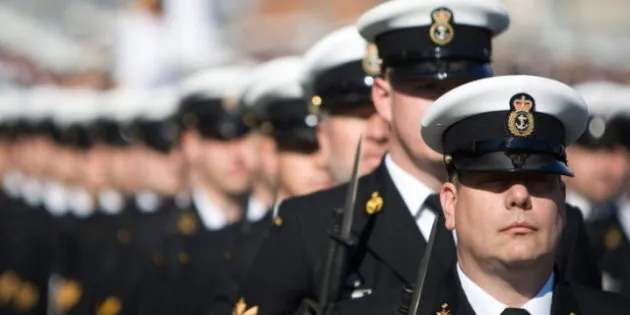
I must admit I am enjoying all the debate that Harper's addition of the word "Royal" to our navy and air force has created. One would have thought that the debate would have centered on whether this was a throw back to our monarchist ties or simply a reminder to Canadians and our serving members of the proud history of our armed forces. Instead it has spun off into a much larger debate that reminds me of the old hidden agenda attacks that the Liberals used to throw at us.
I am not a monarchist, but I can appreciate the addition of the word "Royal." My former regiment had "Royal" in its name. Such a designation was earned, usually based on a regiment's performance in a campaign and it was something to be proud of and part of a regiment's history. The addition of the word "Royal" doesn't disturb me, nor do I see some Conservative plot in adding it to our navy and air force.
Some suggest that Harper is trying to recast our history so that it is seen from a conservative slant. Others wonder if we are behaving like colonials. Still others see these moves as part of a larger attempt to play down key Liberal initiatives like the Charter, peacekeeping and multiculturalism. I have even seen speculation that this is all about boxing in the NDP in Quebec, even though many of Harper's initiatives pre-dated the last election.
There is nothing wrong with knowing and understanding our history and that includes our symbols and traditions. We need to promote them so that we have a better understanding of where we have come from and who we are today. But if we are going to promote our history, let's look at it openly, warts and all. Only then will we get a true sense of where we come from and who we are.
Any promotion of our military must include our actions in the First and Second World Wars. But we can not forget Korea, nor gloss over our sacrifices in Bosnia or what happened in Somalia. Our peacekeeping role in the Suez crisis and our resulting peacekeeping efforts around the world can not be glossed over. They are part of the foundation that makes us who we are on the world stage today.
If we want to promote our Canadian connection to the Arctic we need to know more about its original inhabitants, their culture and way of life. We need to know who explored that region -- English, French, Danes, Americans and Norwegians to name a few. If we are to focus on the North West Passage, perhaps Canadians should know about the achievements of the RCMP vessel the St Roch. And we need to know about the darker side of our Arctic history as well -- residential schools, the slaughter of the sled dogs etc.
With the number of court decisions that come down every year I doubt any Canadian will forget that the Charter exists, there is nothing that Harper can do about that. Love it or hate it, it is a fact of Canadian history and our daily life. It needs to be taught and understood. We need to come to grips with whether or not it is the Charter that many of us disagree with or is it the judicial interpretation of the Charter? While we are at it, how about teaching new Canadians and our school-age children about the original Bill of Rights that was brought in by John Diefenbaker in 1960.
And while we focus on present day rights, let us not ignore our past. We need to look at the internment of Japanese Canadians, Ukrainians, Italians and others. We need to look at racism in Canada and know that it is not just an American issue. I would suggest that most Canadians know more about racism in the United States than they do about what happened in our own country. Most Canadians know about the American Klu Klux Klan, but do they have any idea that it existed up here?
I also doubt the Conservatives are trying to bury multiculturalism. It has enriched this country, made us much more cosmopolitan and opened our eyes to many different cultures. All positives in a world that gets smaller with every new advance in technology. But when we accept multiculturalism we should not forget who we are. There is no need to bury our history, our symbols or downplay our special cultural and religious days such as Christmas and Easter. If I were to move to another country I would not expect them to change the way they celebrate their festivals or religious holidays. Anyone wishing to move here and eventually become a Canadian needs to know who we are historically, and who we are now, at home and on the world stage and accept what days we view as important... be they religious or historical in nature. We have become far too politically correct.
Promoting multiculturalism and our European history should not mean that we ignore other rich cultures that existed here long before Europeans had a clue that North America existed. Our First Nations have a rich history that all of us, including prospective immigrants should know more about. If we know more about our historical relationship with the First Nations, we will have a better understanding of the ongoing land claims process, their grievances and some of their objectives. And we can not ignore the events and broken promises that have led to the current impasse and difficulties that exist between the First Nations and any Canadian government, be it Liberal or Conservative.
Good for Harper if he wants to promote our history and symbols and give Canadians and new Canadians a better understanding of who we are and how we got here. I don't see a plot or hidden agenda, but I do say it is up to us to learn from the past, change what we don't like and move forward.