Featuring fresh takes and real-time analysis from HuffPost's signature lineup of contributors
Mark Milke

GET UPDATES FROM Mark Milke
 

Is It Open Season On Private Property In B.C.?

Posted: 10/17/2012 3:47 pm

The federal and B.C. governments have always claimed that native land claims would never affect private property, that First Nations governments would never have veto power over private land.

Right. Tell that to a retired 70-something couple from Vancouver Island, Gary and Fran Hackett, who face a Caledonia-like entanglement with their land. Their property in Vancouver's Marpole neighbourhood, which was in their family for almost five decades, has just been frozen. That was due to the discovery of assumed aboriginal bones.

When the Hacketts decided to retire a few years back and build condominiums on their property, they deliberately reduced the land cost as part of their partnership deal with a developer. The goal was to sell affordable condominiums. With smaller units at under $230,000 and an average price of $329,000 (reasonable by Vancouver standards), it is why 81 out of 108 units were pre-sold until "the troubles" began earlier this year.

In January 2011, the Hacketts obtained the necessary development permit from Vancouver. In December that year, the province issued permits to recover and record any culturally significant finds, including human remains. Both governments knew that the land contained potential cultural deposits from aboriginal activity that pre-dated 19th-century European settlers.

The Hacketts paid for the archaeological dig themselves, as indeed every private property owner in B.C. must. The initial estimate for the dig was $130,000; archaeological costs to date exceed $500,000.

The provincial permit granted to the Hacketts was clear that any remains would be moved elsewhere as it wasn't practical to keep them on the property. "Articulated human remains" will be subject to a "careful and respectful removal" and "will be re-interred or relocated according to the wishes and protocols of local First Nations," read the permit.

When their archaeologist found skeletal remains in one small corner earlier this year, that's when problems arose for the Hacketts.

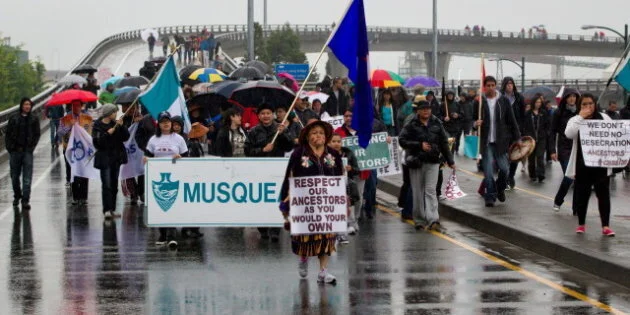
Protests from the Musqueam First Nation and others started in March. One May demonstration shut down the nearby Arthur Laing Bridge in the morning commute for two hours. Almost predictably, non-aboriginal politicians and the police ran for cover; aboriginal politicians have made this a cause celebre, and at the expense of private property owners.

SACRED GROUND

The protests have been animated by the discovery of intact partial skeletal remains of two infants and partial disarticulated (in essence, unattached bones) of one adult and child.

It is understandable that some feel every bit of ground is sacred. But that over-romanticizes matters. This is not a recent graveyard with headstones identifying one's near relatives.

Every human community in history is eventually built over past inhabitants. Paris is built over crypts that contain six million skeletons. Most were re-interred from above-ground graveyards in the late 18th century for health reasons and to make way for a growing city.

Back to the Marpole remains: The intact burial area is in a two-metre by two-metre wide plot that sinks just five-eighths of a metre. (Fragment remains were also found in a relatively small, already-disturbed area). That represents 0.113 per cent of the surface area. The city has refused to issue a building permit based on "the public interest"; similarly, the province denied the extension of its own earlier permits after the Musqueam protests.

The Hacketts and their developer partner could re-apply for permits to develop part of the land. That would be costly, cumbersome and a high-risk gamble given the protests and political shenanigans. In effect, 99.887 per cent of their land has been frozen.

The reasonable compromise is to move the remains. It has happened before. In 2006, human remains suspected of being up to 2,500 years old were found at a Nanaimo building site. The bones were transferred to the Snuneymuxw First Nation who said they would "bring it back to our community and do the proper ceremony." The City of Nanaimo supported the reburial process.

A 2008 reference in provincial permit archives makes reference to another relocation of remains, this within Montague Harbour Provincial Marine Park on Galiano Island. There are other examples in British Columbia.

When aboriginal claims crop up, especially related to previous habitats and human remains, reason can easily be sacrificed to emotion. But the proper balance is to respect such human remains and to respect private property.

The Marpole remains should be removed respectfully and reburied as has already happened elsewhere in British Columbia; the protests should end; the development should proceed.

That would be a reasonable outcome, unless the City of Vancouver, and the B.C. and federal governments now wish to signal that it is open season on private property in British Columbia. And if that is how they feel, they should compensate the Hacketts for the value of their land plus their substantial costs already incurred. Private individuals should not have to pay for government cowardice.

 
FOLLOW CANADA BRITISH COLUMBIA
The federal and B.C. governments have always claimed that native land claims would never affect private property, that First Nations governments would never have veto power over private land. Right. ...
 
 
  • Comments
  • 11
  • Pending Comments
  • 0
  • View FAQ
Comments are closed for this entry
View All
Favorites
Recency  | 
Popularity
HUFFPOST SUPER USER
BigLittle
07:41 PM on 10/19/2012
"...a Caledonia-like entanglement with their land."

This raised the spector of guns, physical intimidation, etc. Nonsense. Anyone who has driven by the protest knows that the picture of an elderly couple being held hostage by angry natives is pure fantasy. The development is a corporate play, represented by a Conservative Party insider.

People who don't live in Vancouver, or who haven't visited the protest should know that this "Caledonia-like" picture, like much of this post, is propaganda. Typical Fraser Institute.
11:59 PM on 10/18/2012
I'd like to say I can't believe this has happened to private property owners , especially after the government gave them permits for the project, but in fact knowing the way the natives and the government work it's totally believable! Believable, but disgusting! The natives seem to do whatever benefits THEM, and they always seem to bring in the big emotional thing , genuine or not, and the bleeding hearts , politicians, and beaurocrats fall for it every time, which always ends in them backing off to appease the natives. I for one am fed up with the politicians cowardice and the natives arrogance, and would like to see SOMEONE take a stand! The natives are milking society for millions and millions of tax dollars with no end in site, yet they still try to take from TAX PAYING citizens like this, and they wonder why people are fed up with them? The Hacketts should be totally compensated for THEIR land and their costs, and NOT with taxpayers money - if the natives want the land make THEM pay for it out of the millions they have! Come on politicians, grow a pair!
Throddy Borkins
03:03 PM on 10/18/2012
This story is almost unbelievable and the Provincial Gov't should not allow this type of situation to happen. As property owners you are now concerned about the property rights and do we really have any?
This couple should have their property restored back to them and or compensated full land value.
Stop this nonsense, one cannot trust governments to help and support us who do we trust? We pay the taxes in this province.
paintitblacker
shit happens life goes on
05:51 AM on 10/21/2012
and if gas or oil were discovered there , the out come would be the same
This user has chosen to opt out of the Badges program
photo
11:18 AM on 10/18/2012
surprised by "natives" constantly asking for more and more ?
im not
Donna Meness
www.findmaisyandshannon.com
08:25 AM on 10/18/2012
UPDATE

On September 27, 2012 Musqueam received the Province of B.C.’s decision regarding the permits issued by the Province under the Heritage Conservation Act to permit a 5 story condominium development at c̓əsnaʔəm, also known as the Musqueam Marpole Village Site. As recognized in the decision, this site was declared to be a National Historic Site in 1933 as one of the largest pre-contact middens in Western Canada and has special significance for Musqueam.

Musqueam is pleased that the proposed development is no longer authorized by the permits issued by the Province and that the ancestral remains are to be restored to their original condition. Their disturbance caused great anguish to the community and the proposed development would have desecrated an ancient and sacred burial place and destroyed a site precious to the Musqueam as representing one of the few links to our heritage extending back thousands of years. It would also have destroyed a Canadian historic site and a heritage site that should be protected for all British Columbians.

Musqueam looks forward to being actively involved in the steps to be taken to restore the ancestral remains in accordance with Musqueam customs and beliefs, steps that must be taken immediately to prevent further deterioration.

http://www.musqueam.bc.ca/c%CC%93%C9%99sna%CA%94%C9%99m
Donna Meness
www.findmaisyandshannon.com
08:24 AM on 10/18/2012
http://www.musqueam.bc.ca/c%CC%93%C9%99sna%CA%94%C9%99m

see: Recent Site Issues


http://www.ubcic.bc.ca/Resources/timeline.htm#axzz29eVYgTve

&

http://www.ubcic.bc.ca/News_Releases/#axzz29eVYgTve

&


http://www.ubcic.bc.ca/issues/SpecificClaims.htm#axzz29eVYgTve

SEE DOCUMENTS UNDER :Additional Materials for Review and Consideration
Donna Meness
www.findmaisyandshannon.com
08:14 AM on 10/18/2012
RCAP/CHAPTER 6:

1.2 Sacred and Secular Artifacts

Aboriginal people are seeking the return of artifacts held by museums and
collectors as one way of reasserting control over how their cultures are
depicted. These objects are the physical records of history and the physical
manifestations of culture. They help define Aboriginal identity:
Traditionally, Aboriginal cultural knowledge is transmitted and documented
primarily through the oral tradition, but also through such things as dramatic
productions, dance performances, and they are documented on such
artifacts as wampum belts, birch bark scrolls, totem poles, petroglyphs and
masks. This is the Aboriginal way of transmitting knowledge and of
recording information and history.
Greg Young-Ing
Vancouver, British Columbia, 4 June 1993

Items taken from Aboriginal people and communities over the years may be
secular or sacred. Secular objects might include tools, hunting equipment
and clothing — articles of everyday use. Some objects have sacred
significance, such as medicine bundles, which contain objects associated
with visions and are opened only on ceremonial occasions.

RCAP report/ Vol.3 /Chapter 6 /Appendix 6A: Excerpts from Turning the Page:Forging New Partnerships Between Museums and
First Peoples*


_____

I worked this conference...
Donna Meness
www.findmaisyandshannon.com
08:12 AM on 10/18/2012
RCAP report/ Vol.3 /Chapter 6 /Appendix 6A: Excerpts from Turning the Page:Forging New Partnerships Between Museums and
First Peoples*

This report considers the disposition of Aboriginal cultural patrimony,
including human remains, burial objects, sacred and ceremonial objectsand other cultural objects that have ongoing historical, traditional or cultural import to an Aboriginal community or culture. The Canadian MuseumsAssociation and the AFN should endorse & encourage the adoption of the following guidelines relating to the repatriation of Aboriginal cultural patrimony:

a. Human Remains
b. Objects of Cultural Patrimony

The treatment, use, presentation and disposition of sacred and ceremonial objects and any other objects of cultural patrimony should be decided on moral and ethical grounds with the full involvement of the appropriate First Nations as equal partners. In the event of disputes between individuals, between an individual and the community or between communities, theonus should be on the First Peoples to resolve the dispute according to customary practice.
Recommended options for this process include the following:
(i) Restitution or Reversion.
(ii) Transfer of Title.
(iii) Loan of Materials
(iv) Replication of Materials
(iv) Replica

c. Repatriation of Foreign Holdings
The CMA and the AFN are urged to promote repatriation of human remains and objects of cultural patrimony held outside the country, subject to the same criteria outlined above under 1 & 2, through lobbying efforts in association with national governments, UNESCO, the International Council of Museums and other professional organizations.


* Report of the Task Force on Museums and First Peoples (Ottawa:
AFN
Donna Meness
www.findmaisyandshannon.com
10:38 AM on 10/18/2012
Examples of successful claims to objects in the Canadian Museum of Civilization include the return of confiscated POTLATCH items to the Alert Bay and Cape Mudge peoples in 1978, the Starlight MEDICINE BUNDLE to the SARCEE (TSÚÙTÍNÀ) people of Alberta in 1989, and the 1991 return to the SIX NATIONS Confederacy of three WAMPUM belts (the Circlet of the League, the MOHAWK Chief's wampum, and a SENECA wampum called The Three Sisters). In 2001, the museum adopted a written policy on repatriation (see MUSEUM POLICY). Several other museums across the country also have, or are developing repatriation guidelines or policies.

The topic of artifact repatriation is now commonly addressed in Canadian LAND CLAIMS. These agreements usually outline government responsibilities for helping First Nations to repatriate artifacts to their areas. The NISGA'A agreement (1999) was the first to include major provisions for repatriation. The Nisga'a have negotiated the repatriation of 200 artifacts from the Canadian Museum of Civilization and the Royal British Columbia Museum. The LABRADOR INUIT Land Claims Agreement (2005) also provides for the repatriation of nearly 80 artifacts from the Canadian Museum of Civilization. Several First Nations are establishing their own facilities for the safekeeping and exhibition of repatriated objects

http://thecanadianencyclopedia.com/articles/repatriation-of-artifacts
Donna Meness
www.findmaisyandshannon.com
10:48 AM on 10/18/2012
sorry wrong section cited:


http://www.collectionscanada.gc.ca/webarchives/20071211060649/http://www.ainc-inac.gc.ca/ch/rcap/sg/sia6a_e.html

a. Human Remains

(i) Remains of individuals whom evidence indicates are remembered by name must be offered for disposition at the request of the families, their descendants or clan, upon notification of the appropriate First Nations, community, tribes, clan or family members.

(ii) Human remains which evidence indicates may be affiliated with a named First People must be reported to that Nation, community, clan, tribe or family.

(iii) Upon agreement and in cooperation with the museum the appropriate First Nations group may work with scientific interests for a mutually agreed upon period, and may have the remains re-interred according to the appropriate traditional or other religious practices of the First Nation or Aboriginal community.

(iv)The treatment and disposition of remains and associated burial objects that are ancient or that cannot be affiliated with a named First People shall be decided through discussion and negotiation with an advisory committee of First Peoples. The First People may work with scientific interests for a mutually agreed upon time period and may have the remains re-interred in manner consistent with local traditional practices.

(v) Museums that acquire human remains through any means must involve the appropriate First Nation in the treatment and disposition of the remains.

(vi)The retention of Aboriginal human remains for prolonged periods against the expressed wishes of First Peoples is not acceptable.