It was all so cozy. That is, until the people woke up and realized what was going on.
It used to be that a few guys from the oil industry could get together over drinks and make the decisions on major infrastructure projects. After all, the governments parked themselves on the sidelines with Chapter 6 of NAFTA, leaving compliant regulators behind to rubber stamp everything industry brings forward.
Then it started to fall apart. Faith in the industry and their supposed regulators was shaken with the Deepwater Horizon spill. Enbridge followed suit by dumping over a million gallons of tar sands crude into Michigan's Kalamazoo River. Government failure to pass meaningful climate legislation in both DC and Ottawa shifted attention towards the polluters themselves -- chief among them the exploding tar sands and the pipeline companies who want to move that carbon to those who would send it up into the already crowded atmosphere.
Even the reliably rah-rah-fossil-fuel International Energy Agency recently put out a report highlighting how energy infrastructure "locks in" pollution for decades to come, bringing into sharp focus the fact that infrastructure decisions are not in fact being made by people we elect to serve the public interest, but rather by those who are acting in their own short-term financial interest.
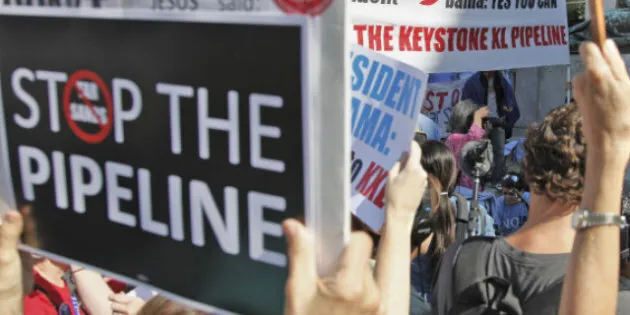
In 2011 these factors came together in the form of a building public uprising against tar sands pipelines. Hundreds of people put their freedom on the line in DC and Ottawa, getting arrested over the proposed Keystone XL pipeline, which is now delayed. Over 4,000 people are signed up to speak against Enbridge's proposed Gateway pipeline across British Columbia, joining First Nations who are also staunchly opposed. Even Enbridge's proposed partial reversal of its existing Line 9 in Ontario is starting to draw heat for potentially bringing tar sands oil to Quebec and New England for the first time through a creaky, old pipeline network.
Some of the old boys can't seem to get their heads around the fact that their club has started to crumble. Enbridge CEO Pat Daniel has taken to conspiracy theories, thinking his Canadian environmental critics are really just disguised Americans after his oil. Conservative politicians have meanwhile been dusted off and pressed into action on both sides of the border, suddenly taking an interest when industry isn't getting its way, despite being usually content to let the "market" (a.k.a. the oil companies) decide.
So where does this leave us? Is the pipeline interruptus we saw in 2011 the new normal, or will the industry get back to the place of running the show without the pesky interference of the public?
One thing is clear: continued political dithering over climate change will continue to paint huge targets on any energy infrastructure that helps to increase emissions. Industry is reaping what it sowed in this regard, after having lobbied successfully so far for politicians to do next to nothing to rein in pollution. As the impacts of climate change become more serious and more visible, expect a growing public backlash to fossil fuel activity.
As 2012 takes shape, we'll see if this backlash begins to coalesce into a more coherent political movement for change, not just for alternatives to the tar sands, but also for more democracy in how our energy choices get made. This is entirely consistent with what we've been seeing in the Occupy protests -- the feeling that the select few have been running things in their interests for too long, and that the system is badly broken as a result.