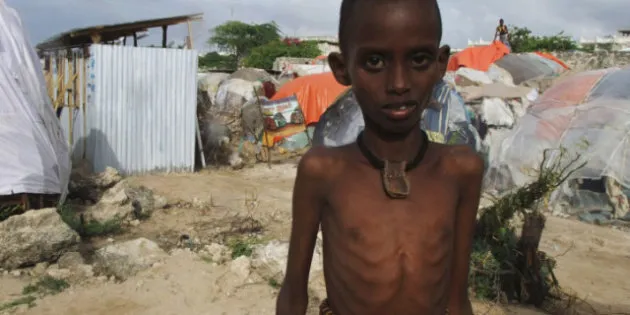
Recently, I had the honour of speaking at a fundraiser for the victims of the famine in the Horn of Africa, organized by local health care providers, Dr. Farook Hossenbux and his nurse/partner Geri Hossenbux. Speakers included a representative from Doctors Without Borders, local groups raising money for the cause and local artists. Several mentioned the phenomenon of "donor fatigue" in this case and puzzled about why it was so hard to raise money for a crisis threatening as many as 12 million people, many of them children, while other recent disasters have been met with an outpouring of generosity.
When I spoke, I addressed this question and said that the reason might be related to the narrative upon which most people in the global North assess this situation. Most Westerners see the crisis in the Horn of Africa as a combination of a large population, chronic poverty, corruption on the part of African government officials, failed states and no rain, and that none of this will ever change so giving money to this self perpetuating crisis is throwing it away. But I offered another narrative that I believe is closer to the truth.
I believe the water and food crises in the Horn of Africa are the direct result of old-fashioned colonial exploitation: land grabs by foreign hedge and investment funds and wealthy countries setting up large foreign-based agribusinesses that are guzzling the lion's share of the water resources and using them to grow crops and biofuels for export and drive up speculation. Ethiopia, for instance, has already leased seven million acres of land at $1 an acre for 100 years and has put another seven million on the market. Lake Naivasha in Kenya (where the movie Out of Africa was filmed) provides most of the cut flowers (88 million tons every year) for Europe. As a result, the local Masai population has no access to its traditional water source, and the lake, like hundreds of others in the region, is dying.
Foreign acquisitions are forcing small farmers and peasants off the land depriving them of access to food and water. The food and water of the region is being used for export for profit and not being used for local people. As a result, food prices in the region have gone up 200 per cent in less than a year and the price of water has risen 300 per cent. The foreign minister of Ethiopia defends his government's actions with the neo-liberal explanation that these foreign "investments" will make the country wealthy enough that it can stop producing food and start buying it on the world market. But exactly the opposite is happening when you drain the land of its water, as is being done by this agribusiness industry, and the rains stop coming. The drought is directly related to both climate change and the resulting desertification of a land stripped of its water sources.
In my remarks, I pointed out that there is enough food and water for all in that region, (as there is for every region on earth) if they moved to a set of policies based on respect for the land, water and people, instead of the greed and raw power of global food interests increasingly entrenched in global and regional trade agreements.
Here is what is essential to know: deserts can arise because humans treat land and water badly. Desertification is taking place in over 100 countries in the world, as we strip the land of land-based water from aquifers and rivers, sending it to thirsty mega-cities (who dump it untreated into oceans), or using it to grow food and other goods for the world market, where it is transported out of local watersheds in the form of "virtual water exports."
Water-retentive landscapes, conservation, watershed restoration, rainwater harvesting, small, local and sustainable farming, poverty reduction, and the human right to food and water: these are the guideposts to a sustainable, just and full recovery for the Horn of Africa.
People at this fundraiser opened their hearts and their wallets to do their part to ease the suffering in the Horn of Africa and that is as it should be. But if we are to stop this perpetual cycle of death in this region of the world, we need also to have the courage to talk about justice as well as charity.
Maude Barlow