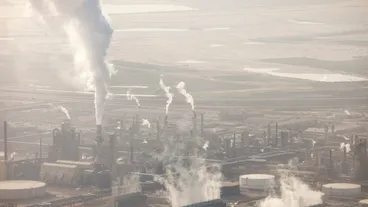
Pardon my french, but Canada's tar sands suck. As a Canadian it blows my mind that we can have the second largest deposits of oil in the world, but our government remains billions in debt and one in seven Canadian children live in poverty. Here are ten reasons Canada's tar sands suck.
What the hell indeed is going on in Fort McMurray, you might ask. How did I get to spend time talking to Malcolm Gladwell, and Bill Cosby? What is bringing these people so far north? Well, what is bringing them is the Northern Insights speaker series from the Fort McMurray Public Library - but I think what is really drawing them in is the narrative of this community.
TarSandsRealityCheck.com, which launches today, offers fact-checked, easy to understand information about Canada's tar sands. Created by academics, ec...
Last week the world hit a new milestone. We crossed 400 parts per million CO2 concentration in the Earth's atmosphere, 50ppm above what is considered a safe level. According to Canada's new advertising campaign website Go With Canada, our government is taking steps on environmental protection, climate action and industry monitoring. Reality paints a different picture.
Canada's ability to oversee large energy projects is crumbling. No matter which way you look at it, Canada's regulatory system just isn't up to the challenging task of protecting the health, environment and economy of Canadians from risky energy projects.
If we connect the dots between all the natural gas, coal and tar sands proposals in B.C., a big picture emerges and the choice we face becomes both stark and clear: B.C. needs a government with leadership and vision to make the hard decisions. The province needs courage to stop building pipelines that would put at risk thousands of jobs and lock us into global warming. We need stewards to protect our collective future wisely, by investing in green jobs and saying yes to a clean energy future.
In the past the BC NDP condemned the Liberal carbon tax policy without doing the hard work to address how an NDP government would address these challenges. Under the leadership of Adrian Dix it is now clear that an NDP government would take these issues very seriously and they have taken the time to carefully consider how the carbon tax needs to cover more greenhouse gas emissions to ensure that we not only reduce pollution but also build a stronger and more equitable economy for B.C. I'm impressed.
Gerry Protti, Alberta's new overseer of environment and safety in the province's oilpatch, has been central to a network of oil industry front groups and lobbyists for many years and it is raising the eyebrows of more than a few people. Protti was recently named as the new head of the Alberta Energy Regulator, a new provincial agency whose mandate, is "...to provide for the efficient, safe, orderly and environmentally responsible development of energy resources in Alberta."
TransCanada, the multinational corporation hoping to build the controversial northern half of the Keystone XL pipeline, spent over $280,000 on lobbying the U.S. government in the first quarter (Q1) of 2013, according to lobbying disclosure records.
Quebec's recent Earth Day 2013 celebrations saw a lot of misguided ideas being bandied about by environmental activists who are determined to radically shrink Canada's energy production and consumption based upon a single value: preventing climate change.
Some people think a widespread shift from fossil fuels to cleaner energy sources is not practical or even possible. And so we carry on, rushing to squeeze every last drop of oil and gas from the ground using increasingly difficult and destructive methods like fracking, deep-sea drilling and oil sands extraction, with seemingly little concern for what we'll do after we've burned it all.
Questions include what exactly caused the spill, how big was the spill exactly, and how long did it take for emergency responders to react to the spill, to name a few. But one thing is certain according to the new study: For the residents of Mayflower, quality of life has been changed forever.
Jim Hansen, the esteemed scientist formerly of NASA, is spewing "nonsense" when he is talking about global warming and Canada's Keystone pipeline, according to Joe Oliver, Canada's Natural Resources Minister and former investment banker turned heavy oil mouthpiece.
A National Post article explains that various energy initiatives, such as a plan to convert one of TransCanada's existing natural gas pipelines into an oil pipeline from west to east, came about through discussions with only the relevant parties, which enabled greater cooperation.
O'Brien's has had its hands in the botched clean-up efforts of almost every high-profile oil spill disaster in recent U.S. history, including the Exxon Valdez spill, the BP Deepwater Horizon spill, the Enbridge tar sands pipeline spill into the Kalamazoo River, and Hurricane Sandy.
The government appears determined to challenge any information, person or organization that could stand in the way of its plans for rapid tar sands expansion and transport and sale of raw resources as quickly as possible to any country with money. The results have been astounding.