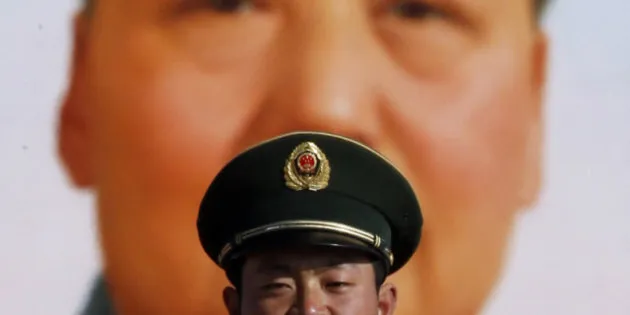
In March, while clamping down on simmering protests in China following the Arab Spring, the Chinese government's top legislator told 3,000 deputies at the National People's Congress that it would brook no challenge to the Communist Party's authority.
"We have made a solemn declaration," stated Wu Bangguo, chairman of the National People's Congress standing committee, in affirming China's "five no's" -- no multiparty elections, no diversity in guiding thought, no separation of powers, no federal system and no privatization.
In the past, the Chinese government had denied that it had a policy of squeezing out the private sector. This unofficial policy, which entrepreneurs dubbed "guo jin min tui" -- literally "the state advances as the private sector recedes" -- has since become a household term that serves the government well: To assert its authority, the government now unabashedly declares that its absolute control of all power centres in Chinese society includes the private sector. China is heading for a degree of government ownership and central planning unseen since Mao's passing.
The extent to which the Chinese government believes that a few people at the top of the government hierarchy can micromanage an economy for 1.4 billion people became clear with the recent release of the government's latest five-year plan. Many governments think they can pick a few winners in their economy. China's central government thinks it can pick 750 of them, and plans to provide them with the support needed to make theirs a self-fulfilling prophesy. More, China thinks it can pick losers -- it found 426 of them -- and will ensure their demise.
The winners include coal mines, perfumes, electric cars, airports and wildflowers. "National champions" and other state-owned companies operating in winning sectors get free land, cut-rate financing, instant approvals, guaranteed domestic markets and expedited stockmarket listings. The losers -- they include companies in disposable foam plastic dinnerware, vertical gas water heaters and cardboard detonators -- get nothing but a date by which they must terminate operations.
China's micromanagers also have a third category -- a kind of purgatory -- for industries that will be tolerated for a while. These include villa-type real estate developments, golf courses, artificial leather, certain types of toothpaste and small versions of the winners -- small coal mines, for example. These tolerated sectors -- typically in the private sector -- will receive no government favours and are expected to disappear over time.
China, disdainful of what it sees as the West's weakling management of its economies, is confidently taking the helm of its own. As put by Premier Wen Jiabao at last year's National People's Congress, "The socialist system's advantages enable us to make decisions efficiently, organize effectively and concentrate resources to accomplish large undertakings."
China's liking for national champions -- state-owned companies that are typically also traded on stock exchanges -- is easily understood. According to one study of the decade ending in 2008, its national champions' assets, sales and R&D expenditures grew on average 25 per cent a year, while their profits grew at an astonishing 40 per cent a year. From the Communist party's perspective, national champions and top-down planning have another advantage -- they provide the party with control that would be impossible if people and industries could act independently.
The architect of China's top-down plan is its National Development and Reform Commission. This all-powerful agency, easily the world's largest planner, itself operates at the very highest levels in the Chinese hierarchy -- directly under the State Council, China's Cabinet. This is the agency that issues the country's five-year plans (the twelfth five-year plan has just begun), that both plans and manages China's economy, and that epitomizes the China model, the envy of much of the world for its readiness to act decisively.
Yet top-down decisive action -- when detached from market demand -- also has large, less-easy-to-measure downsides. China's ghost cities provide the most spectacular example of central planners that got it wrong -- entire cities able to house tens and even hundreds of thousands each that remain mostly deserted years after their completion. Less well known are the high-speed rail lines that run devoid of passengers, the four-lane highways devoid of cars, the airports devoid of planes and the hydro dams devoid of water.
China's signature Three Gorges Dam, the world's largest and once the epitome of the China model, now symbolizes the folly of central planning -a Shanghai daily even called it "that monstrous damming project" -- because it has failed to achieve any of its major goals, including flood control, navigation, and the provision of cheap power. There is, in short, no way of knowing whether the immense gains that central planning conferred on the national champions exceeded the immense costs that central planning imposes on the rest of the economy.
And now China is taking central planning to a new level through guo jin min tui. Through this creeping nationalization of the existing private economy, the Chinese planners expect the winners to absorb many of the small industries in purgatory, adding to the heft of the winners while eliminating the small fry and streamlining the industrial sector. China's planners are taking other steps, too, to ensure that the private sector recedes.
Foreign competitors to China's national champions will generally be restricted by being prevented from operating in China in competition with Chinese companies. The only exception to this rule involves Western companies with technologies that Chinese champions need. In such instances, the Western firm would be allowed in, as a junior partner to the Chinese national champion, on condition that it turn over its technology to China.
Western firms have been accepting China's terms. In high-speed rail, for example, foreign companies such as France's Alstom, Germany's Siemens and Japan's Kawasaki had until recently controlled about two-thirds of the Chinese market. In 2009, the Chinese government changed the rules, requiring them to provide their technology to state-owned Chinese corporations in exchange for the right to bid on future rail projects. These multinationals now account for less than 20 per cent of the Chinese market. The national champions, meanwhile, not only dominate the local market, they are now competing against their junior partners in foreign countries, most recently having won contracts in Australia and New Zealand.
In another example of how the private sector is giving way to state producers, foreign multinationals until recently held 75 per cent of China's wind market. They're now down to 33 per cent or less, having failed to win a central government-funded wind energy project since 2005. China accomplished this feat using sticks and carrots. The big carrot: China offered the stateowned companies' customers lavish subsidies that effectively squeezed out foreign manufacturers. The big sticks: The government slapped a 70 per cent local-content requirement on the foreigners and hiked tariffs on imported components.
Not surprisingly, Western companies -- feeling unwanted -- have begun to pull up stakes in China. Which suits China just fine. Its planners take the goal of guo jin min tui seriously -- the state advances as the private sector recedes.
The question that remains: Will the current helmsmen of the Chinese communist economy fare better than their predecessor, Great Helmsman Mao? The answer may lie in an alternative meaning for guo jin min tui that Chinese citizens understand all too well. The phrase can mean both, "The state advances as the private sector recedes" and "The nation advances as the people fall behind."
Patricia Adams is an economist and the executive director of Probe International, a Toronto-based think-tank.
This article appeared in the Financial Post.