Featuring fresh takes and real-time analysis from HuffPost's signature lineup of contributors
Patricia Pearson

GET UPDATES FROM Patricia Pearson
 

Attawapiskat's Abandonment Crisis

Posted: 11/29/2011 5:25 pm

If you want to understand what's going on in Attawapiskat, you need to hop on a plane. There's pretty much no other way to grasp why one of Canada's First Nation fly-in communities would be receiving disaster relief from the Red Cross for simply attempting to exist as a town.

I see it this way, at any rate, because I had to travel by bush plane from Thunder Bay to three Oji-Cree reserves 600 kilometres north in the remote Ontario forest before I could grasp the essence of the crisis.

What this is about, in all kinds of ways, is distance. A distant bureaucracy from a distant culture imposing baffling edicts and regulations on a group of people who were highly self-sufficient hunters and trappers for thousands of years before they wandered into the quicksand of the Indian Act.

The Oji-Cree didn't spring fully-formed from the earth as "lazy welfare bums" whose chiefs "squander taxpayers' money."

On the contrary, a strikingly competent people were assigned patches of land in the boreal wilderness -- and that is what you glimpse from the plane, the unutterable vastness of that wilderness -- and told to stay put. No more following the game, or the trap lines. The forest around them became Crown Land. They cannot log it, not even for houses. They're not allowed to run a saw mill. They can't secure mortgages.

Instead, a Kafkaesque bureaucracy thousands of kilometres away in Ottawa devised an arid calculus for Aboriginal housing allotments that apparently takes no account of location. X amount of money per home, regardless of whether the home is built two feet outside of Toronto or upon the isolated flood planes of James Bay.

As a result, the Oji-Cree bands find themselves having to spend a significant chunk of allotted money on shipping the materials they aren't permitted to cull from the world around them. Money diverted to shipping (and flown-in contractors and inspectors) means fewer houses, and over some decades the shortfall becomes extreme. People crowd in together. Children start sleeping in shifts.

If windows arrive cracked, they get installed cracked, because there is no cash to buy a replacement window. (Nor is there a store.)

There are no nearby materials with which to mix and pour concrete foundations, so the houses go up slipshod on wood bases, on damp or flooded ground. It doesn't take long for mould to spread.

If your door knob falls off, you can't replace it, because there's no store. (See above.)

If your steps rot, you can't repair them, because you haven't got a hammer. (See above.)

The tragic absurdity of the situation only pops out at you when you fly up there, because who can imagine the predicament?

Walking around the community of Summer Beaver, for instance, trailed by cheerful dogs, I was absolutely floored by the absence of everything civic. This was a town, but there was no community centre or restaurant or playground or sports arena or clothing shop or Timmies. The entire society was serviced by a single corner store selling corner store stuff, like Beef-a-Roni and Coke. Nothing else for hundreds of kilometres except hauntingly beautiful woods.

The people are stoic, witty and hospitable. Remarkably, they continue to be hopeful. The health director at Summer Beaver sends emails to Health Canada, pointing out that the houses are filled with mould, which elicit "mould assessments" by experts that, in turn, result in formal reports back to Summer Beaver saying "Yes, indeed, you've got mould."

It's like your entire nation had been conquered -- not by soldiers, but by "Emily," the automated Bell Canada voice assistant who led us all in circles a few years back until enough customers roared.

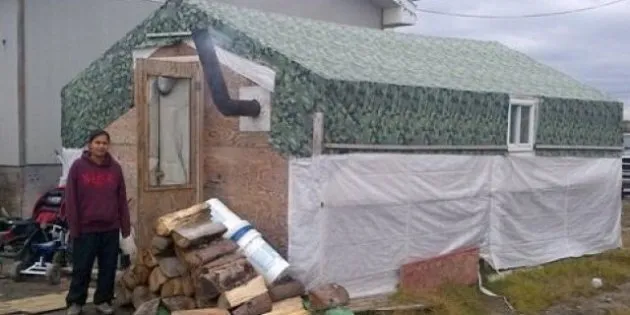
I'm guessing it is only a matter of time before the houses are condemned, like the homes in Attawapiskat, and everyone spills into tents. This is what I mean about the Red Cross having to provide disaster relief for the disaster of trying to live when bureaucratically-governed.

The school in Attawapiskat was condemned over a decade ago. But the government forgot/wasn't interested/didn't get around to building a new one, giving rise to "Shannen's Dream," a campaign spearheaded by the children. They went down to Ottawa, led by a spirited and articulate 13-year-old named Shannen Koostachin, and said, "Please, may we have a school?"

No, you may not.

There is still no built school, although it continues to be promised, as if it were an indulgence not to be taken too seriously, such as when children ask their parents for a pony.

Put the school in place, though, and what is the curriculum teaching? Algebra, perhaps, but not how to trap beaver or operate a power drill. The education offered to the Oji-Cree is neither practical nor culturally relevant. You cannot take an ancient nomadic culture out of the forest, stick them in "towns," and skip the part about teaching them how to build according to code. This is particularly ill-advised if you are also going to force them to forget how to hunt and trap by packing them off to residential schools for a couple of generations. They now know precisely nothing of this, nor that.

I visited the Oji-Cree with the North-South Partnership for Children, a fledgling coalition of private citizens, Rotarians, philanthropists and NGOs in southern Ontario who are working with the communities to find more practical, relevant and flexible solutions. What the communities are seeking, overwhelmingly, is skills training, distance mentoring, knowledge transfer, moral support. "Just walk beside us for a while," as one elder put it.

They don't want to be rescued, although there's nothing for it in the short run. But they don't want that in the long run. They want to be oriented, the way we regularly and abundantly orient immigrants to their native land.

They also wouldn't mind a wee bit -- just a modicum -- of respect. You try living in a tent for two years in -40C weather and keeping your sense of humour. They're doing it even as I write.

www.pearsonspost.com

www.northsouthpartnership.com

Loading Slideshow...
  • A child with a facial rash from lack of clean water and sanitation.

  • Many children are scalded and burned from living in densely overcrowded houses with makeshift wood stoves.

  • Inside a makeshift tent -- home to a family of six.

  • A young mother stands in front of the tent she has shared with her husband and four children for two years.


If you want to understand what's going on in Attawapiskat, you need to hop on a plane. There's pretty much no other way to grasp why one of Canada's First Nation fly-in communities would be receiving ...
 
 
  • Comments
  • 47
  • Pending Comments
  • 0
  • View FAQ
Comments are closed for this entry
View All
Favorites
Recency  | 
Popularity
Page: 1 2  Next ›  Last »  (2 total)
photo
Blodo
Time to build a better world
09:10 AM on 01/11/2012
The Indian Act is the most dysfunctional piece of legislation Canada has ever produced. Time to tear it up and look at these remote communities with totally fresh eyes.
HUFFPOST SUPER USER
BUTCHER99
04:57 PM on 12/13/2011
time to retire the kid with the rash picture and the rest of them? Do you not have any other pictures you could post?
07:22 PM on 12/01/2011
shame, shame, shame on useless, greedy, careless Canadian governing/governments
11:48 AM on 12/01/2011
Since this story first hit the mainstream news, I've read a lot of information. Here is the number that keeps leaping back at me that nobody has answered - why is it that the band's salary line increased by 1.4 million dollars last year and more than that the year before? While I understand that things cost a lot more money up there, buying from the Northern Store, I can't imagine sitting there, watching your family and friends living in horrid conditions (and I think that we can all agree that living in a tent is awful) and voting yourself a pay increase. I just can't imagine living there and saying "that's somebody else's problem."

The problem with this article is that it compares Summer Beaver to Attawapiskat as if they were the same place. Summer Beaver is a village of 362 people and Attawapiskat has four times the number of people. It has a Northern Store, which carries tools, groceries and furniture - expensive, but they sell hammers and nails and Black and Decker power tools. They have a small nursing station, a coffee shop and a variety store that sells variety store stuff. Yes, lumber is hard to get in the summer, but this has been an issue for years and there is a winter road and a barge that brings in supplies. 1.4 million dollars can help fix a lot of houses.
This user has chosen to opt out of the Badges program
08:08 AM on 12/01/2011
Thank you Ms. Pearson for your rather enlightening article. You've shown us a bit of the other side of the coin, so now instead of just automatically asking "where did all the money go?" with indignation, we actually have think about the issue.
Thanks for going there and seeing it for the rest of us with your own eyes, instead of just writing an opinion piece. This is worth so much more.
12:48 AM on 12/01/2011
I watched the crisis video made by the community and was very interested to see the chief of the village drives a cadillac escalade.
10:10 PM on 11/30/2011
Here's a novel idea...why not ASK our First Nations brothers and sisters what they believe is the best solution to their ongoing problems? Why not have some real communication where we LISTEN instead of trying to impose what we believe is best for a society whose culture and unique challenges we cannot begin to understand...why don't we respect and support the needs of the aboriginal people instead of telling them how it should be done, based on OUR cultural beliefs.
photo
Blodo
Time to build a better world
09:19 AM on 01/11/2012
There is lots of listening done. The problem is...who do you listen to: the Chief and Council? The Chief's past opponent? The family of Chief and Council? Those who don't even bother to vote because they don't think it will do any good? Those who got kicked off reserve because they tried to expose corruption? The bands? The regional tribal councils? The Assembly of First Nations? Their agendas have parts that overlap and parts that are entirely at odds.

The political system that has been established on reserves is a totally artificial European imposition that breeds corruption, and First Nations people do not speak with a united voice. Attempts to scrap the Indian Act in the past (under Trudeau) were met with strong resistance. There may be a growing number of young people who are ready for drastic reform, but regardless, it will still come down to someone in Ottawa making some very tough decisions.
photo
Peter Biesterfeld
Documentary film maker, writer, educator
09:20 PM on 11/30/2011
It's not a news flash that housing issues and other social ills in many First Nations communities are the residue of unspeakable colonialist attitudes and behaviours practiced by the dominant culture. Get rid of the Indian Act, dismantle Aboriginal Affairs and Northern Development Canada and negotiate as equals nation to nations for independent FN governments and end this dependency on Canada the colonialist entity that calls the shots about all aspects of native life telling you whether you have "status" or not, where you can live how you can make your living and what kind of education you receive. This issue is not about billions of unaccounted-for dollars pumped into communities and corrupt chiefs, its about hundreds of years of oppression. And the prevailing bureaucracies around "Aboriginal Affairs" ensure that the dependency, corruption and the oppression continue.
03:09 PM on 11/30/2011
Thanks for this blog. It clarifies a lot about the predicament. I feel bad. We all feel bad. But we all have the same question: Where are the hundreds of millions of dollars that have been spent on the reserve system? Because it's pretty obvious no one gave it to these people
photo
EllaMai
Non-violent complainer. From North of the border.
12:47 PM on 11/30/2011
Each and every band signs a treaty with the government. They give the government land in exchange for perpetual gratuities. The bands negotiated the funds they were to receive. The people living in those communities need make their elders accountable for doling out the supplies properly. Alternatively, if the community simply can't be viable because of distance to civilization, then perhaps a tough choice needs to be made on relocation.

You can't live a modern lifestyle with all the conveniences of civilization if you live thousands of miles from it. And if you expect exactly that, but still want to live in a "traditional" way, you have to realize you can't reconcile those two. It's one or the other.

As a Canadian tax payer, I am all for keeping the treaties and paying for the land we now own. But some realism needs to happen on both sides for this arrangement to work out.
01:10 AM on 12/01/2011
Not every band in Canada is party to a treaty. There are numerous bands that have been slowly pushed out of their traditional home bases. This was caused mostly by the timber industry and the colonization societies that were busy providing new Canadians with land grants. So when bands were petitioning for reserve lands they were basically given the lands no one else wanted, so it's not entirely a "live in the middle of nowhere because you want to" it's a "live here because no one else will" procedure.
And not all treaties were involved land transactions. The earliest treaties were the Peace and Friendship Treaties which were supposed to have promised dual stewardship over the lands.
photo
HUFFPOST SUPER USER
canadagirl76
A mind is like a parachute, they work best open.
11:43 AM on 11/30/2011
It's absolutly shameful that this is happening in 21st Century Canada. I for one am going to contact my MP & see what exactly is being done. I am sickened that my country would allow this to happen.
11:29 AM on 11/30/2011
Excellent article Patricia. The government needs to change its way of dealing with our First Nation brothers and sisters. As you point out, they need someone to walk beside them for a way and give them a hand up. Simply throwing money at them is disrespectful. As Canadians we need to raise these people to first class citizens and help them to establish a new lifestyle model appropriate to the times. In the case of Attawapiskat: How long can this community built on permafrost be viable in the long term with the trend of global warming?

Governments need to craft a long term plan along with the native people that unfortunately may have to be done one community at a time.
This user has chosen to opt out of the Badges program
photo
CanadaStan
Cogito ergo spud, I think, therefore I yam
10:17 AM on 11/30/2011
ReserveTransparency.ca
http://taxpayer.com/node/11969

"If you're fed up with the fact that many reserve politicians are able to keep band financial information hidden from the public, then you've come to the right place!

This web site was set up to:

* Provide all Canadians with information on what they can do about the lack of transparency on reserves
* Inform band members as to their legal right to band financial information
* Provide band members with information on how they can apply for audit & salary information (current federal information laws do not require bands to disclose band audit details to non-band members)

Scroll down to find out more! "
09:43 AM on 11/30/2011
Tragically, Shannen Koostachin was killed in an automobile accident. This adds more heartaches to the tragedy.
12:37 AM on 11/30/2011
Well-written and well-explained. Thank you, Patricia Pearson. Especially for actually going there.