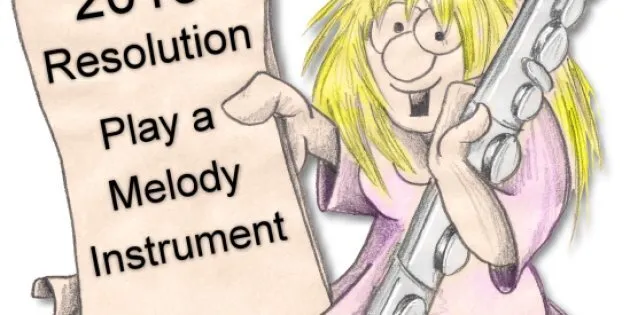

To many people, the thought of playing music brings back bad childhood memories, akin to playing dodgeball and lunchtime detention. Most have reasons why they let music fall from their lives, and that's so sad, because music is a language and if you can read it, you have endless resources at your fingertips.
Playing music can invigorate you, relax you, make you laugh, be a friend when times are hard, bring back cherished memories, and also is a great vehicle to connect with other generations. Play a song for your parents and unlock long forgotten memories. Play along with your son and he may laugh at you, but he will also tell his friends that his Mom is cool.
There is a misconception in the world that learning is for the young. That somehow if you don't become a concert pianist by the age of six, you may as well give up music altogether. Well, for one thing I don't want a six-year-old deciding my career path, but also it's not all or nothing with music.
As with reading, you don't have to become a book editor, because you can read. You don't have to read tomes on boring subjects, just because you have that ability, and so it is with music. If you like the music from the 80s (and who doesn't?) you can play that. Got a thing for medieval ditties? No problem.
Any type of music, for any reason is wonderful, and as an adult you get to choose. You are not at the mercy of a proscribed, rated, and officially approved music list, which is generally bereft of any soul.
Music is not a punishment, it's a reward.
Because music is difficult for most children, it becomes a bad thing, or a bad memory. As with sports, there are the achievers that we secretly hate, and the rest of us who are waiting for the day we can drop the subject. A surprising thing happens however, as adults we have retained the basics and are amazed at how good we are at something when we try it for the second time.
Also, as adults, we are good researchers. We can sift through materials and find things that are pertinent to us and don't have to wait for the "rest of the class" to catch up. We can move along at a remarkable clip and not get stuck in a rut trying to grasp a concept that our child brain just couldn't understand.
Many people ask me "what's the best instrument to play?"
Answer: Melody Instruments
I group instruments into three main types:
- Melody Instruments: You play the tune.
- Strummy Instruments: You strum these while singing (guitar and ukulele).
- "OMG, what are my hands doing?" instruments: You play the harmony as well as the melody (piano and harp).
Not only will you achieve success quicker by concentrating on one thing, but the melody is the filling in the cookie, the icing on the cake, or in other words, the best part. As adults, we get to indulge ourselves and eat our dessert first.
Which melody instrument? If you studied one in school, or have one, probably that would be your best choice. If you had piano lessons, don't have an instrument, or are new to music; a C (non-transposing) instrument is best, simply because there are more resources available on the web. I think the very best instrument for getting back into music, if you don't already have an instrument, is the EWI.
Some popular melody instruments:
C -- Non-transposing:
- EWI
- Flute
- Violin
- Soprano Recorder
- Oboe
- Trombone (Bass Clef)
- Cello (Bass Clef)
Transposing Instruments:
- Clarinet (Bb)
- Trumpet (Bb)
- Alto Sax (Eb)
- Tenor Sax (Bb)
- French Horn (F)
Besides the instrument, it's also handy to have a method book, because it will explain or remind you of musical elements, like fingering, how to read notes and rhythm. Method books also have some simple exercises, which are useful at the beginning. I think of it like a dictionary, a handy reference tool, but boring to sit and read on its own. Though this material is available on the web, it's more convenient to have it in one quick reference book.
YouTube is also great for learning an instrument. You can play along with videos, like Karaoke for instruments. I have found that if you know the tune already, that speeds up learning ten-fold. Many of my play-along videos can be found at YouTubeFinder.ca, and these work with any C instrument. Sheet music is also readily available online by Googling the name of the song followed by filetype:pdf. As with the videos, if you already know the tune, you will be astounded at how quickly you learn.
Finally, have a goal that involves playing at least one song for someone special or better yet a group of friends. Purpose focuses the mind and also helps you overcome those times when you may become discouraged. Once you have been the star of the show, you will be hooked on music and love it for the wonderful treat it is and should have been all those years ago.