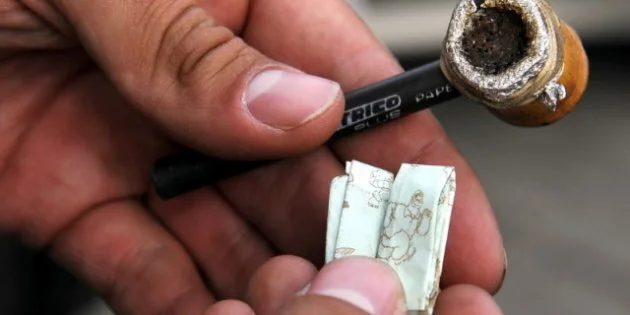
Vancouver Coastal Health's (VCH) recent decision to launch a crack kit pilot study is not -- as some would say -- enabling drug use. Nor is it -- as Miranda Frum would lead readers to believe in her Huffpost blog entry on January 4 -- a monetary assault and slap in the face to smokers whose addiction is, albeit, a legal one.
Our recently launched pilot project is far from the waste of health care dollars that some factions have made it out to be. Instead, the pilot project will create linkages between people with addictions and the health care system as well as prevent unnecessary hospitalizations due to easily prevented infections and injuries. These goals, however, are getting lost in the ideological debate about harm reduction and the public's opinion of whose health care needs should receive priority funding.
The debate is indeed ideological, because the scientific evidence about the effectiveness of harm reduction has been proven. Harm reduction is an effective health care intervention for some of the most vulnerable people in our population.
In addition, this pilot project will provide VCH with much-needed information about crack
addiction in our community. Specifically, it will help VCH estimate the number of crack smokers
in Vancouver through the measurement of demand. The pilot project will also allow VCH to
determine if the distribution of crack kits is an effective way to engage users and, ultimately, track and evaluate the health outcomes arising from access to safe pipes and clean mouth pieces.
Currently crack pipes are sold in a makeshift manner by a number of agencies in the Downtown
Eastside, without the benefit of linkage to Vancouver Coastal Health. Through this pilot project,
VCH will evaluate whether or not we can use distribution of crack kits as an effective way to
engage people and help them access other health services including addiction treatment.
This turned out to be one of the major benefits of Insite, the supervised injection site.
At the street level, introduction of this pilot project will prevent the type of harms associated with makeshift crack pipes that are in use right now by people who can't afford to buy a suitable pipe, which frequently explode, leading to cuts, burns, and infections. Crack smokers
need to use brillo pads in these makeshift pipes as screens, which can break, be inhaled, and get stuck in the lungs prompting hospital visits.
And a few years ago, Vancouver experienced the largest ever reported community outbreak of invasive pneumococcal disease, which is a serious bacterial infection spread by saliva. The outbreak resulted in many admissions to our hospitals for people with blood infections and meningitis; one third of hospital admissions were to an intensive
care unit. The outbreak was largely among crack smokers and sharing pipes was likely an
important mode of transmission of the germ causing the outbreak.
Crack smokers develop sores, blisters, or cuts on their lips and mouth from contact with hot
smoke, hot glass, or metal pipe stems. These wounds may lead to increased susceptibility to
Hepatitis B and C, and potentially HIV through the sharing of pipes.
The fact that VCH spends 10 times more on treatment than it does on harm reduction means
it is not a question of one or the other. Both are required tools on the ongoing battle against
substance abuse and its negative impacts on people's health.
At VCH, we believe harm reduction and treatment are necessary components of any successful addictions strategy. Unfortunately, treatment for addiction is difficult and there are high rates of relapse, so harm reduction programs such as this one remain needed.
All debate aside, it is striking to me that getting lost in the vitriole about this pilot project are the people so adversely affected by addiction. They're our sons, daughters, mothers, and fathers.
VCH is committed to finding ways to keep these people alive and healthy through various harm
reduction initiatives while working to engage them in treatment for their addictions. For this most important goal we make no apologies.
Why is it the only way in this country to get ahead is to either be part of the privileged class of the corporate elite or the social sewage that leeches off the working class? Ordinary Canadians who are funding social programs they'll never benefit from are getting the short shrift from both ends of the system!
Then and only then would I consider allowing them to be classified as "rehabilitated" and released back into the general populace.
Junkies are a danger to society and we should stop treating them like wayward babies.
Not much of a loss when human refuse takes itself out of the gene pool if you ask me.
Dr.Jay Cole
listen.to/drjaycole
The only thing "SAD" is our Government spending money pointlessly on enabling addictions. They are not even attempting to find the root cause or figure out a way to stop the addictions, yet they play into it and let the citizens destroy themselves even further. I suppose this is because these same sick citizens are not included in the "Big Picture" that our overseers have in mind.
Dr.Jay Cole
http://listen.to/drjaycole
Sombrely, though, crack cocaine addiction is a very serious problem and I fully support all harm reduction strategies. In fact, I would supply all addictive drugs to all addicts free of charge. I'm serious.Reflect on the idea. It would be much less expensive than "The War on Drugs"; we would be able to clearly identify the addicts to provide them with the help they so desperately need; we would reduce communicable disease; policing would become more efficient,etc,etc. Illicit addictive drugs are a public health problem not a criminal problem.
Tragically, besides craven vote-hunting politicians opposing this policy, Organized Crime would do everything to oppose it (up to an offer you can't refuse) since their vast profits would evaporate virtually overnight.
What’s the reality here? Are crack users obeying the rules and keeping clean on kit use?
Is this just theoretically containing infection?
You know when they go through 'clean' periods??
When they DON'T HAVE ACCESS.
You know WHO THE #1 ENABLER OF MY BUDDIES ARE???? THEIR FAMILIES.
Yes. Crack addicts MOTHER provides him with subsistence - which he uses on CRACK.
When he is out on his own, away from Vancouver, WORKING for a living - he doesn't have access or opportunity - he's CLEAN.
HARM REDUCTION IS A FRAUD.
If the Vancouver Police would walk down the street and arrest every drug dealer in sight, throw high people in 5 day 'come down' clinics, access goes way down, prices skyrocket - all of a sudden - 'poof' the number of hard-core street-heads goes DOWN BY 50% in A YEAR. MANY LIVES SAVED.
Compare that to the ZERO LIVES that HARM REDUCTION IS SAVING.
Every druggy wants to be clean, and he would if he did not have access.
It is totally possible to reduce access to negligible levels thus forcing the price way up and accessibility way down.
As a scientist, I've seen the data on harm reduction. Harm reduction works. It does not encourage addiction. Addicts were addicted before these programs existed and would be addicted without harm reduction. They just died in greater numbers. With harm reduction models, those who want a way out can find it when they're ready by remaining connected to a system that doesn't abandon them as beyond hope. If this doesn't make sense to the Ms. Frums of the world, I hope they do not have to learn the lesson the way I did. It is not a pain I'd wish on anyone.
Thanks Reka and thanks for your work. I work in NS with a population of poor, homeless addicts and mentally ill. In my experience, many that have addiction issues also have mental health problems that they are self-medicating with alcohol and illicit drugs, because these are, believe it or not, more readily available than the prescription drugs and psychiatric services these individuals really need.(Do I hear any Ms Frums calling for an increase in mental health care spending? I thought not). Many of our homeless in NS are individuals who have been given bus tickets from other parts of Canada to get them "off the books" of welfare and health agencies in those provinces. In my community, it is virtually impossible for such people to get a family doctor, though there are doctors doing what they can at walk-in clinics. I once shared the attitudes of those like Ms. Frum, but personal experience with a family member, now deceased, has altered my perspective dramatically. (cont'd in part 2)
This is another, big fat disgusting LIE.
The 'harm reduction' center in Vancouver - after years of operation and a massive budget - managed to save ONE LIFE, which is within the statistical margin of error, thus scientifically speaking - they saved ZERO LIVES.
All that money and energy for NOTHING.
We have elderly people dying, people starving in the streets.
TAKE AWAY THE 'HARM REDUCERS' BUDGET IMMEDIATELY- and put the money where we know for sure the money will be effectively spent and result in ACTUAL SOCIALLY POSITIVE OUTCOMES - not fake academic ones.
...so you'd rather increase your taxes to subsidize the increased cost to the medical (ER, paramedics) system from diseased users? Trust me - harm reduction is peanuts compared to medical costs. What's the saying...an ounce of prevention is worth a pound of cure?
And start reading. Before you spout off and make yourself look even more uninformed, why not read some actual scientific literature:
1) "A cost-benefit and cost-effectiveness analysis of Vancouver's supervised injection facility."
Int J Drug Policy. 2010 Jan;21(1):70-6. Epub 2009 May 6.
Result: "Through the use of conservative estimates, Vancouver's SIF, Insite, on average, prevents 35 new cases of HIV and almost 3 deaths each year. This provides a societal benefit in excess of $6 million per year after the programme costs are taken into account, translating into an average benefit-cost ratio of 5.12:1."
http://www.ncbi.nlm.nih.gov/pubmed/19423324
2) "The cost-effectiveness of Vancouver's supervised injection facility."
CMAJ. 2008 Nov 18;179(11):1143-51.
Results: "Focusing on the base assumption of decreased needle sharing as the only effect of the supervised injection facility, we found that the facility was associated with an incremental net savings of almost $14 million and 920 life-years gained over 10 years"
Interpretation: "Vancouver's supervised injection site is associated with improved health and cost savings, even with conservative estimates of efficacy."
http://www.ncbi.nlm.nih.gov/pubmed/19015565
Continued....
Sorry lots of fluff but no facts
Harm reduction programs are not solving anything.