
Featuring fresh takes and real-time analysis from HuffPost's signature lineup of contributors
Robin Rowland

GET UPDATES FROM Robin Rowland
 

Pine Beetles' Move Up Threatens Western Forests: Study

Posted: 01/02/2013 1:04 am

With temperatures climbing from climate change, the mountain pine beetle is now moving to higher elevations on mountain slopes and is a "rising threat" to the whitebark pine, which is found mainly in the Rocky Mountains, coast range of B.C. and the northern U.S., says a new study.

The report was published Monday by the University of Wisconsin-Madison in the Proceedings of the National Academy of Sciences.

It's a significant finding in B.C. where a provincial report says the pine beetle epidemic has now killed an estimated 710 million cubic metres of commercially valuable pine timber — 53 per cent of all such pine in the province. The rate of damage has been slowing for several years, but is projected to grow to 58 per cent by 2017 (to 767 million cubic metres).

Both the provincial and federal governments have spent hundreds of millions of dollars on the mountain pine beetle epidemic. Beetle-killed pine forest is more vulnerable to forest fires, and it is possible that the drier wood from beetle-killed wood is responsible for the explosions at mills in Burns Lake and Prince George.

"Warming temperatures have allowed tree-killing beetles to thrive in areas that were historically too cold for them most years. The tree species at these high elevations never evolved strong defences," said Ken Raffa, a University of Wisconsin-Madison professor of entomology and a senior author of the new report.

A warming world has not only made it easier for the mountain pine beetle to invade new and defenceless ecosystems, the scientists say, but also to better withstand winter weather that is milder and erupt in large outbreaks capable of killing entire stands of trees, no matter their composition.

"A subject of much concern in the scientific community is the potential for cascading effects of whitebark pine loss on mountain ecosystems," says Phil Townsend, a Univeristy of Wisconsin-Madison professor of forest ecology and a senior author of the study.

The mountain pine beetle's historic host is the lodgepole pine, and it was widespread lower elevations until the pine beetle infestation began to spread in the late 1990s. The pine beetle, which is about the size of a grain of rice, played a key role in regulating the health of a forest by attacking old or weakened trees and fostering the development of a younger forest after the older trees died or were destroyed by fire.

However, recent years have been characterized by unusually hot and dry summers and mild winters, which have allowed insect populations to boom. This has led to an infestation of mountain pine beetle described by the scientists as "possibly the most significant insect blight ever seen in North America."

The B.C. government report says:

Over most of the Interior, extreme winter weather (colder than minus 35 Celsius for at least several days or even weeks) historically killed most of the pine beetle population, limiting the duration of, and damage from, periodic epidemics. Such a widespread weather event has not occurred in the B.C. Interior since the winter of 1995/96.

In the U.S., there have been a number of studies of pine beetle infestation of the whitebark pine.
In 2011, the Seattle Times cited a study in the mid-2000s that showed whitebark trees had declined by 41 per cent in the Western Cascades, while nearly 80 per cent of the trees in Mount Rainier National Park were infected.

The newspaper also quoted the U.S. Fish and Wildlife Service reporting in 2007 that beetles killed whitebark pine trees across half a million acres in the U.S. West — the most, at the time, since record-keeping began. Two years later, beetles killed trees on 800,000 acres.

Blog continues after gallery:
Loading Slideshow...
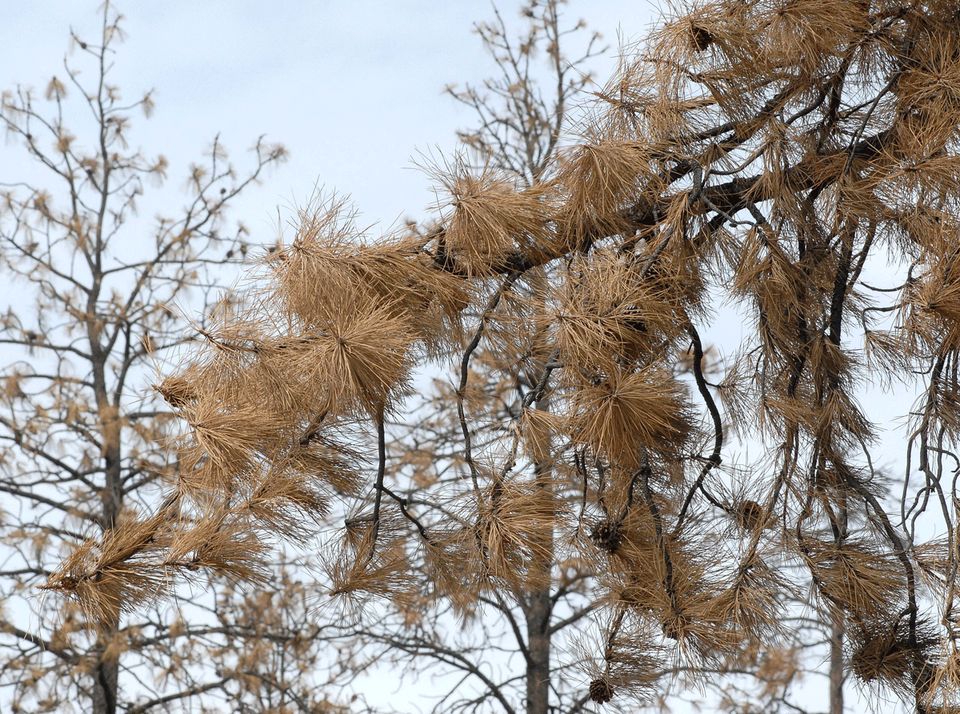
  • Dead Ponderosa Pine trees, victims of the pine beetle, in Kamloops in British Columbia. The insect has devastated forests throughout the interior of BC and has moved into Alberta.

  • Dead trees, victims of the pine beetle, stand along Highway #5 just outside of Kamloops in British Columbia. The insect has devastated forests throughout the interior of BC and has moved into Alberta. (CP PHOTO/Don Denton)

  • A lone surviving tree stands among dead trees, killed by the pine beetle infestation, just outside of Kamloops in British Columbia. The insect has devastated forests throughout the interior of BC and has moved into Alberta.

  • A dead pine tree, a victim of the pine beetle, stands in a field just outside Kamloops British Columbia. The insect has devastated forests throughout the interior of BC and has moved into Alberta.

  • MP Rob Merrifield speaks with Forestry Entomology technician, Daryl Williams, left, and Northern Forestry Centre Director General Dr. Gordon Miler, in Edmonton, Alberta, on Friday, April 4, 2008, about the newly announced $2 million in funding to boost spread control of the mountain pine beetle.

  • Dr. Allan Carroll, one of Canada's top mountain beetle researchers with the Canadian Forest Service peels back the bark of a lodgepole pine infested by pine beetles in Alberta's southern Rocky Mountain forests in Kananaskis Country, Alta. on Wednesday Aug. 29, 2007. Alberta is frantically trying to slow the insect's eastward march despite a full-blown infestation in neighbouring British Columbia.


The lodgepole pine co-evolved with the bark beetle, and so it evolved chemical countermeasures, volatile compounds toxic to the beetle and other agents that disrupt the pine bark beetle's chemical communication system.

According to the Wisconsin study, despite that robust chemical defence system, the lodgepole pine is still the preferred menu item for the mountain pine beetle, suggesting that the beetle has not yet adjusted its host preference to whitebark pine. "Nevertheless, at elevations consisting of pure whitebark pine, the mountain pine beetle readily attacks it," says Townsend.

He adds the good news is that in mixed stands, the beetle's strongest attraction is to the lodgepole pine, suggesting that, at least in the short term, whitebark pine may persist in those environments.

However, the 2007 U.S. study quoted by the Seattle Times also warned that unlike the lodgepole, whitebark pines produce few seed cones and do so late in life, so they "aren't set up to survive massive slaughter."

The new study, conducted in the Greater Yellowstone Ecosystem, also showed that the insects that prey on or compete with the mountain pine beetle are staying in their preferred lodgepole pine habitat. That is a concern, says Townsend, because the tree-killing bark beetles "will encounter fewer of these enemies in fragile, high-elevation stands."

Whitebark pine trees are an important food source for wildlife, including black and grizzly bears, and birds such as the Clark's nutcracker which is essential to whitebark pine forest ecology because the bird's seed caches help regenerate the forests.

For a longer version of this story see Northwest Coast Energy News.


Follow Robin Rowland on Twitter: www.twitter.com/rowlandr

FOLLOW CANADA BRITISH COLUMBIA
With temperatures climbing from climate change, the mountain pine beetle is now moving to higher elevations on mountain slopes and is a "rising threat" to the whitebark pine, which is found mainly in ...
 
 
  • Comments
  • 7
  • Pending Comments
  • 0
  • View FAQ
Comments are closed for this entry
View All
Favorites
Recency  | 
Popularity
This user has chosen to opt out of the Badges program
photo
03:30 AM on 01/03/2013
A recent study in Alberta found that the cold temperatures suspected to control them were not working. They had three hard winters in a row with severe cold temps and it did not affect them as expected. They rolled on. Plus since they have pretty well devastated all thats easily accessible they may be also be just going where the remaining food is in the area. They were up to the 5000' level basically from the start here. Appetite drives these insidious things more than anything..After they consumed my two mature pines (in the Kamloops area) area they went after a remaining giant 60yr old spruce tree.
07:04 PM on 01/02/2013
Went for a flight from Kelowna to Calgary the other day and was disgusted with massive amount of clear-cut logging in Southern BC. It is just a checkerboard of logging. New logging roads everywhere. I can't believe Christy thinks she cut down trees to shore up her budget. Piss poor forestry management.
04:21 PM on 01/02/2013
In the late 1980's I was on a Mountain Pine Beetle extermination crew that performed "crash and burn" (knock down an infested tree and burn it at the stump) in BC's Northern Interior. The BC government was doing experiments in the last part of that decade to see which method worked best to eradicate the then growing threat to BC's forests.

3 methods were employed, our "Crash and Burn" crew, another crew who randomly selected infested green stands and injected poison via a hypodermic axe to affected trees (*called "Hack and Squirt"). The 3rd method would bait trees with PB Hormones to attract mega bugs then poison would be administered via the axe into the tree once it was infected. In 1989, the projects ended due to the funding being cut. A few years later, mid 1990's we started to see that the PB had ruined a lot of the forests after running unchecked since the crews disbanded in early 1990.

What would have happened if the BC Government never cut the funding back when the infestation was small? Would we still be in this mess? We should replant some of that forest with Hemp first to make the soil better and trees can grow faster after a few seasons of wild Hemp preparing the ancient (now devoid of green timber) forest floors. Not to mention harvesting a percent the Hemp to fund some of the reforestation costs would be an excellent idea imho...
04:11 PM on 01/02/2013
This is what happens when you plant pine farms rather than actual reforestation. Also, the BC government won't take it really seriously until the beetle is found in Stanley park or some other "important" area.
photo
HUFFPOST SUPER USER
Robert C Lawson
justice & human rights for all
10:07 AM on 01/02/2013
well, we have been watching this happen in Canada for some time now.What is often missed in these reports is that to some extent this is a natural process and also that there is no defense or way to alter it[which may be good, our so called solutions in nature are so often worse than the problems],.. the pines will die out, other species will then move in as light,food and water become available,mountain hemlock,douglas fir,balsams,cedars,cypress are all out of the beetle dietary/reproductive cycle,These species will take up the area,s that are being damaged and in fact are doing so at an exponential rate, it is nature at work,,birds,squirrells etc will eat other cones and seeds and transmit them instead of white pine and the species will shift, but the process will not,,adaptation is one of natures laws, so be it,..
This user has chosen to opt out of the Badges program
06:13 PM on 01/02/2013
I suggest Stuart Kauffman who did some complexity theory work on adaptive landscapes.

From a faint memory is a take home message is that if things change too fast, adaptation doesn't take place. Could be applied at a species level or ecosystem scale.

Now its entirely possible that a forest of some type will be around in some areas at a 4 degree change by the end of the century, even with the aid of people moving stuff around, imagine a plot of land planted with a suitable species. Within 40 years, that species will no longer be optimal for that piece of land with a 2 degree increase. But 40 years is not a long enough period of time for that forest to really put on volume. So maybe losses are cut and another species of tree is tried. In 40 years one would face the same dilemma. The goal posts are continually moved and a forest really can't catch up until some climate stability is achieved. Basically what one is looking at is severely reduced production on forested lands if temperature changes too quick. And that is not looking at all the other factors that could hammer a stand of trees with climate change.
photo
HUFFPOST SUPER USER
Robert C Lawson
justice & human rights for all
07:49 AM on 01/03/2013
A good point, natural selection can be a complex situation, one which we have very little real understanding of,In situations where adaptations have a finite limit? we often find that the adaptation, "adapts" as well,..In the natural world, no opportunity is missed,ever!, if there is the slightest advantage? then that will be used and adapted to,ditto any disadvantage as well,,natural forests are never a mono species situation, they often start as one,change to another, then change again,often to allow the prime species an advatange that will allow it to end up as the prime user of any nutrients or sunlight,.. nature is very clever,..very!,..methinks that much like the natural world, our adaptations will have to adapt and adapt again before this actualy stabilises or reverses.