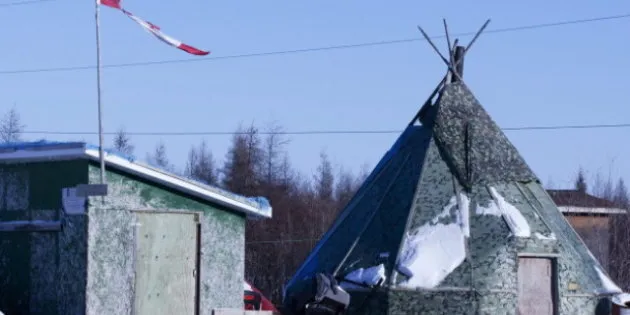
I was born and raised on the Quebec side of James Bay, across from Attawapiskat, a community that has been in the news lately. A lot of credit goes to people like my colleague, Charlie Angus, for raising the profile of the housing crisis there and getting people involved. If you haven't heard yet, Attawapiskat is a First Nation where many people are without homes for the winter. They will go without running water. They have gone without a school for a generation of children.
This is not unusual.
People may recall the stories about Kashechewan that were in all the media a few years ago, or Pikangikum. There are many others. Sandy Bay First Nation in Manitoba wants people to know they are in similar circumstances.
Estimates are that 80,000 new houses are needed and similar numbers are in need of major repair across the country. There are over 100 communities living under boil water advisories. There are over 40 First Nations that have no school for their children to attend.
Embarrassed by the media and public attention, the Harper government leapt into action this week and immediately blamed the people of Attawapiskat. Basically, they said that big money had been spent there, so we'll solve the situation by sending in an accounting firm to run the government.
Others have analyzed that spending to demonstrate the fallacy on which Harper is relying, an argument that really shouldn't need to be made. Does anyone think people would choose to live this way? Or is it just that Indians can't be trusted to manage money?
Outside the government, people are mobilizing, donating items of use, and the Red Cross has gotten involved. Most are treating this as the crisis it is, pointing to the avoidable tragedy and urgently pleading for help to stop it from happening. Let's hope that succeeds.
But what about the dozens of communities where the media aren't paying attention? Will crises come and go relatively unnoticed? And what about stopping this from happening over and over again?
That is where people need to see the bigger picture and focus on solutions.
The bigger picture explains why Attawapiskat should not be seen in isolation. The situation there is the result of deliberate policies.
It begins with the Crown breaking the partnerships with First Nations that formed the basis of the treaties and ignoring their own laws, like the Royal Proclamation of 1763. Yes, history matters if you want to understand how we got to this point.
It is followed by a policy of segregation. They invented the idea of "status" Indians, as defined by the Crown, and created reserves, where the Crown chose what it thought was valueless land and compelled people to stay there.
That was followed by the policy of assimilation, where the Crown reversed itself and started encouraging people to leave reserves to join the rest of Canadian society. Encouragement took the form of legislation that stripped people of their "status" and denied them the right to live with their families and communities if they did things like get an education.
The policy of assimilation is still in place. Only now, the Government of Canada uses talk of formal equality -- treating everyone exactly the same -- to justify treating First Nations like they have no Aboriginal or treaty rights, despite the Constitution of Canada and the UN Declaration.
So, there will be no partnership with First Nations to support them in self-government. There will be no co-operation in planning and implementing effective long-term strategies to make reserves liveable. There will be no money to help catch up from decades of neglect and mismanagement by a distant bureaucracy. There will be red tape and catch-22s and bureaucratic inertia. The plan is that the reserves will fail and people will have to move away. Those who don't die first.
That plan is what John Duncan is hinting at when he talks about "unviable reserves." They're pressing to close them down and send people into the cities as they tried with Kashechewan. They are introducing legislation to privatize reserve lands so that they can be sold or taken in default of loans. The fact that this will make resources, like the diamonds around Attawapiskat, more readily and cheaply available to developers is pure coincidence, I'm sure.
There are solutions. Working in the original spirit of partnership, supported rather than constrained in self-governance, First Nations can move forward. The deal that I helped negotiate between the Grand Council of the Crees and the Government of Quebec called La Paix des Braves has achieved some of that and is benefitting people from all communities in the area, Aboriginal and non-Aboriginal, right now. It is not the only example. That is what is meant by reconciliation.
On the other side of the same bay from Attawapiskat, their Cree cousins are not living in the same squalor. It can happen elsewhere.
Follow Romeo Saganash on Twitter: www.twitter.com/RomeoSaganash
The real shame of Attawapiskat - The Globe and Mail
Harper wants 'accountable' First Nations self-government - Canada ...
Attawapiskat crisis plan called short-sighted - Canada - CBC News
Canada News: Cramped and precarious: Attawapiskat woman living ...
Hundreds homeless in Attawapiskat - Timmins Daily Press - Ontario ...
We are writing a book on their adventures called, "Who's Sorry Now? The Good, the Bad and the Unapologetic Mohawks of Kanehsatake". It is a satirical review of how Indian Affairs, the Quebec government and their point man, James Gabriel, were trying to remove these Mohawks off their land to mine the niobium they are living over. Niobium is a mineral that makes steel and other metals stronger and lighter, for armaments and space exploration. For twenty years the Mohawks have constantly resisted these attempts to remove them to the point that Canada organized a raid on their community. So the whole issue got international attention.
Niawen'kó:wa! (nee-ah-wenh-go-wah)
Thank you very much!
Kahentinetha
http://www.mohawknationnews.com/
http://www.mohawknationnews.com/wordpress/2011/12/19/mnn-cold-as-ice-attawapiskat-debeers-diamonds/
RE:
Niocan’s proposed niobium mine near Kanesetake, Quebec,
http://www.miningwatch.ca/fr/categories/Kanesatake%20-%20Niocan
&
http://www.dominionpaper.ca/articles/3972
&
http://www.newswire.ca/en/story/605101/niobium-mining-by-niocan-in-oka-unanimous-opposition-from-the-mohawk-the-citizens-of-the-region-and-the-upa
&
http://www.ocap.ca/node/700
MNN: 18 Dec. 2011. Kashechewan is a Cree community on James Bay. In 2005 half their people had been evacuated due to DeBeers Diamond Mining overloading the sewage system. In 2010 they gave $5,231,000 to eight Indigenous communities, most of which went to lawyers, consultants and the political elite; DeBeers took out $446,020,000.00 worth of diamonds. In 2005 MNN was called in to Kashachewan, just south of Attawapiskat. COLD AS ICE, is a story about three Kanionkehaka who were kept out. We issued an Objection to DeBeers. It's relevant to the Attawapiskat issue.
Please read and understand.
MNN Mohawk Nation News.
http://bsnorrell.blogspot.com/2011/12/mnn-attawapiskat-kashachewan-and.html
I had to leave my home where my heart belonged because there were no jobs. Had I not, I would not now be sending my hard-earned money off to Ottawa in order for it to be squandered and misused on behalf of people who are unwilling to come to terms with the facts. The facts being that without employment they are going nowhere.
Another example of political incorrectedness would be when Canada refused to sign the Un Declaration for Aboriginal peoples. They are dominant related and it is not helping aboriginal people whatsoever.
We would like to address two types of response we expect this strategy will meet.
The first will come from those who will say the fundamental elements of our strategy are already in place. That the inherent right to self- government has been accepted. That land and resources are under negotiation. That specific challenges whether on health care or education or justice are being addressed.
We accept that honest efforts at a better approach are being mounted. These however are clearly inadequate for the challenge at hand. In addition, they remain almost wholly subject to shifting political agendas. The basic straightjacket of the status quo remains in place.
For decades, the prevailing perspective has been to see the relationship between Aboriginal and non-Aboriginal people in terms of a Minister or a Department of government dealing with a client group of individuals, or bands.
Until that straightjacket changes, progress will be limited, no matter the competence or conviction of the Minister. We call upon the Government of Canada to deal with Aboriginal peoples on a nation-to-nation basis recognizing and encouraging the emergence of another order of government.
It became abundantly clear to us that any strategy that is not based on that premise and, in addition, is not integrated that is ad hoc, piecemeal or sporadic will not do the job.
http://www.ainc-inac.gc.ca/ap/pubs/spch/spch-eng.asp
So, there will be no partnership with First Nations to support them in self-government. There will be no co-operation in planning and implementing effective long-term strategies to make reserves liveable. There will be no money to help catch up from decades of neglect and mismanagement by a distant bureaucracy. There will be red tape and catch-22s and bureaucratic inertia. The plan is that the reserves will fail and people will have to move away. Those who don't die first.
That plan is what John Duncan is hinting at when he talks about "unviable reserves."
*******************
To further understand the issue:
The Circle Game: Shadow & Substance in the Residential School Experience..
http://www.nativestudies.org/native_pdf/circlegame.pdf
&
http://www.indigenouspolicy.org/ipjblog/post/The-Apologia-Canadiana-lessons-for-an-Indian-Boarding-School-Apologia-Americana.aspx
&
http://www.irvingstudios.com/child_abuse_survivor_monument/ResidentialInstitutions.htm
The AFOA was founded as a not-for-profit association in 1999 to help Aboriginal people better manage and govern their communities and organizations through a focus on enhancing finance and management practices and skills. AFOA's premise is that effective management is key to building social and economic prosperity and essential to successful Aboriginal governance.
Only applicants of Aboriginal descent will be admitted into the programs. For more details, see:
http://www.centennialcollege.ca/Programs/ProgramOverview.aspx?Program=2806&Calendar=2012-2013
http://www.centennialcollege.ca/Programs/ProgramBenefits.aspx?Program=2411&Calendar=2012-2013
Respectfully,
J'net AyAy Qwa Yak Sheelth Cavanagh, B.A., M.A.
Indigenous Studies Curriculum Developer & Manager
School of Communication, Media and Design
Centennial College
jcavanagh@centennialcollege.ca
416.289.5000 ext: 8717
or 647.267.2208
in relations to all my other comments... I always see the forest for the trees & prefer to scrape away at the BS.
All aspects Indian/White relations in Canada will always be the implemention of the federal gov't 1969 WHITE PAPER..
The ROYAL COMMISSION ON ABORIGINAL PEOPLES did 5 yrs. of research & I'll con't to post the work they did..since Canadians have a very short memory..
http://www.aadnc-aandc.gc.ca/eng/1307458586498
Canada’s Aboriginal students have long faced formidable barriers to higher education. Responding to this inequity, Centennial College has introduced two business programs that address the native community’s desire for training in business foundations coupled with an understanding of Aboriginal needs as identified by the Canadian Council of Aboriginal Business.
Centennial developed the two-year Aboriginal Business Diploma program in partnership with the Aboriginal Financial Officers Association of Canada (AFOA), which ensures the curriculum meets the business needs of the Aboriginal community. The program delivers the fundamentals of business, basic accounting, finance and business communications, in addition to Aboriginal business ethics and practices.
The three-year Business Administration—Accounting (Aboriginal Stream) program provides students with a strong foundation in accounting and understanding of Aboriginal business requirements. In addition to the rigorous accounting curriculum, students will take courses in Aboriginal strategy and decisions, governance, and Aboriginal challenges and advocacy. Students are eligible to apply for the AFOA’s Certified Aboriginal Financial Manager (CAFM) designation. CAFM program graduates may also be eligible for transfer credits into the CGA program of professional studies, leading to accreditation as a certified general accountant.
To assist entry into its two new programs, Centennial is offering 40 bursaries of $1,000 each to entrants who meet the selection criteria.
The college is accepting applications now for classes starting in 2012.
jcavanagh@centennialcollege.ca