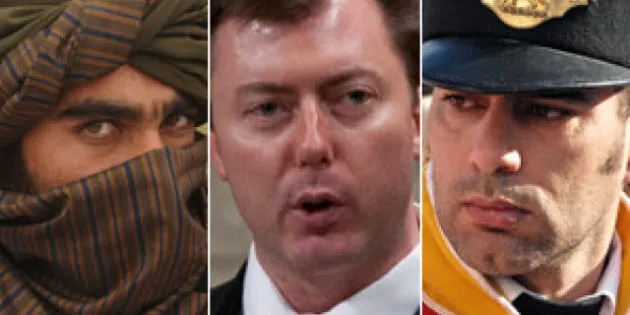
Besides napping, Tory MP Rob Anders is well-known for taking controversial positions. But on the War of 1812?

In a recent newsletter, the MP compares the 1812 conflict to "the last 10 years of warfare against Islamic terrorism."

UPDATE: The Canadian Islamic Congress has condemned the statements in Rob Anders' newsletter comparing the War of 1812 to "Islamic terrorism."

While it may be odd to compare such very different wars, what is perhaps more surprising is the choice of the phrase "Islamic terrorism."

Even George W. Bush, whose religious fervour is legendary, never described the War on Terror as a fight against specifically Muslim terrorists. Officials in Canada, the U.S. and other allied nations have been careful to use language that will allay accusations that the West has been waging a new crusade or religious war.

SEE THE NEWSLETTER

Bush even famously described Islam as a religion of peace soon after Sept. 11, 2011. "The face of terror is not the true faith of Islam. That's not what Islam is all about. Islam is peace. These terrorists don't represent peace. They represent evil and war," Bush said.

Anders, who has recently fallen out of favour with his own party, seems to be becoming less concerned with staying on message.

In July, he went on Sun News and attacked his own government and Treasury Board President Tony Clement for honouring Norman Bethune, a Canadian communist doctor who has become a hero in China.

In March, he was removed from the Veterans Affairs Committee after being caught sleeping through the proceedings. Anders was also forced to apologize to two veterans' advocates whom he called "NDP hacks" and "Putin supporters" for bringing his slumbers to attention. Both advocates turned out to be Conservatives.

Last November, a video of Anders nodding off in the House of Commons went viral. Anders blamed a recent car accident.

SLIDESHOW: WAR OF 1812 FACTS

The strangeness in the newsletter doesn't end with the insinuation of a religious war.

"The war of 1812 [sic] ensured that the historic traditions of British liberty would live on in North America. It gave strength to the Canadian militia movement and to the notion of a citizens [sic] duty and responsibility to bear arms for the defence of the nation.

These same principles of freedom, liberty and volunteer military service are alive today and have guided us through the last 10 years of warfare against Islamic terrorism."

It seems more than a little odd to say a victory against the Americans resulted in the survival of "British liberty" when both Canada and the U.S. were once colonies of the United Kingdom. Not to mention the fact that the American Constitution is chock full of references to liberty.

And to say that volunteer military service was the norm in the British forces that pushed back the American invasion is just factually incorrect.

In fact, the impressment of American sailors into the Royal Navy was one of the main reasons the U.S. gave for pursuing the conflict in the first place.

Impressment refers to the practice of essentially kidnapping sailors and forcing them to serve in your navy.

And while the redcoats and militiamen on the British side were volunteers, there was a strong class element to the forces, with richer men able to purchase a rank while poorer men served in the line.

So even though Anders is sticking to the Conservative line on the importance of celebrating the bicentennial anniversary of the conflict, he might do well to be a little more careful with his language in the future if wants to avoid the ire of the party.

Loading Slideshow...
  • This Official White House photo of President Obama's situation room was taken by Pete Souza during the operation to kill Osama bin Laden on May 1, 2011. The photo has quickly become iconic in its own right, in contrast to the images of bin Laden after his death, which have not been released.

  • Maj. Gen. William T. Sherman poses for photographer Mathew Brady, c. 1864. General Sherman, who coined the phrase "War is hell" after a career leading Union troops in the Civil War, was widely despised in the South after his division burned much of Atlanta in 1864.

  • Roger Fenton's <em>The Shadow of the Valley of Death</em>, taken during the Crimean War in 1855. There has been considerable controversy over the years as to whether or not Fenton had the cannonballs placed on the road.

  • On the Western Front of World War I, German and British soldiers exchanged gifts and fraternized during the Christmas Truce of 1914. The episode, during which about 100,000 British and German troops unofficially ceased fire, has entered into the European consciousness, as in the Oscar-nominated 2005 film, <a href="http://en.wikipedia.org/wiki/Joyeux_Noel" target="_hplink">Joyeux Noël</a>.

  • Prime Minister Winston Churchill inspects an American Tommy gun during a 1940 tour of defenses along England's northeastern coast.

  • View taken from Dresden's townhall of the destroyed Old Town after the allied bombings on 13/14 February 1945. The Frauenkirche (Church of Our Lady, not seen in the picture) situated in the city centre, was reduced to rubble during 2nd World War allied bombing, and has now been restored to its former glory.

  • Wounded Marine Gunnery Sgt. Jeremiah Purdie (C), reaching out as he is led past stricken comrade after fierce firefight for control of Hill 484. S. of DMZ during Vietnam War.


WAR OF 1812 FACTS


Loading Slideshow...
  • The War Of 1812 In 6 Slides

    Some things you might not know about the War of 1812. (Photo by Mark Wilson/Getty Images) <em>With files from The Canadian Press</em>

  • Why Did It Happen?

    The United States was angry over the British navy's high-handed practice of snatching alleged deserters off American ships to serve in the Royal Navy. An expansionist faction in the United States believed Canada was ripe for the plucking because Britain was heavily engaged in fighting Napoleon. (Photo by Mark Wilson/Getty Images)

  • When Did It Happen?

    The war ran from June 18, 1812 to January 1815. (Photo by Mark Wilson/Getty Images)

  • Where Did It Happen?

    Most of the fighting occurred on the Windsor-Detroit and Niagara frontiers, as well as in the area between Montreal and Lake Ontario. (Photo by Mark Wilson/Getty Images)

  • What Were The Major Battles?

    Queenston Heights, Oct. 13, 1812; York (now Toronto) April 27, 1813; Chateauguay, Oct. 26, 1813; Crysler's Farm, Nov. 11, 1813; Lundy's Lane, July 25-26 1814, Washington, D.C. Aug. 24, 1814; New Orleans, Jan. 8, 1815. (Photo by Mark Wilson/Getty Images)

  • Who Were The Major Figures?

    Maj.-Gen. Isaac Brock (pictured) was the British commander in the early months of the war. He was killed at the Battle of Queenston Heights repelling an American invasion force. Tecumseh assembled a coalition of natives to fight alongside the British. He was killed at Moraviantown Oct. 5 1813. Charles-Michel de Salaberry led a small force of mainly Quebec militiamen to defeat a much larger American invasion force at the battle of Chateauguay on Oct. 26 1813. (<a href="http://en.wikipedia.org/wiki/File:Isaac_Brock_portrait_1,_from_The_Story_of_Isaac_Brock_(1908)-2.png" target="_hplink">Wikimedia</a>)

  • Famous Last Words

    "Push on, brave York Volunteers," last words attributed to Brock. (<a href="http://en.wikipedia.org/wiki/File:Push_on,_brave_York_volunteers.jpg" target="_hplink">Wikimedia</a>)

THE NEWSLETTER


Rob Anders Newsletter